My ARFID, Explained

After I mentioned my ARFID diagnosis in my Leader Dog posts, a few folks asked for more info. Here’s a piece I wrote about (all caps) MY OWN, PERSONAL, INDIVIDUAL EXPERIENCE with ARFID. Mileage may vary. I never managed to find the below “article” a home with a publisher, so I’m stashing it here. I may do a follow-up later, as this article is now a little dated and I’m learning more about myself and ARFID as I truck along. Enjoy!

* * *

A Spoonful Of Sugar: Arguing and Arbitrating With ARFID

By Caitlin Hernandez

Misery constricted my chest as I sat, rigid with dread, the fiberglass bench gouging my legs. Sunshine pulsed enticingly against my back as the whoops and screeches of unadulterated kindergarten joy filled my ears. Our richly deserved, twenty-minute recess was dwindling down the drain. I longed to run, to play on the structure, to practice jump-roping, hula-hooping, or dribbling a ball. But here I was, cloistered in the corner. “Hurry up, Caitlin,” one of the grown-ups prompted, not unkindly. “Finish eating and then you can play.” My friend Sammy joined the conversation, her chocolate-scented breath clashing obscenely with the orange slice on the napkin in front of me. “Just eat it,” she encouraged. “It’s no big deal.” Tears threatened. My nemesis had a thick, unchewable peel, and wet, stringy flesh that would stick between my teeth. Its acidic juice would be eye-wateringly bitter. I couldn’t bear to touch it, much less put it in my mouth.

Well-intentioned admonitions like Sammy’s would plague me forever … but at five years old, I had no way of knowing that. By five years old, I’d accepted, even appropriated, the traits adults ascribed to my eating behaviors. I was “picky.” “Fussy.” “Stubborn.” At five years old, I believed I’d “grow out of this”; that, perhaps, my sensitivities to certain tastes and textures were simply related to my congenital, total blindness; that, one day, the allure of bribes and blending in might make eating an orange slice … well, a piece of cake.

Hindsight—ironically, re: my aforementioned blindness—is twenty/twenty. My trials with eating are rooted, not in blindness—at least, not in blindness alone—but in a condition called ARFID: avoidant/restrictive food intake disorder. The National Eating Disorders’ web site explains that adults and children with ARFID have difficulty meeting nutritional needs, due to sensory issues, low appetite, fears of aversive consequences during or after meals, or combinations of all three.

Unlike better-known eating disorders such as anorexia and bulimia, ARFID is rarely tied to concerns about body shape or size; however, like other eating disorders, ARFID’S manifestations (a narrow list of safe foods; omissions of certain groups, colors, or textures of food; and failure to consume balanced nutrients) yield medical consequences (GI complaints, weight loss and/or gain, fatigue, poor immunity, etc.), which, in turn, impact social functioning. The teasing and criticism of peers, haranguing from concerned loved ones, and inaccurate or nonexistent advice from medical professionals can cause or increase depression and anxiety. Self-consciousness, about both eating “differently” and people’s comments and perceptions, can make shared meals miserable at best and impossible at worst.

I’ve heard ARFID described as terror of eating unsafe foods. For me, though, ARFID’S main ingredient is disgust, combined with daily doses of trepidation, mixed well with embarrassment, topped with a generous garnish of dismay. Imagine being asked to eat a bowl of mud, or a handful of plastic, or a slab of rotten meat. You’d probably feel horrified. Scared. Unable. Those “foods” feel dangerous, inedible. They are certainly not, and never could be, anything close to appetizing.

I love tacos … hard-shelled, with beef and cheese ONLY. NOTHING ELSE. PLAIN. After years of trial and error, I’ve learned the precise language necessary to order successfully at Taco Bell: “Two crispy tacos with no lettuce.” However, with or without the magic words, ordering tacos is always a gamble. Hard shells aren’t always available, meaning that I either have to chew through a leathery soft shell or scoop taco guts with a spoon, which usually consternates me enough to deplete my appetite. Often, I’ll be revolted by the gritty scrape of unwanted lettuce against my tongue, its ominous crunch filling my ears. The mushy consistency of beans or the eerie crawl of vegetables mingling with the meat and cheese will put me off a plate entirely. Even if some kind soul removes offending items, their taint has usually sullied the dish beyond repair. And if a main course oozes into a preferred side dish, I often won’t be able to eat that, either. Sometimes I can gag down a few bites, but by then, my roiling stomach and anxiety will be competing to terminate the meal.

Taking a bite is often a leap of faith. Have these crackers gone stale and changed from pleasantly crumbly to startlingly dry and dusty? Have these noodles begun to harden because I’m eating too slowly? Is my “plain meat” truly plain? Did this restaurant change its brand of beef, type of cheese, cooking technique, or seasoning since my last visit? Even water can taste metallic, plasticky, unfiltered, or unclean. Some of a food’s qualities can be assessed by touch, certainly … but handling food is so taboo in American culture, even and especially among the blind, that I rarely rely on this. Asking sighted people for help can lead to scoffing: “Parsley doesn’t taste like anything!” “You won’t even notice a difference!” And because I present as both disabled and younger than my years, my ordering a small, simple meal off the kids’ menu often causes people to infantalize me more than they already might.

As a child, I drank copious milk and ate enough meat and carbs to maintain what the doctors deemed “age-appropriate weight.” Besides having slightly high cholesterol, which was hereditary, my lab results were acceptable. The lunches I ate at school—pepperoni pizza, hot dogs (no bun), chicken nuggets (no sauce), cheese burgers (plain), and peanut butter sandwiches (sweet French bread only, and no jelly)—were typical enough among my peers that my eating quirks slipped under the radar.

In my teens, my appetite, weight, and iron levels dropped slightly, delaying puberty and negatively affecting my sleep. I was still unable to eat any fruits or vegetables beyond potatoes, french fries (no ketchup), and Motts applesauce (plain and unsweetened only), which adults always discounted.

During college, tasked with feeding myself independently for the first time in my life, I went through terrifying periods of little to no appetite. I often had horrible stomachaches, whether or not I managed to eat. Clumps of my hair fell out on the shower floor, and my blood tests revealed anemia.

When I graduated college after a particularly difficult senior year, a disturbing, pins-and-needles sensation permanently prickled every inch of my skin. My braille display felt painfully scratchy beneath my fingertips, and the peculiar numbness caused me to fumble and drop objects. Doctors cited anxiety and advised me to “relax.” I was able to navigate these obstacles reasonably well until the COVID-19 pandemic. My decrease in physical activity led to a diminished appetite. I was always cold, even in warm weather, and felt constantly exhausted, even when I rested. My headaches multiplied in frequency and intensity. Most distressing, I would routinely dissolve into tears, devastated by my lack of enthusiasm about even my favorite foods.

My (then) doctor, concerned by my unintentional and severe weight loss, cautioned that, due to my eating habits, I was at risk for everything from heart failure to a skull fracture. Alarm and guilt over my inability to eat “well” caused my desire for food to decline still further. If not for my partner’s gentle and ever-present support, the downward spiral would surely have continued.

Even after attending partial hospitalization and intensive outpatient eating disorder programs, in which I received one-to-one therapy and psychiatric support, it has proven impossible to disentangle ARFID, blindness, and anxiety: to know where one ends and the next begins. However, my original therapist and I continue to research ARFID together, and I find immense relief in naming and unpacking my lifelong struggles with food. As I work to resolve my shame and discomfort around eating, I strive to unlearn many ingrained convictions. All food — ice cream, boxed macaroni and cheese, McDonald’s — is good food, regardless of the time of day it’s ingested. Eating whatever I can manage is preferable to eating nothing at all. Fidgets and audiobooks are helpful distractions during mealtimes. Supplements can fill in gaps when a full meal feels overwhelming.

Even if I don’t feel hungry, simply sitting in front of a plate of pleasantly-aromatic safe foods can sometimes encourage hunger. Prepping food for the week and making lists of easy-to-eat safe foods provides structure and choice, especially when my partner is out of town. I don’t have to try new foods unless or until I’m ready. On some days, no spoonful of sugar will make the proverbial medicine go down. But on other days, I only need half a spoonful of sugar. The support of those who accept my experiences with ARFID can make even a sour day seem sweet.

Relationships are Complicated

Since being diagnosed with breast cancer, I’ve had a hard time trusting my body. To be clear, it’s not as though before I was diagnosed I loved my body deeply. Like all relationships, my relationship with my body is complicated. There’s a whole mix of love, despair, admiration, frustration, caring and neglect.

I generally feel – or felt – that I understood my body, that I knew what it needed even if I didn’t always manage to give it what I needed. I trusted that if I gave it what it needed, it would give me what I needed.

I had a motorcycle accident years ago that the doctors said would leave me with a limp and constant pain. I walked out of the hospital after just 9 days, against doctor’s orders and “treated” myself with the things I believed my body needed. And guess what? No limp. No persistent pain (except that I started having migraines after that accident – but even those have diminished to just one or maybe 2 a month).

Even the migraines responded to my personal regimen of massages and CBD and regular hot tubbing!

Then I went in for my first mammogram (on my way to top surgery) and they discovered cancer.

Here I was, doing all the right things, working out in ways I enjoyed, eating food I liked, working at something that really mattered to me, giving back to the community and being in a flourishing, loving relationship. How could I have cancer? Even a little one?!

I know, I know. Anyone can get sick. There’s no way to protect ourselves completely from cancer or any host of body ailments. And yet I could not shake the feeling that my body had betrayed me. That I had taken care of it, and it had forsaken me.

I have been running for literal decades. When I was training for a marathon, I would feel a little nervous before the long run on the weekend, but otherwise I feel good and strong when I run. In fact it’s been a go-to method for improving my mood for a long time. But these days, every time I set out, I feel a little more than just nervous. These days I’m not sure I can trust my body to do even this simple thing, putting one foot in front of the other, over and over. While my body feels more like me than ever before (remember all this started with potential top surgery), it also feels less like my own, somehow. It feels like I don’t know my body. Like I’m not sure how it will respond, or what it will do.

I’m glad to be recovered from surgery and revisions (just so you know, I had a TERRIBLE experience with multiple surgeons at UCSF – I’ll tell you the story if you ask). I’m glad I had health insurance and a partner who loved me through all of that. And I’m glad to be cancer free. And at the same time, I’m worried every time I go to run or work out.

Relationships are complicated. Guess I will have to make peace with that.

Brrrring!

I don’t have games on my phone. I used to do duolingo (before the app got taken over by AI – Atrocious Imaginings) and word games before I knew the level of treachery at the New York Times, but that’s it. Total transparency – I do have insta on my phone. I know it’s also awful in many ways, but I’m far from perfect. And so when I’m on my phone, most of the time is spent messaging folks (we love a voice message around here), watching a youtube (yes, yes, there are problems there too) on how to manage some crochet thing, or reading a book. Plus I call my mom once a week or so. That’s it. My phone spends most of its time in a phone stand.

Caitlin, on the other hand, is VERY attached to her phone. She doesn’t do games either, but she nearly always has it in her hand. She reads a lot on her phone, and she has many more people to text than I do, plus scrolling, and YouTube. Then about a month ago she started using WaterMinder. She really appreciated the gamified way the app got her drinking more water. Every time the reminder splashes, we all sing out WowTER in big voices.

I admit that I give her a hard time about how much she’s on her phone. And she gives me a hard time when I don’t pick up or notice that someone has texted us. (bonus track at the end for more on that) That said, we were pretty comfortable in our two camps, phone-on-stand vs phone-in-hand.

Then a friend of ours was wondering about a gratitude app that we could use and share our gratitudes without too much pressure. Caitlin is kind (and as I said, very attached to her phone) and she went on a search. What did she find? She found Finch.

If you are not aware of this app, the website says:

“Meet your new self-care best friend! Finch is a self-care pet app that helps you feel prepared and positive, one day at a time.

At Finch, our goal is simple: to make daily self-care something you actually want to do — not something that feels like a chore.

We know that building healthy habits can be hard. Life gets busy, priorities shift, and it’s easy to put yourself last. That’s why Finch was created: to be a gentle, encouraging companion that helps you take small steps every day toward a more supported, balanced version of yourself.”

What they don’t tell you here is that there are cheerful chimes and rainbow stones you collect when you complete a goal. And with those rainbow stones you can buy outfits and furniture to decorate your birb house. That’s not a typo, that’s what Finch calls it. You can get micro-pets and bonus points for completing goals in different areas like Connection, Calm, Gratitude (yes, that’s how she found it), Movement and Self-Kindness.

So then wherever I was in the house I would hear this brrring! sound as well as various cheeps and dings. Caitlin thought it might function as the gratitude minder she was looking for and so I downloaded it too.

And guess what? They have some decent psych-science behind what they are doing. And it does work for the Gratitude Goal in that it reminds us to share a gratitude (in the app you cannot message each other – beyond sending Good Vibes that the app writes for you). It turns out the brrrring! sound is really fun (and motivating)! Our friend did a lovely job of decorating and dressing up her birb – and they even had a white-cane for Caitlin and sports headphones for me.

And nowadays if you were able to listen in at our house you’d hear laughter, Maite talking, singing and…brrring! Finching. I still don’t keep my phone quite as handy as Caitlin does, but I do pick it up just to log my goals several times a day. If you decide to join, and you know either of us, let us know so our birbs can be friends!

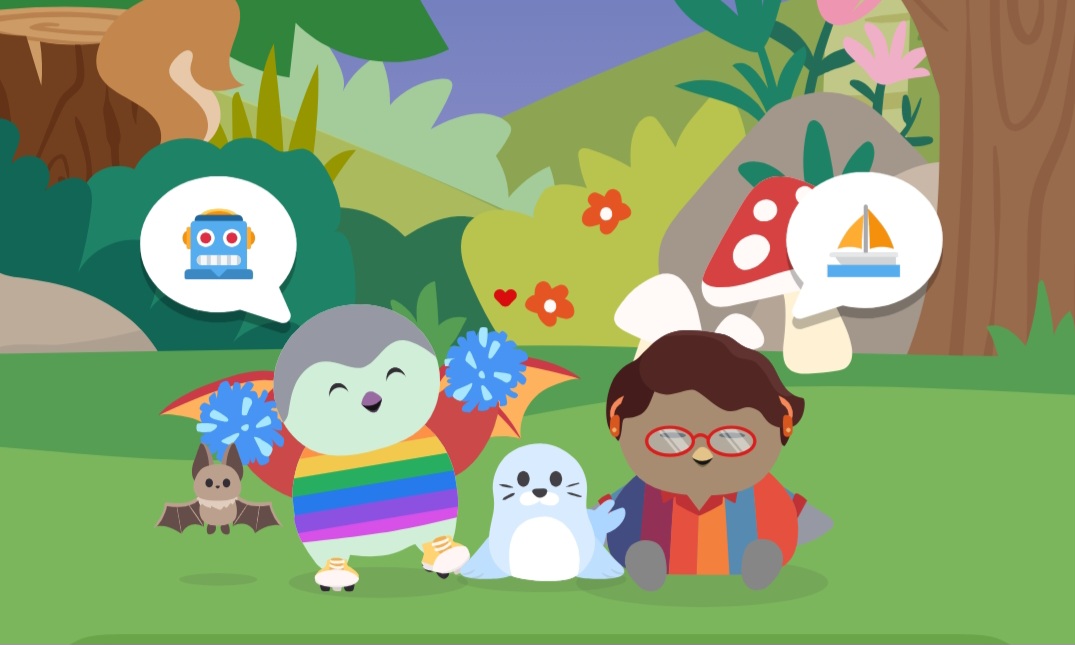
Image is a screenshot from Finch with Caitlin and my birbs and micropets. The background is a forest scene, green grass, trees, that kind of thing. Caitlin’s birb is on the left with her baby bat. She is holding blue pom poms, is wearing a rainbow shirt and is smiling and dancing. Her thought bubble has what looks like a scared robot. Next is my birb’s pet seal who is quite a bit larger than the bat because I didn’t know I could keep it from growing up so it reached toddler, I think. Then my birb is sitting on the ground next to the seal. My birb is wearing a multicolored striped shirt, red glasses, sporty headphones and has sideswept brown hair. Its thought bubble has a sailboat.

Bonus track: The other day Caitlin left me very early to do things with her mom, and I was supposed to take Maite to the vet. I was so tired, I fell back to sleep after she left, not my usual behavior. When I woke up, I leapt out of bed to give Maite her pre-procedure meds. Then I dressed and took her right outside for her walk so we wouldn’t be late. Back inside, I took a quick shower and got dressed. As I was pocketing my keys and wallet, I unlocked my phone for the address of the vet. Imagine my surprise when I saw multiple missed calls and texts from Caitlin. The vet had called, apparently, while I was blissfully sleeping and then tried her phone. They had to cancel Maite’s procedure and wanted to reschedule. Caitlin then proceeded to call me, text me and call our neighbor to get him to come and knock on our door (he didn’t. or if he did, he did it while we were out walking). I promise you, I would have looked at my phone before I left, but Caitlin really needed that immediate response!

Mobility At Home

I’m sure it’s very easy for folks to come home from a mobility immersion like mine and, albeit unintentionally, slip right back into old patterns. Sadly for them, they don’t live with Doc Martha, who is all about “consolidating learning” and treating each new day as an opportunity to create positive change, both in your own life and, you know, The Big World!

As soon as she picked me up from the airport, Martha was all, “So this is the new arc! Looks different!” and, when we came upon our first staircase, “Show me that anchor thing.”

Martha and I still walk Maite together most summer mornings, but because this generally involves lots of about-faces and off-roading, I continue to use my cane in my right hand and hold Martha’s hand in my left to be guided.

After my return from Michigan, though, we’ve also started taking short walks, sans Maite, after dinner, with the idea that I’ll walk some useful, short routes, write them out, and eventually walk them independently.

So far, we’ve gone to the post office to drop off a piece of mail (functional mobility!) and to a little joint near us called All Night Pizza, which wounded me by not having chocolate ice cream on the night we went (I could have gotten their fried chicken, if I’d wanted, because I like theirs a lot!).

On both night walks, I walked entirely solo: unattached, no physical guidance, while Martha walked behind me and didn’t assist or run block, other than to give me initial directions, reminders, or help with street crossings (more about that in a sec). We typically walk around the neighborhood linked up, so this is definitely a new habit for us. Also, during walks, if things are calm, Martha will often stand behind me at a street corner with Maite so I can practice just crossing without an attached route.

On our first walk (to the post office box), I immediately became frustrated. I followed the directions fine and wanted to show off my new skills … but, unlike in Michigan, SF has tons of hills! Even in its streets! I kept veering wildly, probably because I was so focused on walking quickly that I didn’t notice I was following a downhill slope instead of keeping my straight line. (In other words, the hill lured me into a false sense of straightness—no pun intended—and caused me to veer.)

One time, I ended up on the wrong up-curb altogether, which horrified me. I … didn’t even know that was possible? Was it possible to have done that in Michigan and I just … never did, magically? Did I miss something?

Anyway, I hope the hills are the problem, and that I can practice those streets enough to learn how a proper crossing feels beneath my feet, even if I am going against the grain of the street. Still, all this quickly put me into an angry tailspin re: can I seriously not go anywhere without there being unforeseen (haha) obstacles? There were some high notes, though. I definitely got significantly less hung up on sidewalk junk, thanks to my narrower arc. Often, I made perfect or near-perfect crossings, although, of course, even without the added hilly complications, these streets are just … different, so different things happen. I always just seemed to hit the domes in Michigan and be lined up right, but our streets are not nearly as straight and nice. So sometimes, even when I tried to line up with the inner curb, it wasn’t quite right, and was only helped when I also compared with the outer curb, which Jeffrey and Hannah told me I didn’t really need to bother with in Michigan.

So I kind of just … realized that the skills I gained are absolutely fantastic, and I learned a lot, and I was and am super stoked and happy and proud that I went and that I learned so much. AND, because two things can be true at once, I hate that the job of being a competent traveler will never be done. They did warn us about this, and I always knew it intellectually, but I still hate it. Especially in terms of blindie things, I like to go after a skill hard, get my proverbial Girl Scout badge (or rainbow stones from Finch) proving mastery, and then move on to the next thing. But mobility isn’t like that.

I know Leader Dog can even send an instructor out here to work with me at home, but, at this stage, I don’t want that. It feels unfair to have to do that when I already feel like I did so much work.

I wish there were, like, short courses for my sighties, so they could become impromptu mobility support ambassador people and immediately know tips that could help me in any given situation. I resent feeling like I need “legit” mobility instruction to puzzle out and plan for the intricacies of every new route.

I do know that, between the two of us, Martha and I can probably figure out a lot of things, and I just need to be patient, and stay willing to practice. It just felt hard when things didn’t immediately go right. I remember feeling this way after coming home from guide dog school, too, interestingly. It’s quite a leap going to an environment where there isn’t an immediate fix or suggestion to an accessibility or blindie skills-based problem.

Someone in Michigan (I think it was Jeffrey, but maybe somebody else we heard from) said that mobility is often hardest in our own neighborhoods, just because people we know might be around and have their own reactions, comments, or feelings to us moving through the environment. Martha and I had a cute situation like this. I was crossing a street and our next-door neighbor, whom we affectionately call “Uncle Wayne,” because he has dubbed me his niece, saw me from the other side. He helpfully yelled, “Come toward me!”

Martha shushed him, and I playfully yelled back without thinking, “No! I’m doing it myself—watch!”

I hit the curb a little off-center, planted my feet (per the technique), swept to one side, found my domes, and sailed up the curb into a good old Uncle Wayne hug and fist-bump. And that was it … because Uncle Wayne is chill and did not freak out about me walking across a street untethered to Martha. I love that guy. I may or may not have jumped up and down and bragged a little.

Martha has also definitely had to wave people on when they try to yield to me as I wait for an all-quiet, all-clear. There was a hilarious moment this morning, on our Maite-walk. Martha and I had detached so I could cross a street solo, with Martha and Maite behind me. A car idled; Martha waved her on and told her to go ahead; and, as she drove through the intersection, the driver audibly grumbled at Martha, “I don’t know what you think you’re doing … you’re supposed to be holding her hand.”

Looool! I know I’m supposed to be ashamed that, because of my example, this woman possibly thinks that hand-holding equates real human guide, AND that Martha and I presumably hold hands on Maite’s walks so often that this woman thinks I’m incapable of walking by myself. I still found it funny and knew her heart was in the right place. I mean, if I can’t hold hands with my wife, what even is the point of my life? I don’t care what the “proper sighted guide” haterz say. This is a hill I would die on. Also, I still maintain that I get much more information and cues from Martha’s hand than I do from anyone’s elbow, even Martha’s. I’ll die on that hill, too. Come for me!

Poor Martha was just like, to me, “I don’t know why that woman just yelled at me.” Heh. I told her that, next time, we can explain that I’m “practicing,” or “learning.” In my experience, those quick buzz words seem to calm people down when they panic about seeing a blindie caning around in the wild while their sightie, seemingly cavalierly and irresponsibly, looks on without assisting.

Interruptions like these, however, don’t bother me. I feel better, in fact, that our people are watching out for me. Seriously, though, I need a resource on which to share these incoming mobility woes and struggles. We have forums and sites and email lists and What’s App groups for blindie notetakers, computers, phones, braille, cooking, shopping, guide dogging, dating, even traveling with the help of Meta glasses. Why don’t we have one for trading good old-fashioned cane hacks? There’s so much lived experience we could all share. We could even have mobility professionals join, once a blindie or two has approved each one and determined that they aren’t paternalistic, saviory, or blind police-like. If I didn’t despise mobility so much, not to mention the way social media has become so janked up re: accessibility, I’d seriously start something. How has this gap not been addressed?

Oh, and for anyone who cares, Martha found me a great, stretchy new fannypack to replace my Braille Sense’s side-bag. So now my cane hand and arm can move freely, but I still have my stuff on my person. And she found tennis tape in cool new colors! AND, my wrist and arm are no longer sore as I use my new, narrow arc and grip closer to the top of the handle, so I’m back to my glittery rainbow canes. Hooray! My aesthetic still lives, mostly.

Stay tuned to this space, if you so desire. Probably, if I can stay in good habits, I’ll start blogging about other things, not just mobility (let’s hope, since I don’t even LIKE mobility, geez!).

I attached my micropet’s egg to my Writing goal on Finch, so I’m motivated to write every night, heh. (That will make no sense unless you have the Finch app. Which, if you do, send me your friend code, please and thank you. I will send you presents and vibes on there for suresies.)

As I used to say on good old LiveJournal back in the day, “Tootles!”

Leader Dogs, Day 6: Final Day

Shout-out to my dad for reading my blog, even though he doesn’t like to read! He was like, “Wow, you really like to write!” Heh … he knows this, but must have forgotten the extent to which I can ramble.

I’m writing this as I fly home. One of my cohort is on the same flight, so we braved the airport together. More about that in a bit.

So Friday was our last day. Hannah and Jeffrey, doubtless not wanting me to worry (which I tooootally would have, so good job on their part), explained that I’d basically be doing a scaffolded dropoff. Hannah would pretend to be a clueless Uber driver. She would give me SOME useful information to locate where I was, but not a full route. Jeffrey would be with me the whole time if I needed help; I’d just need to put up a hand. Hannah would park the car and then join us.

Of course, I IMMEDIATELY started to panic. I hate hate HATE dropoffs. They are my entire worst nightmare.

Now, Jeffrey did say, at the beginning of this week, that we might do a dropoff, IF I was ready. I assume that scaffolding the dropoff was their way of acknowledging my absolute terror and hatred of the activity. But I think, in my head, I assumed they’d do more of a, “Remember that route we did once or twice? Yeah, do that by yourself.”

But, in hindsight, I also think they wanted the route to go well, so I’d feel more confident going home. I could have told them that that was unlikely to happen.

Still, when they proposed the dropoff, I thought to myself, “Well, I’m here, and they’ll be there the whole time … the worst thing that happens is that I panic in the middle and fail.”

They also impressed upon me, in the car, that they wanted me to do my best and push through the discomfort, as much as I could. In just a few days, they don’t know me well enough to know that I rarely give up in the middle, even with things I hate. I mean, okay, with certain people, I’ll just give up and let them help me. But with other things, my pride gets involved, and I don’t want to be seen asking for help, no matter what.

Anyway, my destination was a pharmacy. I had the address. Hannah The Uber Driver gave me some pretendedly-vague directions re: what street she “thought” we’d just passed (“So pharmacy might be behind us”), what street we were on now, and what was around (“There’s an alleyway to the left, and a sidewalk to the right”), etc.

But when I asked, “So when I get out of the car, which direction should I go?” or “Do you have any idea where X street is?”, she demurred.

I hissed to Jeffrey, “What else can I ask her?”

He kind of chuckled and was like, “She just gave you a lot of good information there.”

Well, probably she had … if I was the sort of person who could, you know, hold that in my head and mental-map … while panicking.

So I was kind of upset right from the get-go and was like, “Well, okay, I’ll just … do my best.”

What a horrible feeling (for me) this kind of situation is. I seriously can’t even begin to describe it. At least here, in Michigan, it was nice and quiet, without all the hustle and bustle and terrible racket of San Francisco. But still, my throat and mouth go all dry, I feel like I’m going to cry, and all I want to do is grab the nearest person and just ask them to either guide me to where I need to be or put me in front of a destination so I can get an Uber there.

Again, I’m not ashamed to admit it … but I totally am. And I feel completely compelled to all capitalistically be like, “Whatever, I spent the last ten years of my life fighting tooth and nail to get and keep the job I wanted … what have YOU done with your life?” Which, I know, isn’t even helpful. But I still want to make all kinds of justifications about how mobility never felt accessible or relevant to me, and how can people expect me to do something that makes me feel so fundamentally terrible and unsafe, etc. etc.

Anyway, back to the moment. I don’t even remember all the things that happened. I think first, I just … walked. Now, even as I did that, I knew — I totally knew! — that the right thing to do would have been to stop, think, and try to plan. But I was just like, “How am I supposed to plan when I literally have no idea what to do?”

Now, we were on familiar streets, let me name that. There’s a grid system, and then there are numbered streets, streets with tree names, etc. So all of that was familiar to me. We’d worked with those things. And I quote “should” have been able to do something with that information. But I just … could not. I couldn’t at all take the information Hannah had given me, apply it to what I already knew, and then extrapolate from there to figure out where I ought to head. So I was, quite literally, just “walking blind.”

I think my first plan was to ask someone for directions … but, of course, no one was around. I hit a couple of driveways, didn’t know if they were streets or not, and pulled out SIRI for walking directions. She, of course, was only moderately helpful, but did indicate (sort of) that I was going in the right direction. So I kept going.

Jeffrey, I might add, was right behind me, thank God. And he did talk to me, double thank God. If he’d done the whole, “I’m silently walking ten feet behind you … or am I?” thing, I would have lost my entire shit right there. But he didn’t, because I’d already told them, at the beginning of the week, how I cannot abide that.

Next, I think, was when I ran into (or rather aggressively pursued) some construction workers. This took me off my line of travel, but I didn’t care. As it turned out, they were clueless and didn’t know where the place was, but gave me their best guess. I turned around and went their way (which, thankfully, wound up being correct).

Jeffrey also let me know, at that point, that I was walking in the street.

Me (frustrated): They should have told me that! … Although I guess that’s not what I asked, but still!

They had also told me to cross at the next corner. SIRI told me something different, but I ignored her because (a) I wasn’t convinced she was giving good or particularly accessible walking directions anyway, (b) she said something like “turn right on X street,” and I didn’t know if that was the street I was on, and (c) again, it just seemed more … safe to just keep going and act like I knew what I was doing, even though I knew in my head that that was the opposite of helpful.

I know everyone always says to slow down, stand still, and think … but in the city, you CANNOT do that without everyone swooping down on you, pushing and pulling, and offering help, whether or not you need it.

People are ALSO always saying, “Look confident! Look like you know what you’re doing! Don’t hesitate, or people will mess with you!” I knew Jeffrey was right there and nothing was going to happen to me, but I just felt like I was in total Fight And Flight mode and couldn’t just stop and think.

Anyway, I had no idea what to do. So it wasn’t like I had anything I could pause and think about.

So, I crossed that street and was like, “Ooh, maybe they made this REALLY easy for me and the pharmacy’s right here!”

I blazed up the first staircase I found, which had one of those cloth things hanging at knee-height over its doorway, indicating it was closed. So, undaunted and still hopeful (and ridiculous), I blazed back down the steps and was about ready to ask at the NEXT building when Jeffrey was like, his… I’m gonna pause you right here, friend.”

He and Hannah very kindly talked me through what had happened so far, praised my good arc and my crossings, and whatever other kind things they could think of. They also gave me a couple hints. I was SUPER close to tears by then, but (of course, because I’m me), I acted like I wasn’t and just kept going.

I think I crossed a few more streets (nothing big, just all-quiet all-clears), then ran into some people who were eating outside. They knew where the pharmacy was and confirmed that I was going in the right direction, which amped me up a little.

I kind of forget how everything ended. I seem to recall that I had to cross a bigger street (like, with a stop sign or light), and was appalled that they’d make me do that for a dropoff, haha. But now that I think about it, I seriously don’t remember lining up for and crossing it. Oh, well, whatever, you got the highlights of the thing.

The point is, I got to the pharmacy, with their help.
Again, I was still mega-tearful. Jeffrey, perhaps deducing this, didn’t talk about the dropoff at all but, instead, answered one of my questions from earlier by teaching me an abbreviated cane technique to use in crowded stores. I’ve always just choked waaaay up on my cane, but Jeffrey advised using a pencil-grip. I asked if there was an alternative, because pencil-grip has always been really hard for me to maintain; it feels really unsustainable and makes my fingers hurt almost immediately. Hannah showed me that, instead, I can tuck the top of the cane under my arm, or farther back, more like against my ribs, and then use my standard grip along the shaft, below the handle. That worked really well.

Jeffrey showed me all around the store and had me follow him using this technique. This meant that he was able to steer me around pharmacy junk. He was also telling me all about random things in the store, and I was thinking to myself, “Wait, is this being videoed for his portfolio?” Because he’d also told me, earlier, he still needed videos for his class, and would I mind helping, and I’d said sure. But he’d said we’d do that AFTER the dropoff. So now, in hindsight, I think he was randomly going into vivid detail about the store so I could pull myself together and get my bearings.

Back outside, they had me cross the street again so we could get back to the van. (Again, mind-blowing to me that they don’t just default to, “You’ve just been through a tremendous ordeal; do you want human guide?” But I liked that! I rose to the occasion! Because I COULD do it, with their guidance, and it felt like it gave me some of my confidence back.

Jeffrey did help me a little, although now I can’t remember how … I think just because I was still a little flustered.

At the van, I was just blithely like, “Okay, now we’re going to do sidewalkless technique and your video, right!?” Again, classic Caitlin, to the tune of, “Can we please not talk about this!?”

Jeffrey was like, “One thing first,” and then gave such a sweet little speech about how much he appreciated my courage in doing something I hated, and something I hadn’t done in twenty years. Again, he praised my arc, and said my crossings were great. Hannah echoed him, adding that, even though I’d thought I didn’t know anything useful, there were a few clues I could have used. For example, since we’d been there multiple times this week, I knew that the street the pharmacy was on would be very loud. So, in a few places, I could have listened for a loud street, figured out where the noise was coming from, and made more correct, timely turns than I did. (She said it WAY more kindly than I’m writing it.)

They also did tell me, as I’d known they would, that it behooves us to slow down and make a plan, not just run amuck and not listen to SIRI (again, they said it much more kindly). They also named that my focus seemed to be to hop from one person to another, rather than listening to my own internal sense of direction, or even to SIRI which, they said, did give me correct directions that one time. They said they could tell, a few times, by my body language, that I wanted to go with Option A, but then I second-guessed and went with Option B, when Option A was right.

I think this was actually two conversations: one was IN the Pharmacy, and then Jeffrey stopped me before getting into the van to give me more of the Pump-Up Version, re: “There were many positives you can take away from this experience — many things you did well — and you have a lot to be proud of. I don’t want you to go home and beat yourself up over how this went.”

Of course, again, when anyone is kind to me and I feel fragile and upset, I’m just … a wreck, so I just kind of nodded along. I wasn’t about to beat myself up over how this had gone because, in my mind, there was no way it would have gone any differently than how it did, even with the scaffolding of them nearby and an easy, immediate out, if I’d needed it.

This isn’t to say that I don’t think I could EVER do a dropoff. But I know myself and my skills right now, and unless I know the route, or at least a piece of it, I’m not going to figure it out. Even given street names in a familiar area, I just have such a hard time being able to piece things together and put them into a map. I’ve never had anything even resembling a mental map in my head. The best I can do is write and follow a list of detailed directions: my own, non-image-based map. So unless it’s on my proverbial map — unless I’m familiar with enough elements of it to figure out where a thing lands on my “list-map” — I’m not going to find it. At least, not at this stage.

Still, I appreciated that Hannah and Jeffrey were being so kind, and that they’d had enough faith in me to try this. I truly know and believe that they were doing their best to set me up for success, and that, after only four days of working with me, it would have been impossible to gauge if I was just being self-deprecating when I said I could not do dropoffs. I can understand how some of the things I’m able to do might make me seem like more of a capable, competent traveler than I am … and that’s not me putting myself down. I think I have good spatial sense, and that I got a lot better at crossings and technique this week. But a “structured discovery model,” as many folks call it, just has not worked well for me. And because it was always forced on me, I think being thrust back into that (to me) horrible scenario, even with guardrails and kindness, was really activating.

For Jeffrey’s video, we did some work in an area without sidewalks. I vaguely remembered this from guide dog school; you do a thing called “indenting,” where you follow the sidewalk as it turns, then gauge when it has straightened out and then flag and cross.

Knowing how I always love when my kids do something epic while I’m videoing for evaluation, I asked Jeffrey a bunch of questions, like a nerdy, attentive student (which, in many ways, I am). They were questions I genuinely wanted to know the answers to, but I also knew they’d give him extra time to shine in his video, haha. The benefits of having a student who’s also a teacher in your video!

Also, though not on his video, Jeffrey told me the mnemonic for sidewalkless crossings is, “Ass in the grass,” which made me laugh. (As in, you square off with the grass behind you in order to cross, so, you know, ass in the grass.)

I also cited, for the record, as I had a couple of times before, that I still get completely confused after multiple street-crossings or cross-overs and lose total track of the direction in which I ought to be traveling. Jeffrey reminded me about using the sun as a marker when available, plus listening to parallel traffic and other clues, to get back to my line of travel.

We went back to the main building for our outtake (opposite of intake) interview.

First, I rated myself on various mobility skills, like I did at the beginning of the week; then Jeffrey added up the total. I was shocked that my score had gone from 13 out of 30 at the beginning of the week, to 21 out of 30 now. Jeffrey even said he would have given me more points on a couple items than I gave myself, and Hannah agreed that I’m more critical of my skills than she might have been, if asked to rate me. So that was genuinely nice and uplifting. If nothing else, I think I’ve gained a lot of confidence moving through space solo, and really, truly polished my cane techniques.

We also went through my list of goals; it turned out that we’d worked on almost all of them. Jeffrey definitely talked about stop signs versus stop lights versus controls; that’s always been something difficult for me to analyze by sound at an unfamiliar intersection, and because we were working on so many other things, I didn’t think to ask more clarifying questions and be more intentional about learning it.

Around about this time, Jeffrey mentioned the dropoff again, citing that it had been such a long time since I’d done something like that. For whatever reason, I started trying to remember precisely how long it had been since I’d jaunted off somewhere by myself without family, friends, a driver, or someone immediately to hand, even if it was a stranger, who could help me. That got me remembering when I first got to college at UCSC.

Even though I was terrified to be away from home, with no one I knew, I was also bold. I went off to events, not knowing where they (, who’d be there, or, sometimes, even how I’d get home. I went to the dining hall, where I depended on the staff to help me get food (which was awful because … feeding Caitlin is an art form), and sat either alone, hoping someone would come sit with me, or with randoms.

I had Lannie for some of that, but I was also realizing that the cane might serve me better, and because he had to go home sometimes for a cappella things I didn’t want to bring him to, I did do a lot of that with my cane.


CONTENT WARNING: Non-graphic mention of assault below. Skip to the next three stars, or use Find for the word “somehow,” if you need to skip.

I was thinking about all that and realized the inevitable: that when I was sexually assaulted (though not violently) in November of my freshman year of college, by someone I thought I was a friend, my mobility confidence took a big hit. Not that the assault happened while I was out and about — it happened in my room — but I became so much more sensitive to being grabbed, pulled, and just SEEN, after that. I relied SO MUCH on Acquire and classmates to be my buffers, to keep me insulated from strangers and their unsolicited grabbing and “help.”

I couldn’t tolerate the risk that someone would grab or touch me unexpectedly, and it happened SO MUCH. It still does. People are often surprised, because I was and am such a touchy-feely person, but when I was raw and mentally frightened like that, I would lash out at people, sometimes even hit them, when they put hands on me unexpectedly. And I know that people who grab blind folks without consent DESERVE to get hit. But I don’t like feeling volatile like that. And I hate who I became after that even more: a person who, when alone, walks around tense and on-guard, and is much more likely to freeze and just let people haul me around.

It truly can feel like being constantly retraumatized, constantly reminded that my body isn’t mine, that I have little to no control over what happens to it. The most foolproof solution, then, was never to put myself in the position where I’d be overwhelmed with all those feelings, and reminded of the vulnerability that often runs hand-in-hand with blindness. That meant not taking chances, not doing mobility solo, not moving through space alone without someone to run block.


Somehow, all of this was running through one side of my brain while I was still keeping up with Jeffrey and Hannah and genuinely absorbing what we were talking about re: mobility this week. But at some point, all the thoughts just became really overwhelming.

The only words I could get out were, “I know a lot of it is all in my head.”

What I meant by that is that so many people have told me that, actually, I’m good at mobility. I have the skills. I even have the confidence, to some degree.

I know they’re right, that my fear and dread are in my head, that I CAN do it. I just don’t WANT to do it. At times, I feel like I can’t do it, like it’s just too raw and scary to be in the world alone especially presenting as I do: young, female, and disabled. Because, if two people who I thought were friends took physical advantage of my trust and vulnerability — and they did — then how am I supposed to have faith that the rest of the world will be kind?

Some days, I can, and I do. But on other days, and in some situations, especially when I feel powerless and like I don’t know what to do, I just … can’t. And maybe, if I wanted to work and work and work on it, I could force myself to do better and feel better. But I just don’t know if I want to.

This is why I get so mad when people, blind and sighted, say things like, “If you don’t have all the skills, you won’t get anywhere in life as a blind person.”

First of all, being successful can look like a million different things. And so can mobility. I’ve gone to conferences by myself, without knowing anyone. I’ve flown by myself countless times. I’ve taken the bus from San Francisco to LA. I get to my job every day, sometimes with Martha and sometimes on Para-Stranded. When I need to get there, I make it happen.

I can find my way just about anywhere I want to go. And I’ve done all that while doing my best to keep myself feeling secure and comfortable. Even if it means extra time on Para-Transit, extra planning, extra creative thinking, I’ve done it … and I don’t mind doing it, because that works best for me. And I think innovation and ingenuity ought to be worth just as much as always doing mobility, quote, “independently.”

My choices are respected to some people, but many others can (and do, often to my face) scoff, shake their heads, and tell me I’m not doing blindness right, or respectably, and that I’ll essentially grow up someday and “see” the error of my ways. But truly, now, I don’t care about that … at least, most of the time, I don’t.

My number one job in life is to preserve my own sanity. That doesn’t mean I won’t ever push myself, try new things. Clearly, I’m willing to push myself. If I weren’t, I never would have done this program. Even five years ago, I never would have done this program.

I wanted to be better, to do better, and I did. But I think I also still need to make peace with the fact that mobility is tangled up in a lot of really upsetting things for me: things I never really worked on, or brought to therapy, because there always seems to be so much else going on … and, yes, probably just because I don’t want to talk about them.

Anyway, since all I could get out was, “I know it’s all in my head,” Jeffrey and Hannah did what they could to speak to that. I think they thought I meant that I let other people’s voices influence me, and that people discourage me or don’t believe I can do things. Which is funny, because, actually, it’s completely the opposite. People are always telling me (some kindly, and some in a Blind Police-like way), that I have the skills to be better, and that it’s just will, not skill, holding me back. I can’t, off the top of my head, think of anyone of note, who knows me well, who doubts my capabilities. And I know I’m lucky to have that. I am. But it also means that, often, I worry that I’m falling short, that I’m disappointing people.

So yeah, it was heavy, and a few tears sneaked out … but of course I wasn’t about to go into all of this and open up a whole therapy session nobody signed up for.

Okay, on to the lighter stuff.

We worked together to set three goals for the next thirty days, at which point Hannah will call me to check in. Jeffrey The Best Intern Ever will be off on his next adventure, but Hannah did say she’d share my progress with him.

CAITLIN’S THIRTY-DAY GOALS

1: Plan a route with at least one crossing.

I know myself; if I could get away with it, I’d do a route without a crossing. But I’m challenging myself. SEE!?

My hope is, perhaps, to Para-Strand or cab to Destination A, hang there, then learn a route to another high-interest place, Destination B, that’s technically walkable from A, but which I’d typically take another cab to get to, if I were by myself, to avoid a solo route. Like, say I go to a restaurant I like, and then want to pop across the street to a Walgreens to get something. That would be perfect, and would avoid a one-minute Uber ride.

I’m crossing my fingers that Martha can think of a reasonable, high-interest scenario that doesn’t have too many terrifying street crossings between the two destinations. If I get really used to it, I do think that’s one thing I could do by myself, with a ride on each end. But I’d want to run it a time or two first.

2: Go to the beach or on a short hike, using my new Dakota disc and Jumbo Roller-Ball tip, to see which works best when.

I’m hoping Martha will be excited for this, because she loves to hike, and I’ve hitherto been whining that it’s boring. But I’ll have more fun if I can play with my new tips and do some solo walking to practice my skillzzzz!

3: Use Para-Transit to get to the mall; then, plan and perform a route to two stores.

— I seem to recall that Para-Transit usually has a designated entrance and pickup spot for our malls, which will actually be helpful as a home base for planning a route.

Martha’s allowed to help me with this one. Actually, I assume she’s allowed to help me with all of them. But I quibbled this one a bit, because I think it will take me longer to learn routes in the mall, with all its hustle and bustle and ruckus. Jeffrey said that planning and performing the route can happen at the same time, with or without any type of guidance. I’m down with that.

After outtake, I got a Leader Dog sticker for my cane (Hannah said it was the best job she’s ever done re: sticking it onto a skinny cane without getting bubbles in it), and Jeffrey gave me my own Dakota disk. Yay!

Then I went back to my room, had a good little cry to Martha and our friend Amy on Signal, and went to our last lunch. It was bittersweet because one of our cohort lives in Michigan, so was being picked up right after the graduation ceremony. So it was our last time partying down as a fivesome.

The graduation event was very sweet. They had it in the Banquet Room, with fancy tablecloths and those cool scallop-edged paper placemats I was obsessed with as a kid (okay, I still think scallop-edged paper is cool). One of our cohort pointed out to me that they were gilt-edged; you could feel the shiny goldness at the edges of the scallops, too!

The ceremony itself was quick. Lots of accolades from the instructor who ran it re: our bravery for coming so far, for pushing ourselves, and for being dedicated to making our mobility skills better. Most of us said a few words, and a couple of our cohort cutely cried (yay for feeling emotions in public! I need to learn from those folks.)

All our names were announced, and we each got a Leader Dog pin on a graduation card.

I vividly remember how pathetic my speech was when I graduated with Lanniekins (I was too overwhelmed with feels to speak eloquently), so I fully intended not to give a speech this time. But since we were all sitting at a table, and I wouldn’t have to get up and be awkward, I did give a little speech (we all did), expressing how proud I was of our cohort, how neat it was to hear everyone’s stories, and how I’ll definitely be telling all of blindkind about this program, its top-notch instructors, and the way this program truly treats us as individuals and enables us to work on our own unique goals, rather than some cookie-cutter model of what we “should” learn and “should” be doing.

Craig from the kitchen made me another chocolate-syrup-with-a-dash-of-vanilla sundae, and I’d brought my dark Oreos to crumble into it, much to everyone’s amusement. Everyone else had Italian sodas and various other snackies, and we took a group picture. I took a pic with Hannah and Jeffrey, too, and gave them each a big old squeezy Caitlin-hug before they left. I couldn’t believe how much I’d come to like and trust them over the week. I mean, they’re mobility teachers! (Kidding, kidding.) But seriously, it was very hard to say goodbye to them without breaking down.

Then we had delicious pork for dinner (it was soooo tender and juicy, and had little fat pockets throughout, plus yummy seasoning and crispy edges … I think it was my favorite meal there … even better than the sirloin steak, which tasted too smoky for me). Then I talked to my mom and Martha and, you know, did my Finch app before going to bed at 8:30, because I and my buddy Bill had to leave at 5:15 to catch our 8:45 flight.

Even though I gave my leftover snacks to the college kid in our cohort, I still had a job squeezing everything into my huge backpack. I’m not a good packer, especially when I’m impatient and can’t be bothered, so I’m sure I didn’t do myself any favors. But I got it all in. We had a driver and a driver-in-training from a contract company, so not a Leader Dog volunteer, but they were both lovely and so kind. I’d just been decrying my hatred of airport people’s insistence on putting blind folks in wheelchairs when we don’t need them, but I conceded to do it this time, because it would help Bill and me stick to together.

Remember the annoying guy who walked me off the plane when I got here? The one who was complaining about how heavy my backpack was (even though I offered to carry it) and whined about not getting any tips all day? I even tried to be funny and be like, “You should get a FitBit and give yourself a daily challenge! That might make it more fun!” and he was like, “No, I just want someone to buy me a FitBit as a tip.” Weak.

Well, the people Bill and I had were even worse! There were two of them, each pushing a chair, and they were sooo rude and ableist. They were complaining to each other about how much they hated their jobs, how to cheat the system so you can get sick days when you really just don’t feel like coming to work, how they want more tips, how their bosses were all trash, etc. They were even saying how much they hate having to help people with aisle chairs, which is SO unkind! Like, did they just think we couldn’t hear? And, again, I’m at their mercy, so I didn’t feel like I could confront them. The guy kept saying, “I’m not even trying to be offensive …” But bro, you ARE offensive! This whole conversation is offensive! I was just glad Bill and I have been dealing with this stuff forever, so we weren’t hurt or upset by their asshattery, but a person newer to blindness might really have been impacted, especially because it’s such a rude awakening coming from Leader to the airport and coming back to the real-world.

Oh, also, there was this gem:

Me: Could you all please keep an eye out for a family bathroom?

Girl (to Guy): Does she have to go to the bathroom?

What the heck?

Anyway, we shook them off at the gate (or, rather, they ditched out immediately as soon as we didn’t tip them), and we got great directions from some other guy (with a clockface! he knew his stuff!) to the security desk, and got seats together.

Now, Bill is very patiently sitting here while I frantically blog, and in between, we’re chatting about odds and ends. Also, Bill says to add that I forgot the peanut-butter sandwich Leader packed for me. I totally did forget it; it wouldn’t fit in my backpack. I was gonna carry it along, but then I forgot to snag it!

But now, I’ll go be a good neighbor and chat with Bill some more.

Squeeee, I will be reunited with my Martha and my Maíte soooo sooooon! I may never un-hug them! This was the longest I’VE left home, abandoning them behind me.

Thank you all SO MUCH for following along my journey. Here’s hoping I can continue blogging and don’t fall off the wagon again!

Remember to subscriiiiibe if you haven’t!

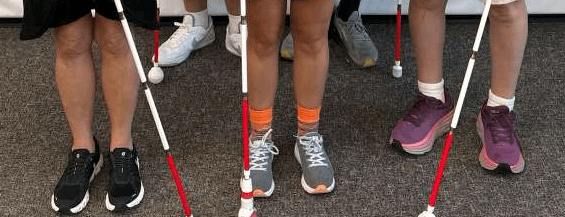
Image shows Caitlin and her O&M cohort – from about the knees down. In the front row are three pairs of tennis shoes, black, blue and purple and three white canes. In the back row are two more pairs of tennis shoes and two more white canes. The back left cane has a spherical tip, the back right has a marshmellow tip. Although the image doesn’t show their faces, I’m certain they all look proud and accomplished. :)

ACCESS INTIMACY AND ADULTING

Mia Mingus, a disabled activist of color, coined the term “access intimacy” some time ago. I remember stumbling across it and feeling that awe that comes with finally finding a label or phrase which perfectly encapsulates an experience that’s integral to your make-up as a person. To summarize very briefly, access intimacy refers to the comfort and ease disabled folks may feel, either with other disabled individuals or with non-disabled people who have truly become allies.

Being disabled, as is now becoming more widely understood and talked about, means constantly trying to function and find acceptance in a society which is not made for us. Even as a child, before I had language for any of this, I knew who I felt safest, happiest, and most myself around. My dad affectionately created the term “dealing” to encompass the things I often requested: a sighted guide, support around accessing the foods I could tolerate, visual descriptions, answers to my many questions. Even within my family, there were people who did this, if not technically “better” than others, with a certain warm, effortless finesse that I’d certainly never taught. I’m not sure that I’d know how to teach it, even now, though that’s not to say it can’t be learned.

In elementary and middle school, I often had my birthday parties at the roller-skating rink. I took turns skating with everyone. Everyone. It was easy, an unspoken given. Similarly, in college, I could rely on every member of my a cappella group to fill in proverbial blanks. Of course, some became my friends outside of singing, while others remained groupmates. Still, though, everyone understood me on a basic level: not just my needs, but also my strengths. I was expected to pull my weight and contribute, and I wouldn’t have had it any other way.

In my mid-twenties, I realized that my attachment to people — my difficulty in accepting that, sometimes, people come into our lives for a reason and a season — was rooted in more than simply being sensitive. It takes a higher level of trust, as a disabled person, to let someone in: to be vulnerable enough to name your needs and allow them to be met, without shame, by someone who may not fully share your experience. This is especially true when a disabled person takes the plunge to let a non-disabled person in. Teaching about disability, even in an incidental way, is labor. So losing access to that connection you’ve worked to build, as a disabled person, can naturally feel like a multi-layered loss.

Now that I’m a thirty-something, I think about this concept from a slightly different angle. I find myself waxing nostalgic about friendships like high school, college, and shared activities, where interacting with people on a daily basis automatically facilitated access intimacy. I’m lucky enough to be in touch with many of these folks, but times have changed. We’ve moved to different places, lived through different situations, and, in many cases, grown away from one another in such a way that meet-ups can sometimes feel awkward, even though mutual understanding and respect are still indisputably there.

People often say that friendships are harder in adulthood. Aside from neighborhoods and workplaces, it can be hard to find clear-cut pathways to create new connections. As a disabled adult, I both crave those connections and also, often, feel too tired and dispirited to summon the initiative needed to build them. And I do think that disability plays a part in this: a double-edged sword, of sorts. Those true connections can be harder to forge, but they can be so much more rewarding because of the work all parties must put in. I intend to remind myself of this whenever I question whether or not the effort is worth the outcome.

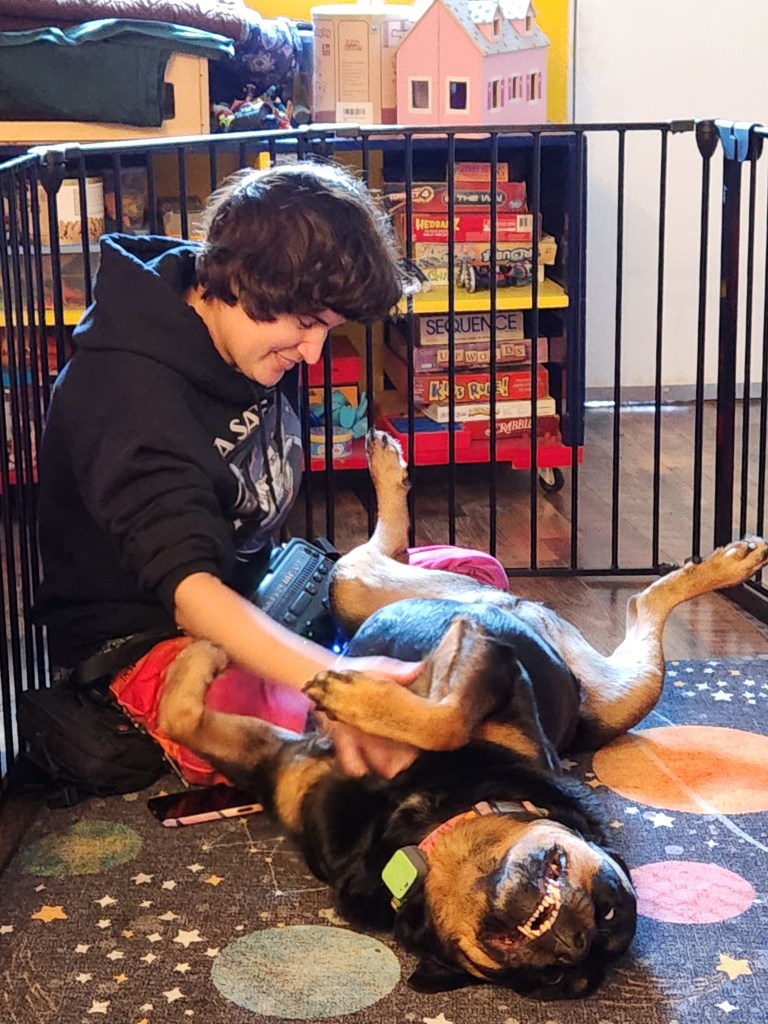
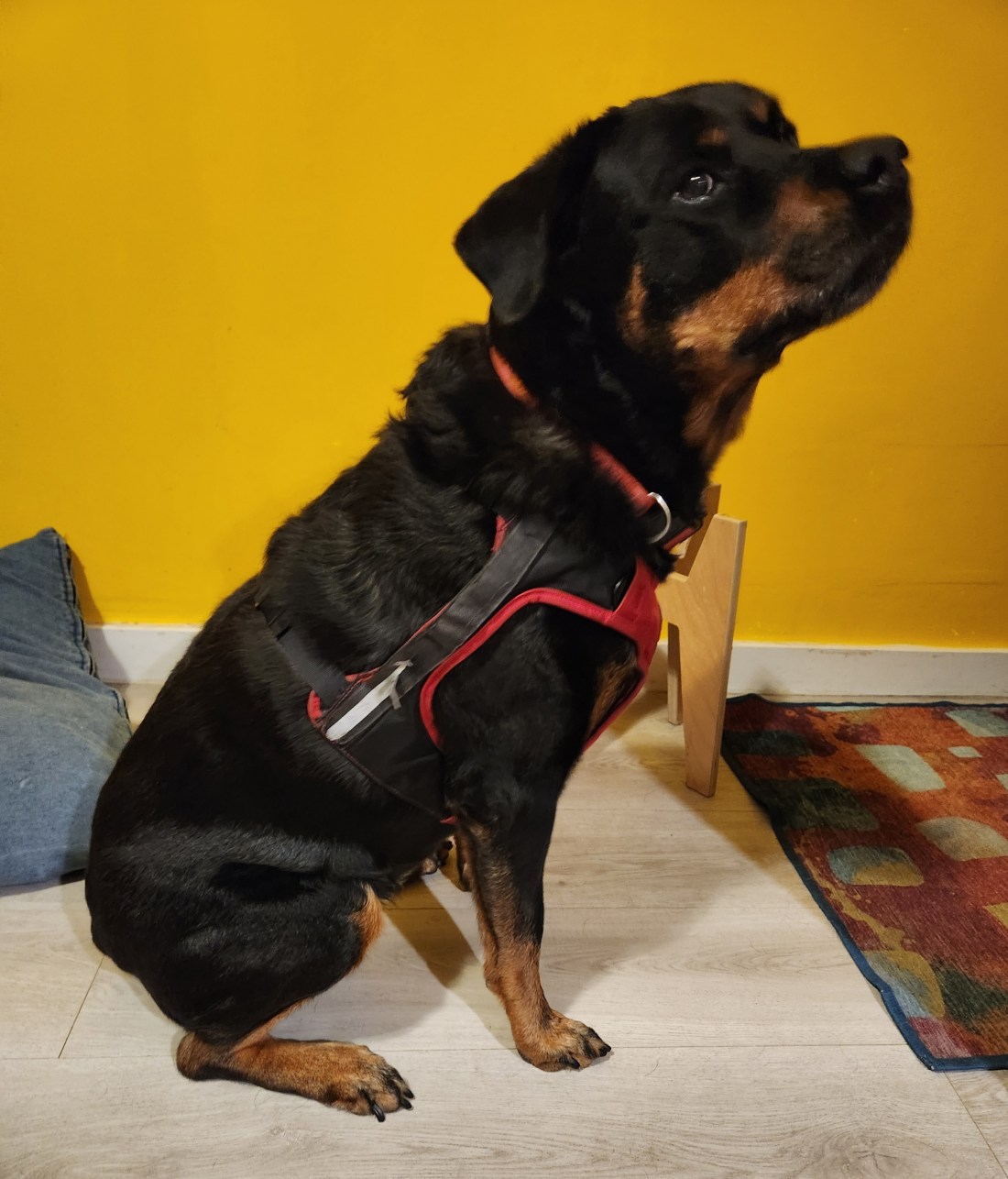
Image shows TJ (Caitlin) sitting on the floor on a space-themed rug, inside a huge baby gate setup with Maite the Rottweiler laying on her back right in front of her. TJ has her Braille Sense in her lap and is wearing her “I am a safe space” hoodie (which is also space themed, complete with an astronaut – although they are not visible). Maite’s mouth is a little bit open, teeth showing, but her face is very relaxed, complete with the whites of her eyes visible. Behind them are shelves with board games, a toy house and other toys. Everyone’s access needs are being met.

Elbows and Etiquette

One of my fave “coffee shops” in SF is Christopher Elbow Chocolates. It’s in Hayes Valley, which is kind of fancy-pants and pretentious, but it’s freaking delicious, and it was close to where I used to live with my dad. I was introduced to this spot by my friend Kate, who’s a braille teacher, and I still go there with her every so often. I also used to take OK Cupid dates there back in the day, partly because of the comfy seating and close-but-not-too-close-to-home location, but also because the staff were always so friendly, respectful, and accommodating.

I went to Elbow last week to catch up with Kate and had an interesting set of interactions that I thought it might be cool to share.

1. My Para-Stranded driver was very kind: an English-language learner who seemed extra concerned about my well-being because Elbow doesn’t have an easy drop-off spot for the big bus. After escorting me across the street and to the door, he seemed hesitant to leave—not at all in a creepy way, but just a concerned way.

2. This is where one of the staff, whom I’ve interacted with often but wouldn’t necessarily have known by voice, greeted me with, “Oh, hi! We haven’t seen you in a while!”

I don’t know if she did it intentionally, but it served the dual purpose of (a) reminding me that I knew her and (b) assuring the driver that I was in good hands.  As disabled folks know, worried non-disableds tend to listen MUCH more to other non-disableds’ reassurance than to OUR assurance … which, of course, is silly, because don’t we know ourselves best? No shade to this driver, though—he was sweet—although I kind of wondered what he planned to do as a means of helping me further? The shop is small. It’s not like there was a staircase I could fall down or anything.

3. I finished greeting the staffer, clarified that I was remembering her name right, and explained that Kate, whom she also knows well, would be coming soon. “Is it okay if I just hang out and wait for her?”

“Of course,” she said genuinely.

Out of habit, I found myself waiting for her to rush out from behind the counter, probably in a panic, and then flounder to guide me. I knew her well enough to know that she wouldn’t grab or pull me, but I found myself automatically bracing to be manhandled anyway. At this point, it’s just reflex to brace when I’m out in the world alone.

Interestingly, and awesomely, she didn’t actually do anything! She assumed competence! In response to that, I, on autopilot, almost asked for her to come and guide me to a chair. But then I remembered just how small and straight this place was, and how devoid of anything that I could damage in any way. It struck me, in a flash, how used I am to letting other people guide me, even when I really don’t need the help, because I’m so afraid of either getting in other people’s way, or appearing inept just by using my cane and doing something in a way non-disableds perceive as “different” or even “too slow.”

“Is anyone sitting back there?” I asked instead.

“Nope,” she replied cheerfully, “it’s all yours.”

And I took my left turn and effortlessly navigated directly to where I needed to be. No hiccups.

Every once in a while, I have these reminders. I remember another one, at my first teaching job. I was called to the phone in a colleague’s classroom while he, myself, and a third colleague were having a meeting across the room from the phone. I expected him to rush across the room and manhandle me to the phone, but he didn’t. I expected him or the other teacher to panic and have an entire fit as I clanked and clattered my way through the thirty-plus empty desks and chairs. But they didn’t. And I reached the phone fine. Maybe with some noise and flailing, but fine. And is it really a crime if I hit a desk or take a little longer? Totally not.

I tell the kids all the time, in response to their appalled gasps when the cane hits something, “It’s okay, that’s what the cane’s SUPPOSED to do. It bumps into things so I don’t have to.”

But I think I forget to remind myself about that sometimes.

I’m so wary of being perceived as hapless just for doing things “the blind way” that I think I sometimes sell myself short. But it feels so good when I’m able to do something simple for myself. And if people flip out about it, I can remind myself that that’s about them and their inexperience with disability. It doesn’t have to be something that I shoulder, take responsibility for, or feel shame about. We may look like we’re struggling, but more often than not, we aren’t, and I will be helping blind-kind more by letting myself flail a bit than by taking the path of least resistance when it’s not always necessary.

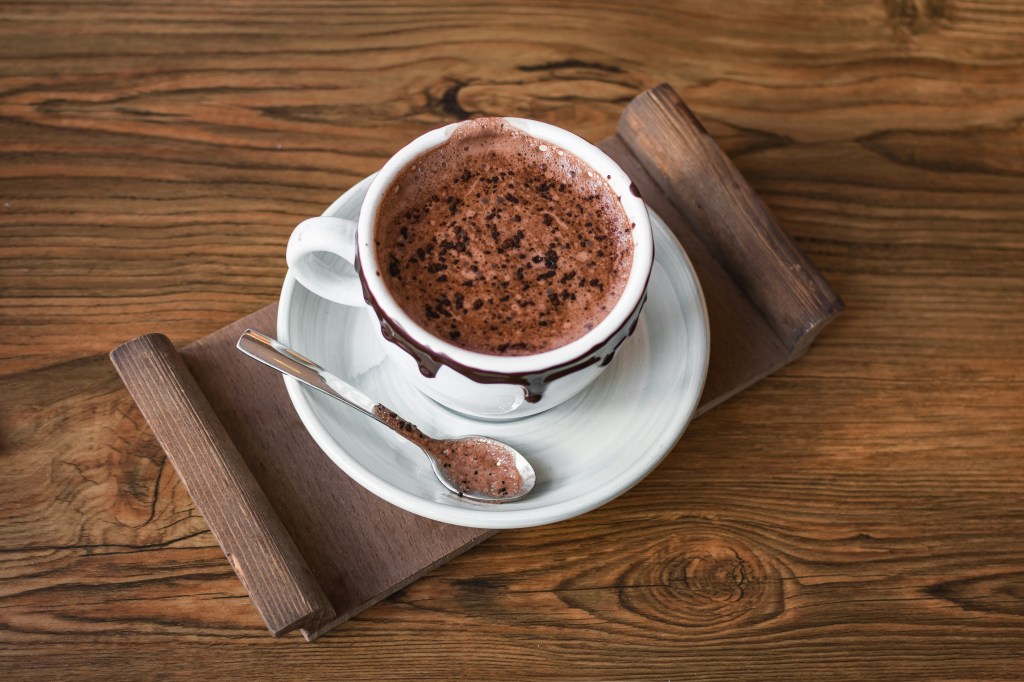
4. When Kate and I ordered, the staffer, as she always has, brought our stuff to us, which was very kind. I do think she does this for other folks, and that it’s not just a disability thing. However, she added an extra touch. I’d ordered drinking chocolate (the darkest possible), which is very rich, very thick, and very hot when it arrives.

“I usually fill people’s drinks to the very top,” she explained, “so they get all of what was in the blender. But I thought it might be easier to just give you the rest of the drink in the blender container instead, so you wouldn’t have an overflowing cup.”

I can imagine some blind-kind being pissed about this and going into a rage, railing at her, saying that they can very well drink the same damn drinks as sighted people, thank you very much. But I, personally, have a hard time holding very hot, very full cups gracefully. I appreciated the gesture and told her so.

5. After a delightful visit with Kate, I took Stranded home. The driver was new and couldn’t find my house. Martha wasn’t home and I was already late to feed the dog, so I asked the driver if he could just park and make sure I was in the right vicinity before leaving. He agreed to this, and we were, in fact, not far from my place.

Once we’d found my house, he very sweetly noticed that our trash cans were out and offered to bring them in for me. I thanked him and told him that wasn’t necessary, but that if he could wheel them slightly closer, I would go ahead and pull them in myself right away. This, I explained, would eliminate the need for me to flail all around the general area of the trash cans with my cane, trying to find where the bins had been left.

He understood this and followed my instructions to the letter, respecting my autonomy and giving just the amount of help I’d asked for. Even when I wrestled a little extra hard with the recycling bin, which is bigger and more unwieldy, and which I wanted to nestle in a spot I could more easily find when I opened the garage door to wheel it in, he was already walking away and didn’t comment. It shouldn’t be a novel thing when people genuinely hear me, but it is, so I always notice and appreciate it just that little bit more.

In closing, I just want to note that I’m not asking for advice or criticism for how I handle myself and mobility-related situations. I know I’m not perfect. No one is. I’m just sharing this because I find it interesting, and in the hopes that it may help someone else whose approach and struggles may be similar to mine.

Peace, hugz, and rainbowz to any and all who want them!

Image is of a cup of hot chocolate on a saucer. There is a spoon that has clearly already been in the chocolate. The cup and saucer are sitting on a tiny wooden tray, just wider than the saucer. To be clear, this is NOT TJ’s hot chocolate. I got this image from Unsplash (shout out to the photographer, Ashkan Forouzani) and thought it would make a nice addition. For sighties.