My ARFID, Explained

After I mentioned my ARFID diagnosis in my Leader Dog posts, a few folks asked for more info. Here’s a piece I wrote about (all caps) MY OWN, PERSONAL, INDIVIDUAL EXPERIENCE with ARFID. Mileage may vary. I never managed to find the below “article” a home with a publisher, so I’m stashing it here. I may do a follow-up later, as this article is now a little dated and I’m learning more about myself and ARFID as I truck along. Enjoy!

* * *

A Spoonful Of Sugar: Arguing and Arbitrating With ARFID

By Caitlin Hernandez

Misery constricted my chest as I sat, rigid with dread, the fiberglass bench gouging my legs. Sunshine pulsed enticingly against my back as the whoops and screeches of unadulterated kindergarten joy filled my ears. Our richly deserved, twenty-minute recess was dwindling down the drain. I longed to run, to play on the structure, to practice jump-roping, hula-hooping, or dribbling a ball. But here I was, cloistered in the corner. “Hurry up, Caitlin,” one of the grown-ups prompted, not unkindly. “Finish eating and then you can play.” My friend Sammy joined the conversation, her chocolate-scented breath clashing obscenely with the orange slice on the napkin in front of me. “Just eat it,” she encouraged. “It’s no big deal.” Tears threatened. My nemesis had a thick, unchewable peel, and wet, stringy flesh that would stick between my teeth. Its acidic juice would be eye-wateringly bitter. I couldn’t bear to touch it, much less put it in my mouth.

Well-intentioned admonitions like Sammy’s would plague me forever … but at five years old, I had no way of knowing that. By five years old, I’d accepted, even appropriated, the traits adults ascribed to my eating behaviors. I was “picky.” “Fussy.” “Stubborn.” At five years old, I believed I’d “grow out of this”; that, perhaps, my sensitivities to certain tastes and textures were simply related to my congenital, total blindness; that, one day, the allure of bribes and blending in might make eating an orange slice … well, a piece of cake.

Hindsight—ironically, re: my aforementioned blindness—is twenty/twenty. My trials with eating are rooted, not in blindness—at least, not in blindness alone—but in a condition called ARFID: avoidant/restrictive food intake disorder. The National Eating Disorders’ web site explains that adults and children with ARFID have difficulty meeting nutritional needs, due to sensory issues, low appetite, fears of aversive consequences during or after meals, or combinations of all three.

Unlike better-known eating disorders such as anorexia and bulimia, ARFID is rarely tied to concerns about body shape or size; however, like other eating disorders, ARFID’S manifestations (a narrow list of safe foods; omissions of certain groups, colors, or textures of food; and failure to consume balanced nutrients) yield medical consequences (GI complaints, weight loss and/or gain, fatigue, poor immunity, etc.), which, in turn, impact social functioning. The teasing and criticism of peers, haranguing from concerned loved ones, and inaccurate or nonexistent advice from medical professionals can cause or increase depression and anxiety. Self-consciousness, about both eating “differently” and people’s comments and perceptions, can make shared meals miserable at best and impossible at worst.

I’ve heard ARFID described as terror of eating unsafe foods. For me, though, ARFID’S main ingredient is disgust, combined with daily doses of trepidation, mixed well with embarrassment, topped with a generous garnish of dismay. Imagine being asked to eat a bowl of mud, or a handful of plastic, or a slab of rotten meat. You’d probably feel horrified. Scared. Unable. Those “foods” feel dangerous, inedible. They are certainly not, and never could be, anything close to appetizing.

I love tacos … hard-shelled, with beef and cheese ONLY. NOTHING ELSE. PLAIN. After years of trial and error, I’ve learned the precise language necessary to order successfully at Taco Bell: “Two crispy tacos with no lettuce.” However, with or without the magic words, ordering tacos is always a gamble. Hard shells aren’t always available, meaning that I either have to chew through a leathery soft shell or scoop taco guts with a spoon, which usually consternates me enough to deplete my appetite. Often, I’ll be revolted by the gritty scrape of unwanted lettuce against my tongue, its ominous crunch filling my ears. The mushy consistency of beans or the eerie crawl of vegetables mingling with the meat and cheese will put me off a plate entirely. Even if some kind soul removes offending items, their taint has usually sullied the dish beyond repair. And if a main course oozes into a preferred side dish, I often won’t be able to eat that, either. Sometimes I can gag down a few bites, but by then, my roiling stomach and anxiety will be competing to terminate the meal.

Taking a bite is often a leap of faith. Have these crackers gone stale and changed from pleasantly crumbly to startlingly dry and dusty? Have these noodles begun to harden because I’m eating too slowly? Is my “plain meat” truly plain? Did this restaurant change its brand of beef, type of cheese, cooking technique, or seasoning since my last visit? Even water can taste metallic, plasticky, unfiltered, or unclean. Some of a food’s qualities can be assessed by touch, certainly … but handling food is so taboo in American culture, even and especially among the blind, that I rarely rely on this. Asking sighted people for help can lead to scoffing: “Parsley doesn’t taste like anything!” “You won’t even notice a difference!” And because I present as both disabled and younger than my years, my ordering a small, simple meal off the kids’ menu often causes people to infantalize me more than they already might.

As a child, I drank copious milk and ate enough meat and carbs to maintain what the doctors deemed “age-appropriate weight.” Besides having slightly high cholesterol, which was hereditary, my lab results were acceptable. The lunches I ate at school—pepperoni pizza, hot dogs (no bun), chicken nuggets (no sauce), cheese burgers (plain), and peanut butter sandwiches (sweet French bread only, and no jelly)—were typical enough among my peers that my eating quirks slipped under the radar.

In my teens, my appetite, weight, and iron levels dropped slightly, delaying puberty and negatively affecting my sleep. I was still unable to eat any fruits or vegetables beyond potatoes, french fries (no ketchup), and Motts applesauce (plain and unsweetened only), which adults always discounted.

During college, tasked with feeding myself independently for the first time in my life, I went through terrifying periods of little to no appetite. I often had horrible stomachaches, whether or not I managed to eat. Clumps of my hair fell out on the shower floor, and my blood tests revealed anemia.

When I graduated college after a particularly difficult senior year, a disturbing, pins-and-needles sensation permanently prickled every inch of my skin. My braille display felt painfully scratchy beneath my fingertips, and the peculiar numbness caused me to fumble and drop objects. Doctors cited anxiety and advised me to “relax.” I was able to navigate these obstacles reasonably well until the COVID-19 pandemic. My decrease in physical activity led to a diminished appetite. I was always cold, even in warm weather, and felt constantly exhausted, even when I rested. My headaches multiplied in frequency and intensity. Most distressing, I would routinely dissolve into tears, devastated by my lack of enthusiasm about even my favorite foods.

My (then) doctor, concerned by my unintentional and severe weight loss, cautioned that, due to my eating habits, I was at risk for everything from heart failure to a skull fracture. Alarm and guilt over my inability to eat “well” caused my desire for food to decline still further. If not for my partner’s gentle and ever-present support, the downward spiral would surely have continued.

Even after attending partial hospitalization and intensive outpatient eating disorder programs, in which I received one-to-one therapy and psychiatric support, it has proven impossible to disentangle ARFID, blindness, and anxiety: to know where one ends and the next begins. However, my original therapist and I continue to research ARFID together, and I find immense relief in naming and unpacking my lifelong struggles with food. As I work to resolve my shame and discomfort around eating, I strive to unlearn many ingrained convictions. All food — ice cream, boxed macaroni and cheese, McDonald’s — is good food, regardless of the time of day it’s ingested. Eating whatever I can manage is preferable to eating nothing at all. Fidgets and audiobooks are helpful distractions during mealtimes. Supplements can fill in gaps when a full meal feels overwhelming.

Even if I don’t feel hungry, simply sitting in front of a plate of pleasantly-aromatic safe foods can sometimes encourage hunger. Prepping food for the week and making lists of easy-to-eat safe foods provides structure and choice, especially when my partner is out of town. I don’t have to try new foods unless or until I’m ready. On some days, no spoonful of sugar will make the proverbial medicine go down. But on other days, I only need half a spoonful of sugar. The support of those who accept my experiences with ARFID can make even a sour day seem sweet.
Leader Dogs, Day 5

Shout-out to my therapist for exhaustively reading this entire blog and making notes on all the reasons she’s proud of me, all the times she laughed, all the things she took the time to search up, and all the things we could talk about in future. She is truly the best, and I adore her and appreciate her beyond words.

Today for breakfast, I got a choco-chip muffin, and Jeffrey encouraged me (kindly) to try quinoa chocolate bark. Apparently, I tried this before, with Martha, on airplanes! But this one was homemade by the chef, and it was way tastier. It was a similar taste and texture to those chocolate / espresso coffee beans I used to snarf from Trader Joe’s: chocolatey and bitter and kinda … gritty. Shocking that I liked it, but I did!

Hannah had meetings, so Jeffrey and I did a quick route-plan, then reviewed and practiced a lot of the key take-aways from yesterday.

* I think I forgot to write yesterday that I’d somehow never really computed that we line ourselves up to cross along the inner curb because the traffic is closer to the outer curb. I mean, I guess I knew that … but not in those exact words. Necessarily. So you just listen to which side your traffic’s on, and then focus on the inner curb accordingly. MAGIC HACKS!

* This one took Jeffrey a couple tries to explain. When and if I veer while crossing a street, and my cane bumps a full curb on a left angle, that most likely means that, when I Go Go Gadget, the up-curb will be on my right, and vice versa. This may not always be true, but is a good place to start. We also talked about doing Go Go Gadget arm minimally at first, then extending farther on each side if I don’t immediately find something. If I go big first, I might miss the domes, since they’re often much closer than I think (IE, the veer is often not that big).

* Again, we practiced not moving my feet when I find the domes and using the traffic to check alignment on more simple crossing. For more complex crossings, I first line up with my shoulder lined up to the APS pole (we went from forearm to hand to shoulder because I am me and need Caitlin-specific choreography). Then, once I’m lined up with the pole, I use the traffic to confirm. This freaked me out a little because I’m usually not on the domes! I just have to trust the surge to guide me! I could also edge forward a LITTLE toward the domes, but carefully, so I don’t lose the magical position!

* Jeffrey reminded me again that it’s okay to wait until I get a parallel surge that I like. It’s okay to wait, take my time, and listen to one or more cycles to ascertain what’s going on and to make sure I’m lined up right.

* We also practiced using the traffic to get back on, or maintain, our line of travel. I always knew about this, but didn’t think as much about it in terms of avoiding sidewalk junk. Jeffrey pointed out that, typically, you get around sidewalk junk most safely by moving AWAY from the traffic. Maybe that should have been obvious, but, again, I just never thought about it that way.

* In terms of parallel surges, we talked about “The Golden Goose” surge, where the cars aren’t just tearing up to the intersection and passing through, but have been waiting for their turn, and are accelerating. This is complicated by the fact that (a) a lot of new cars idle very quietly, causing me to think no one is waiting and that they might be a new arrival, rather than an accelerator, and (b) in busy intersections or areas with lots of noise, it can be hard (for me, anyway) to differentiate.

* Funny moment:

Me: This car’s waiting for me, huh? But I want my all-quiet, all-clear.

Jeffrey: Right. What can you do to encourage him to move on? (Without thinking, I whirled around and pulled up my cane, acting like I was going to leave.)

Jeffrey: Ahh, don’t move those feet!

Me: Ahhh, I forgot!

Jeffrey: Look down or look away, but don’t move those feet.

Me: Should I look, you know, in the opposite direction? Or in their direction, so they know that I know they’re there?

Jeffrey: I think “nose to ground” is a good reminder.

After our water break back at the downtown lounge, we spent some more time with the Wheatley boards. Those are the big felt-covered boards with plastic strips for streets, blocks for intersections, little squares with bumps for truncated domes, little cars and people, etc. These can be velcroed in whatever place you want, to build intersections, simulate crossings and movement of pedestrians and cars, etc. It really seems like an art form to me when these instructors just built complex intersections in a trice.

We did a review of complex lighted intersections. Like with yesterday, Jeffrey took the time to explain things like lanes, different scenarios, being careful about cars that might turn unexpectedly and what can be done, etc.

We then did a quick walk to a complex intersection. It sounded SO wild, but Jeffrey made it clear that we were just going to listen, not cross. He wanted me to be able to hear it in person after we’d simulated and discussed it with the board. Hannah was also able to join us on this leg of the journey, which was great, because she and Jeffrey often tag-team and riff off each other with extra tips, ideas, suggestions, and noticings.

After lunch, we went to the mall, because I’d asked for techniques for the mall, stores, etc.

Best line:

Jeffrey (as Hannah cranks some music): Is this that song y’all were singing earlier? “Lifestyle Of Evan Williams?”

Me: Ahahahahahaha!

Jeffrey: Something about … Dean Williams?

Hannah: “Dear Evan Hansen.”

Jeffrey: Oh, is that what it was?

Me: My dad calls it “Dear Evan Handsome,” if that helps.

In the mall, we talked about using sounds as markers, which sounds like a good idea until you think about all the competing sounds in malls: fountains, mall music, people talking, echoes, music coming from individual stores, etc. Now that I look at it, that list actually doesn’t seem that intense, but it all adds up and becomes a lot. We practiced escalators and went up to Nordstroms. I was going to try soliciting verbal directions to the bathroom from a salesperson, but some customer who reminded me uncannily of my mom was taking forever and a day at the counter.

Me: Can you just pretend to be a stranger and I’ll practice with you?

Jeffrey (turning into his alter-ego, Joffrey The Boy King from Game of Thrones, which he’d told me about): Helloooo, madam, can I … (sketchily) help you?

Hannah (amused): Oh, no …

Me (trying to stay in Caitlin character): Can you please give me verbal directions to the women’s bathroom?

Joffrey (sinisterly): Yes. I’d loooove to. (breaking character) Okay, no, that got creepy.

Me: Ahahaha it was great.

Jeffrey: Okay, Joffrey’s gone, I’m back.

Hannah and I also practiced bathroom tips, but their Nordstroms bathroom was waaaay more straightforward and chill than ours. Still, good notes: try to stick with one wall at a time (not just flail around and go in wild circles, like I frequently do, in search of the stalls); trail the walls with the back of a hand; be mindful that sinks may stick out; etc.

Jeffrey also showed me one of those enormous marbles that rolls around and around in water. I can’t explain it now, but Martha showed me one at the county fair. They’re so wild!

We also talked about how malls seem totally, ridiculously insurmountable to me, but I could pick out a couple of stores and plan a route beforehand. And because they are cool, Hannah and Jeffry reiterated that human guide is a tool in my toolbox! So if I want to do that — if that makes the most sense, like if I just want to browse a mall and not get hung up on every single piece of mall junk — that’s an option.

Hannah also noted that many malls open before the actual stores open, and that would be an ideal time to practice, map out routes, etc., like when I used to practice my routes for school in the summer, or after school. Much easier to learn the route without people swarming everywhere.

On the drives to and from, we talked about odds and ends, from why I became a SpEd teacher, to my attempts to find something noise-canceling that doesn’t make my hearing feel weirdly occluded, to their experiences doing extensive training under blindfold. One of the ladies in our cohort also did a route with a blindfold and poignantly said to me, “I have so much respect for you, Caitlin, because my blindfold comes off, and yours doesn’t.” My “best straight guy friend,” Mitch, from college, said something similar after he did a Dining In The Dark-type simulation, and it really just warms my heart when people empathize in that way. I know people have big feelings about simulations, but when they’re paired with training, education, and-or exposure, as in these cases, I really do think they have their place, teaching empathy but not pity.

I was going to take a nap, but one of our crew texted our thread and told us there was ice cream in the piano lounge, and another told me there was an Oreo-type thing that I’d probably like … and she was right! At dinner, Jeffrey delivered my mail: a brailled letter from Martha (and Maite). Soooo cuuuute! I may or may not have gushed and bragged a bit about how sweet and brilliant she is. Everyone was properly touched.

We had fun chats about favorite desserts and adventures of the day, and I told the group that I, very suddenly, felt a huge influx of big feelings about leaving. I was a wreck after leaving guide dog school because I’d bonded so much with the cohort. And when I left LA after the “Dreaming In Color” summer, I was more sad than I think I’ve ever been in my life. For weeks! I cited that it’s not just about leaving the people and the, like, vibes, which is hard enough; it’s also about leaving a world that feels built for us, where blindness and visual impairment is normal, where we’re understood, respected, and treated well. It can feel very hard to leave that, especially when there are stressors at home, and when you feel some anxiety about preserving and keeping up what you’ve learned, as with guide dog school, but this time on your own (until you teach your people the things you learned, so they can support). The crew, of course, got this.

I forgot to mention that I tried the jumbo roller cane tip today and liked it as a lighter option. It doesn’t hop over cracks like the Pathfinder and Sensaball, but it does pretty well and is much lighter. I bought one at the RA office so I have it as an option.

I also did my best to take pics of the braille rails, wall of snacks (with its braille labels), and fridge (with the braille labels on its shelves) for my therapist. We’ll see how I did.

And, as ever, I’m zonking out! Only one more day … nooooo! I feel like I’ve been here forever!

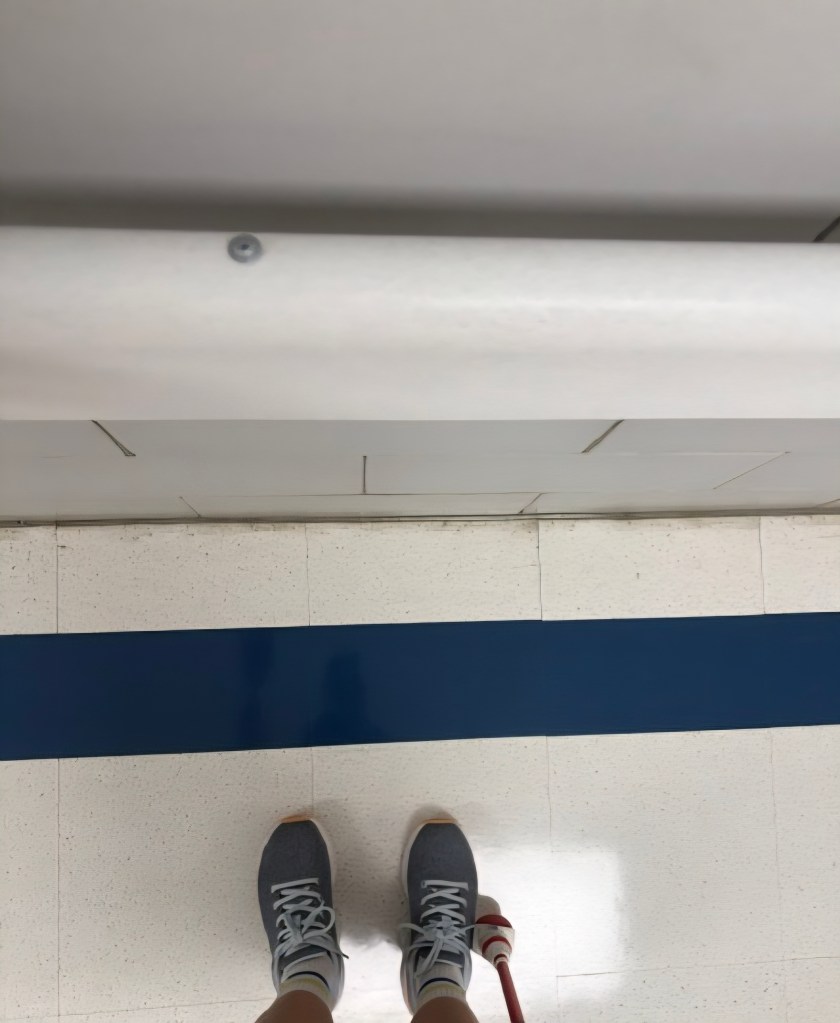
Image shows a bird’s eye view of a white painted hand rail with a “bump dot” screwed into it. Underneath it, on the floor, is a dark blue line running parallel to the wall, very visible against the white floor. Presumably for folks with some vision can use it. Unless it’s for the guide dogs? Next in the picture are Caitlin’s two feet, in their special, ankle-saving shoes and pride socks. Next to her right foot is her cane – the bottom section is red and it has a cane tip I don’t recognize on it. It’s red and white but I don’t think it’s the Sensaball. I’m doing my best, people. Caitlin is long abed and I’m posting this after choir practice. Which was awesome.

Leader Dogs, Day 4

Jeffrey and I wanted to poll the sighties:

QUESTION: IF there were no streetlights, pedestrian heads, etc., would you know how to cross the street? In other words, do you actually understand how traffic works and when is the most optimal time to cross? Jeffrey thinks that, actually, very few sighted folks would cross the street particularly safely or optimally without the “ped heads,” as he and Hannah call them.

After breakfast (bacon and toast for me, nomnom), we did more street crossings. I wrote out some routes and mapped them out on the mobility velcro tactile board thing. The board is confusing, but I comprehended enough to follow my own directions with very little help, which is more than what usually happens!

I also tried flagging straight up and down instead of side to side, which was a little easier, less choreography-like, and saved me some time. Time is worth its weight in gold when you’re trying to cross a street.

I did get a LOT better about planting my feet when I don’t cross perfectly straight. This way, I don’t run the risk of running in the wrong direction of the up-curb and spending more time in the street; rather, I plant my feet, do a Go Go Gadget sweep to either side, and inevitably find the curb.

At the end of the first half of the morning, I crossed a street (an easy one) in front of some Leader Dog volunteers who, I think, were there for Distraction Wednesday, waiting to squeeze squeaky toys and distract the guide dogs so they could practice ignoring temptation. But there were no dogs around, so they were just chatting, and when I got across the street, they cheered very extravagantly. I felt kind of silly about it, because it was what Derek and I call a “baby street,” and I was crossing on an “all quiet, all clear,” and everything like that, but it was still cute.

I’ve also gotten Jeffrey into the habit of doing “up top” and “down low,” which seems to amuse him. I also definitely did a happy dance at one point yesterday and Jeffrey was like, “Um … step a little more forward so you don’t accidentally dance into the street.” Heh.

For the second chunk, we headed toward one of the much more complex crossings. I also practiced listening for, and paying attention to find clues that would help me avoid mixing up driveways and intersections with weak curb-cuts, no truncated domes, etc. I was also especially careful on my “all quiet, all clears,” because I totally missed an approaching car during one and was horrified, even though Jeffrey and Hannah insisted that it had not been a dangerous error. Of course I totally know they won’t let me die, but … when even a simple crossing seems fraught, I start having these existential thoughts of, like, “Why do blind people even cross streets independently when we could literally die?” I know, I know, I can’t say stuff like that or my Blind Pride Card will get taken away. And I know sighties can get hit, too. But it’s just where my mind goes when I do mobility. It can all start to feel so complicated and exhausting, which can feel unfair because sighties don’t have to worry about any of it, and then it can put me in a frustrated, stressed-out, angsty headspace.

The big crossing had an audible signal that gave hecka directions: the name of the intersection, the cardinal direction, a countdown as you cross, etc. It was also set up in such a way that I could press my hand parallel to the sign and use that as a backup tip for getting myself aligned. Because I am me, the choreography of doing that was difficult, because it seems most folks use their forearm, but I couldn’t coordinate that without standing way far away and torquing my body oddly. The flat-hand, and a reminder to stand closer to the sign, not closer to the domes, helped.

With the APS and the parallel surge, most of the crossings went fine once I was used to it. Still, I haven’t crossed a street like that without a guide in years. I’m not ashamed to admit it. (Okay, yes, I’m totally ashamed to admit it, but I oughtn’t to be, because whatever.)

Some Big Crossing things:

* The APS might indicate that it’s safe to cross, and it technically is. But we still want a strong parallel surge, where the traffic has been waiting and has JUST accelerated. My favorite thing about the parallel surge is that, essentially, you can follow it across the street … like a guide! But also, besides following it to the other side, you can use it to help you maintain your line of travel. So you can’t just (cough) blindly follow the APS (yes, Jeffrey and I made that pun … or joke … or whatever we wanna call that).

* What I love about the surges (that they guide you) is also tricky, though, because, obviously, you also can’t get too close to them. But you have to be careful not to get too far away, because then you’ll go into traffic. It’s a delicate balance. That I’m not used to. So you can’t let the cars get any closer to you than they are when you start off from the curb, but you also can’t flip out if you discover they ARE too close to you, because then you’ll get annihilated by the other cars.

* I think I was also getting hung up on the feeling that my feet really needed to be in the precise right position when I aligned myself to cross. Which, I mean, they do … but I just needed some reminders that I can let a cycle or two go by, listen to the parallel traffic, and adjust my alignment as necessary. I think I’ve internalized the sense that waiting a few cycles is, you know, weak and shameful and indicative of garbage mobility skills.

* Hannah taught me a life-hack when I complained that the audible signal poles in SF are often literally, like, five feet away from the curb-cut. If you wait for the perpendicular traffic to go, “run” to the APS (Audible Pedestrian Signal), press it, and come back, you’ll have the maximum amount of time to get yourself re-set up to cross. So after all this, and to some extent during it, I was feeling low-key toasty / tearful / stressed out. Jeffrey and Hannah were great and reminded me to “shake it off,” which is totally a thing Martha and I often cite. Dogs do it for a reason! It literally enables you to complete the stress cycle. Also, if either of them had, you know, even asked, “Are you doing okay?”, I probably would have cried, so I was super grateful that they followed my lead and just kept rolling. I’m one of those people who just disintegrates at the first expression of comfort and sympathy in the face of impending tears, haha. And I despise crying in front of people. After a few crossings, and a lot of encouragement, Jeffrey, because he now knows me from sitting at our dining-room table three times a day, said he was going to buy me ice cream. So kind.

Again, the way the Leader Dog crew do not default to guiding continues to surprise me, which only reinforces to me how accustomed I’ve become to being guided out in the world. They still managed to give me a break by giving me verbal directions to the ice cream place right behind our crossing, but I was still walking solo. As it happened, Hannah told me that the shop had a mini chocolate-chocolate cupcake, which was absolutely perfect. And I think it speaks to Jeffrey’s and Hannah’s bossness that (a) they freaking got me a cupcake, and (b) I was actually able to eat and enjoy it, even after all that stress. Believe me, that’s not always the case, even if I’m given a perfect chocolate thing!

Jeffrey wants to eventually do mobility with kids, and I told him that, if he keeps doing kind things like taking people to get cupcakes and ice cream, he will be perfect at it. I commented that I could have been so easily bought and motivated by going to pizza, ice cream, whatever … but, often, the stringent rules around where mobility teachers could take me meant that we couldn’t do much that was relevant. So of course I didn’t get as much out of lessons as I could have, especially in later years, when the rules became stricter and my abhorrence of mobility got more intense.

Ooh, the last thing I learned in the morning was that it’s best practice to have my cane proceed me as I exit a door. I guess I always kind of felt like, “Well, I already came in, so if that went fine, then the exit will go fine.” But, especially in SF, anything can happen on sidewalks. Or there could be a step which I forget about because something ridonc happened while I was inside the building. You never know!

After lunch, doubtless deducing that I was a little fried, we went to the beach and I got to try the Dakota disc cane tip. I always assumed it would be more like a wheel standing on its end, but it’s actually more like a baby frisbee, and it bounces over sand, snow, and grass really nicely. I super-liked it. My SensaBall and PathFinder tips do okay, but because they’re more like suitcase wheels, they have a harder time than a disc on those textures. When I hit the sand with the Dakota disc, it felt so deliciously swishy in the sand that I ran down the beach. Jeffrey and Hannah were sweet and let me, although Jeffrey pointed out later that, really, for safety, unless a sightie’s around to ensure that there are no giant holes, sand castles, or picnic spreads, my reaction time would not be good, so it’s not ideal to go running blithely all over the beach. But they let me, because they are kind. Although Jeffrey did tease that, if I accidentally ran into the water, he wasn’t going to stop me. But obviously I didn’t … even though the water sounded more like a splashy little puddle than the ocean, which was new for me.

Hannah and I also talked a little about bathrooms, because I cited them as another stressor, especially since I have bathroom anxiety, try to put off going because I hate asking for help, and then am often in a panic and need to go fast, especially when I’m not with someone who’s able to go into the same bathroom as I am, or when there’s not a single-stall bathroom available (I know there’s a better word for that kind, but I can’t think of it … the ones that don’t have stalls!). Hannah said we can practice in the Leader Dog’s lobby bathroom tomorrow, and that she always reminds clients to try sticking with the walls rather than wandering through the middle, trailing with the back of your hand because EW, and also remembering that the accessible stalls have doors that go inward and tend to be on either end of the lineup. I tend not to use the accessible stalls anyway, because I don’t need them and a wheelchair or guide dog user might, and also because it’s just one more giant open space to navigate.

We also walked on a trail, where I liked the jumbo roller tip; it’s lightweight and did well in the dirt and hopping away from the grasslines. It didn’t do quite as well as the Sensaball or Pathfinder, but its lighter weight means that it and wrist, and would be less tiring on a hike. Same with the Dakota Disc. But the Dakota Disc is hollow, so if it gets punctured by something sharp, it will die. It also isn’t meant for everyday use, unless you’re in the snow, and it’s not meant to go on concrete. It’s hook-style, though, so is very easy to swap in and out as needed.

As we drove back, we had a good, honest talk about taking an arm versus trying to walk by myself. Let me add that I brought this up willingly, which I have hitherto never done with a mobility teacher because, you know, I worry they might spontaneously combust when I ask why anyone would bother using their cane when they could walk with a guide, other than to prove that they can? I mean, it wrecks conversations, slows your companions down, trips people, makes people stare, causes random sighties to freak out and grab you and scream if your cane touches anything, etc. But after this week, I genuinely feel like I do want to do a little more walking solo out in the world with other people … because I can. And because a guide isn’t truly, always necessary … it’s just easier. But walking solo also feels … empowering. In a way. Sometimes. I don’t know. I’m unpacking it.

Both assured me that whether I go solo or with a guide is ultimately my choice and can be based on the situation. We talked about how certain family and friends might be better at working on this with me (IE, people who can and will glare at other people who look like they want to interfere, who will be patient and interested in the process, who can strike that balance between helping and standing back, etc.). Jeffrey also pointed out that, now that I’ve refreshed my technique, and my arc has improved so drastically (he repeatedly commented that I hadn’t needed a prompt and was doing well), solo travel might feel less cumbersome.

Speed-through of the rest of the night: we had a tour of the Canine Center and the gift shop. I asked for all the braille things, and the gift shop people were excited because they said they don’t get a ton of people who are into Braille. I brazenly informed them that I’m the biggest braille fan in the world. Because I have no shame. Or modesty.

The canine center was really interesting and we learned a ton of factoids, most notably that (if I remember right) it takes less than three freaking months for puppies to gestate and be born. I could not! What in the world? How!?

My Dark Oreos came, and I gave people samples, including Craig from the kitchen, who made me another fake-chocolate sundae, into which I crumbled my Oreos. Delish.

Then we had a little lecture (optional) about Meta Glasses and Be My Eyes. I thought it would be more about using them for mobility, because I know people do, but none of the other folks seemed very familiar with either service, so it was mostly just introductory stuff. It was super cute to hear their amazement, though. And, as our presenter pointed out, Meta and BME can be a tool in the mobility toolbox, but ought to be primarily a confirmation, not a guide, because they’re unreliable, can hallucinate, glitch, etc.

I promised Jeffrey I wouldn’t stay up late blogging because I was sooo tired this morning (he was amused that he was advising a teacher, of all people, not to stay up late). Off to bed I go, so I can get my eight hours. Sweet dreamzzzz and more tomorrow, if I can stay on sched!

PS. I’m not editing these posts at all, so sorry (not sorry).

Leader Dogs, Day 2

Let me just say right now what a fantabulous job the kitchen is doing with my ARFID. Like, seriously, I have never been catered to (pun intended) so thoroughly (a) without either someone else or myself having to do a boat-load of extraneous advocacy, and-or (b) without feeling like I’m a huge, babyish burden.

Between the jet-lag, nerve-citedness, and my inability to sleep on any pillow ever besides my own (I really should invest in a travel pillow, but I bet that wouldn’t work right either), I wasn’t too hungry for breakfast. The sausages were delicious, though, and I already requested milk and water for every meal. It just so happens that I’ve felt a little sluggish in my body of late, and because soda is an easy scapegoat, I have blamed him and am divorcing him forthwith, at least for the time being. Just when there’s a shelf literally Braille-labeled “Pepsi” in the RA’s office, calling to me. Anyway, the kitchen staff also checked in with me, knew all about my safe foods (I sent them a list, but I often do that and people just willfully disregard it or think I’m exaggerating), and basically said they’d give me Caitlin-food substitutions (IE, plain chicken, burgers, peanut-butter-no-jelly sandwiches, etc.) in place of the fancy things I won’t eat, which is pretty much every meal here, because guide dog schools, like I said, are basically akin to resorts … and are also way better than the literal cruise I went on last year, which had me subsisting on milk, salami and cheese slices, and soft-serve from one floor and Oreo crumbs Martha spirited from a whole different place on the ship.

I also continue to love the Braille Rails, as I call them. Just having those bump-dots and all the Braille labels as reference points is so cool.

After breakfast, we got buddied up with our 1:1 instructors, but because I am a lucky duck, I get TWO instructors: Jeffrey, who’s an intern (he’s almost done!) and Hannah, who my friend, Alexis told me was awesome! They were both incredibly sweet, understanding, and hilarious from the get-go, which quickly put me at ease. I mentioned my anxiety around mobility, and all of my “anti-goals,” as I call them: dropoffs, instructors following you silently, etc. Jeffrey was very clear that I’ll have a say in everything we do, AND he added that a dropoff at the end of the week might be a good confidence-builder IF I decide I want to do it. That thought, of course, is beyond horrifying right now, but I shall not pass judgment until I get to Friday … or I guess Thursday.

I also talked about my general feeling, whenever I do solo mobility, that I’m in the way, slowing people down, appearing clumsy and incompetent, etc., and that I struggle with advocating for my own bodily autonomy in the face of a stranger or a frenetic situation. It was really nice to air these grievances and feel truly understood and respected.

I also mentioned that I have no idea if my cane technique is ideal, or even if my cane’s length was ideal, so we started out using a few different canes. We settled on one that, I think, is slightly longer than the one I brought, which I remembered later is my shortest one. I got a shorter one to accommodate my love for the Pathfinder and Sensaball tips, which are free-wheeling and, as I once said to a friend, “bounce over cracks with tremendous alacrity.” I love these tips, but they increase both the weight and length of the cane. AND, as it develops, I’m very tense in the way I hold my cane. Hannah had me laughing when she called it a “dinosaur arm,” and Jeffrey cited “Go, go, gadget.” This is why we all vibed.

Some fun news is that I nailed stairs, and that, actually, aside from my needing to choke up less on the cane handle and work on narrowing my arc, my cane technique is not rusty enough to give me tetanus. Considering that I haven’t had consistent O&M (I literally just wrote M&M, oops) since I was eighteen, and from sixteen to eighteen was with a guide dog, not a cane, I’m actually surprised I don’t have more egregiously bad habits than I do.

My arc has been an issue ever since I can remember. Teachers used to tease that it looked like I was clearing the way for ten people. I’ve gotten better at keeping it within my shoulders, but it still sometimes goes a little far to the side. This is a problem because, for example, if your cane’s way off to the left and straggling its way back to the right, something might hit me on my right side while the cane’s trying to catch up. So if the arc’s narrower, it has less ground to cover and will keep me safer in my little bubble.

The tricky part is that, between narrowing the arc, needing to relax my wrist and elbow while holding the cane closer to my body, and holding the cane closer to its top rather than further down the handle, my arm and wrist were complaining a bit. Hopefully, it’s just a new sensation, and as it becomes muscle memory, it will be easier on my weak little spindly wrists.

Another thing I asked about, because I literally promised someone I would (although now I forget who I promised!), was how to instruct a panicked, untrained sightie in guiding me through a doorway. Because doors open so many different ways, people are rushing, they’re often crowded areas, etc., I find that this is a place where many guides just freak out, flail, grab, push, pull, abandon, etc. It turns out that the life hack is to encourage the guide to do the narrow-passage technique and continue guiding as normal. I’m excited to see if instructing in this way will stop people from feeling awful about how doorways inevitably go.

I cited some other things I want to work on, but I imagine we WILL work on them and they’ll come up then, so I won’t go on and on. We walked the practice course twice to cement the relaxed shoulder, all-in-the-wrist technique, and reviewed the dorm one more time.

I then had a delicious peanut butter sandwich for lunch, which honestly was just so … calming and predictable, haha. I also discovered that the braille schedule on the bulletin board in the hallway had been tacked up upside-down, which caused some hilarity.

For the afternoon session, we went to the downtown to the training center there. The mobility stuff gets a little more technical here, but I’ll share some cool stuff we worked on:

* Anchoring: I somehow had never heard of this or been taught it. Essentially, when your cane touches a doorway, you keep its tip flush with the doorway while lifting the cane so that it’s pressed vertically against the door. You can then use the cane, not your hands and fingers, to feel for a doorhandle. This could prevent some nasty bites from hinges or hasps or whatever all else doors are made of, although I suppose you also have to still be careful not to get hit in the face.

Similarly, you can use anchoring at curbs. I was always taught, when hitting a curb, to do a big, side to side sweep before stepping up. The anchoring technique involves bringing your feet close to your cane tip as it anchors to the step, then lifting your cane to gauge the step’s height, as well as the area just at the top of the step, enough for you to step up safely. Then, and only then, can you go on your merry way. This gives you a better sense of how high up the step is, and also prevents you from blazing up curbs while swinging your cane wildly in a sweep as you chase after it, the way I was doing.

* Cut-backs: Another thing I never heard about! Basically, cut-backs confirm that you’re maintaining your intended line of travel after crossing a street, rather than veering off into a sidewalk or alley. I’m still kinda figuring these out, but essentially, this gets you away from the street, and involves shorelining until you find the “opening” back to the sidewalk.

* I was introduced to the genius term “sidewalk junk” to refer to things like trash cans, parking meters, and random signs, which I loved. In turn, I kept unintentionally using ostentatious words like, well, ostentatious. And circuitous. And lackadaisical. Which amused Jeffrey … who promptly also started punning.

* I told Jeffrey that I was going to write about this experience in my blog, and he rallied that he needed to video-tape part of our lesson for his mobility exam portfolio thing. Seems only fair.

* Apparently, in quieter areas, if you cross crookedly, you don’t need to leap up onto the sidewalk like a scalded cat and start springing around trying to find the curb-cut. You can stay in the street, as long as you’re safe, and feel around with your cane to see if you’re close to the curb. Who knew?

* The Three Rules Of Street Crossing:

1. Plant your feet, as though they’re in cement. Jeffrey said “see-ment,” which Martha also says, which made me  grin and emulate him.

2. Extend your cane across your body. This is called a diagonal, which does make sense, but for some reason, I literally forgot about five times what this step was called. It was unclear. My brain was probably shorting out from having had more mobility than I’ve seen (pun) in years.

3. Flagging: I just learned this one when I had a couple O&M lessons last year. This asks you to get drivers’ attention by decisively extending your cane and indicating that you’re beginning to walk. Both in high school and last year, I was taught to go really big with this, and when I’m asked to go big, I go big. I think I almost hit Jeffrey with my wild flagging … which is not surprising, because I smacked someone’s car roof last year when I learned this. Jeffrey told me that, like with my arc, I can go smaller and that, if I start on the right, I , which is where my cane seems to like to be when I start to cross a street.

4. Take a big first step, and then pick up that pace!

* I practiced soliciting assistance across a street from Hannah, who pretended to be a wrist-grabbing newb with no experience of blind-kind. We had a good little talk about bodily autonomy and not being afraid of inconveniencing sighted people in general, whether they’re guiding or getting in my way, as I travel. True, but hard for me to internalize.

Those were the highlights! Tomorrow, we’ll do some route-planning and intersections, maybe lighted ones. We just did “all quiet, all clear” crossings today, to practice the mechanics. Other folks did way more complex stuff, but I’m internalizing what Hannah and Jeffrey impressed upon me: that, literally, we’re all on our own path, and that building confidence and skills that feel helpful to me is all that matters.

Can I also just say that it’s super weird to me not being guided everywhere the instant I struggle? I mean, I fully own that I am extremely guilty of letting myself be guided even when I don’t need it … again, mostly because, the second I take a wrong turn, it feels like sighties everywhere have a whole fit and scurry over to save me, which often involves touching and grabbing. So it’s become so easy for me to just … avoid all that and let myself be guided. But there’s no grabbing here! People give verbal directions when asked, and I feel simultaneously looked after and more independent for having taken on that extra ten seconds of fumbling … because it’s not really fumbling, it’s just finding my way there, and who cares what it looks like? It’s wild to me how I can and do totally believe this for other people, but have such a hard time with it for my own self.

I appreciate Jeffrey and Hannah for making mobility fun again, and told them so. There was so much laughter, talking, and silliness, and yet, we got a ton done. They were so kind, encouraging, and complimentary, and I feel so hopeful in light of that. As I told them, I do want to learn, and I do want to be better at mobility than I am. It just never felt particularly relevant to me, nor did I feel like I was able to understand it. They talked some about how the approaches to mobility are changing, and taking into account that a one-size-fits-all approach isn’t ideal in many cases.

In closing, we had a fun, tasty dinner … I ate a whole chicken breast and garlic bread, which is a lot for me in what has the potential to be a high-stress, intense week, without anyone here I know. At guide dog school, they literally called my mom to make sure I wasn’t going to die because I was eating so little and running myself so ragged. Granted, I wasn’t diagnosed with ARFID yet, so didn’t get any food accommodations, and it was a whole month, and I was a nervous wreck, but still! I love not having to worry about food on top of everything else. AND they gave me a cup of milk to-go for my room. So kind.

And now I have written these blogs while intermittently getting up to dance and sing to everything from “Dear Evan Hansen” to Disney jams, and it’s definitely time to get to bed. Sweet dreams and more tomorrow, assuming I still have the strength, haha. But I feel great, and am so, so happy that I took this plunge and that I’m being supported and taught in a way which feels fun, consensual, and accessible to me.

Stay tuned!

Leader Dogs, Day 1

This was my travel day, but a lot still happened at Leader, so it gets its own post.

First of all, y’all’s friend Caitlin’s alarm-setting math went like this:

Me (to self): Okay, my flight leaves at 8:35 AM. That means I should be at the airport by, like, 6:45. So I’ll set my alarm for 5:45 AM, be showered and dressed by 6:15, check my packing list one more time, and I’ll be good!

In case you, like me, aren’t a math person, I’ll make this very clear: I apparently assumed that I was going to magically fly to the airport in about ten minutes.

Luckily, we actually did get to the airport around 6:30, because I was faster than expected, and Martha is always ready for action at a moment’s notice, so she was set way before I was.

Just for funzies, the person at the airport wanted to give us a hard time about gate passes, KTN numbers, etc., and kept doing the, “Will she need a meet-and-assist? Will she need a wheelchair?” Shockingly, even though I’m often infantalized in scores of other ways, this isn’t one that happens to me often. Martha, and most of my people, always ignore, I answer, and the asshattery stops there. But this time, even though Martha had stepped back to literally put herself out-of-frame, and even though I was answering very pointedly, the “Does she” questions kept coming. It was too early to duel about it, but between that, my BrailleSense getting kidnapped for literally ten minutes at security until I blind-card whined, “That’s my braille notetaker and I need to get on my flight,” and the flight attendants and my seatmates not responding helpfully to my bids for access, I was pretty ready to be in a blindie space and take a break from sighted nonsense. Oh, and there was also the employee who tried to force my hand onto her shoulder for sighted guide, the flight attendant who tried to haul me down the airplane aisle by the wrist, and the so-called meet-and-assist who insisted on carrying my backpack even though I told him I’d do it, then panted exaggeratedly like he was going to die, and whined about how no one had tipped him all day and his job was so hard. Bro, let me carry my brick of a backpack like I asked and your job will be less hard, I promise.

Luckily, my volunteer driver from Leader Dogs, Doug, was lovely. He gave me the lowdown on all the things Leader Dogs and, because he told me he and his wife are avid cruisers, I regaled him with the horror story that was Martha trying to keep me from starving to death on Royal Caribbean’s Star Trek cruise last year (I should really do a blog post about that, but TLDR, their food was appalling … like, seriously, summer camp food and college dining hall food were way better).

I was the last of the O&M crew to arrive, and because I jumped from San Fran to Michigan and there was a three-hour time difference, it was already dinnertime. I’m not a great traveler at the best of times, and my nerv-citedness just exacerbates that. Luckily, the first RA I met, Diane, took my mini-flip-out about “What? How is it dinner?” right in stride by telling me I could have a half-portion and spiriting me into the dining hall.

In my experience, being in blindness-centered spaces is kind of a double-edged sword, triple if parents are factored in.

Edge 1: It’s so nice to be among people who know the struggle.

Edge 2: It also kind of magnifies blindness, because along with the presumed competence comes more flailing and productive struggle, which can feel awkward to someone like me, who tends to allow others to help as a means of avoiding looking like a doofus.

Edge 3: If parents, or blindness professionals, or high partials are around, I sometimes feel this low-key pressure to impress, to be competent, to not fumble, to not need help … because it can feel like the other blindies around me don’t need as much as I do.

Sure enough, right away, I managed to displace the cups in the cup dispenser in the RA’S office when I washed my hands, follow Diane into the dining room awkwardly with my “Oh no I’m in a blind space and don’t want to trip anyone” panic, and then not being able to stow my cane in the nifty little broom-holder apparatuses they use on the backs of the chairs here. Rose, one of the kitchen staff who’s also a Leader Dog client, stepped in so kindly to help me and was like, “It’s because all your bling makes your cane so much thicker. Have you been watching Molly Burke?”

This both amused me and horrified me because … no shade, but I’m not a fan. And I never thought my bling would make me seem like one? I mean, not to brag, but I’ve been rocking a cane since 2013. I started a revolution (no pun intended … Revolution is a cane company)! But, no, it was funny, and she did manage to show me a hack to get my cane to comply.

It developed that the O&M crew have our own table, and that we have two retired teachers, one person who lives in Santa Cruz, and one who’s going to college to become an elementary-aged teacher. So, you know, the group was basically constructed just for me, clearly. Everyone was super kind and friendly, and filled me in on the info they’d gleaned by arriving way before me.

After dinner, Diane acclimated me to the dorm. The raddest thing is that there’s a railing system along the hallway with bump dots … so, as you’re trailing, you feel a bump dot, which cues you to read the braille and raised large print above it, which tells you what’s ACROSS the hallway, which, of course, also serves as a landmark for your side of the hall, too. I’ve never seen any system like this before and I was so into it!

The whole experience was also giving me the warmest, fuzziest Guide Dogs For The Blind feels, since I went there in 2006 … which I was horrified to realize, for the first time, was twenty freaking years ago. TWENTY! I am thirty-six! What even is life? I had Lannie twenty years ago. Twenty! Okay, I’ll stop.

But anyway,

Like many guide dog schools, this one feels like a legit resort: Alexa in your room will read your daily schedule and meals to you ahead of time, as will the old-school phone turned new-school; outlets, drawers, hooks, and counter space everywhere; a freaking ginormous desk and chair; a recliner; you name it. And don’t even get me started on the freaking Snack Wall. Anyone who knows me knows that I subsist largely on goldfish crackers, chips, and store-bought treats. If you’ve ever seen Martha’s and my snack wall, just know that the Leader Dogs one puts ours to shame, mostly because mine is, of course, restricted to Caitlin-foods only. This one has, like, ever candy, chip, or bar you could ever want … except, strangely, not Fritos, but this can totes be forgiven.

They also left a surprise Leader Dogs backpack and water bottle on a hook for each of us … and offered to put a Braille-on “CAITLIN” label on mine. So cuuute! These little touches never fail to melt my soul, like when the Braille Challenge people gave us labeled shampoo, conditioner, and shaving gel bottles that one year.

My phone was janked up, so I wound up going back to the RA office after unpacking, and they not only fixed my phone but gave me the WiFi and a yellow Gatorade, because the braille label just said “Gatorade Assorted” and I cannot. Only yellow forever, please and thank you … and it’s great because normies tend not to like yellow, so I bet I’ll be helping everyone out.

And then I talked to my mom, texted my dad (who just moved to Kentucky and was subsequently in my time zone), and had a good-night chat with Martha and my precious giant baby Rock Wilder, Maíte the Magnificent, whom I miss desperately. Seriously, if I don’t get to hug a dog sometime this week, we may have a problem. I have gotten so attached to my dogter that it’s probz not ideal. And Martha keeps sending me adorable clips of her snorfling and toe-tapping and snoring. So much better than weak pictures, right!?

Also, just saying, I’m still loving the Finch app, and I’m getting to check off all my exercise goals while I’m here! So if you have Finch and wanna be friends, come join myself and “The Mouth,” named after the famous YouTuber (ahahahaha YouTuBird!) who is basically a ventriloquist genius. Search him up if you have not.

Stay tuned for Day 2; if I can keep up my writing flow, I’ll catch up tonight.

Also, in case anyone cares, Alexa is playing me the Dream Street album, and it is two-thousands-bubblegum-tastic and I have no shame.

Okay, more laterz. Huggles if wanted.

WELCOME, PLUS A LIFE UPDATE!

Hi, people!

So, in case you are either (a) fully sighted with no blindies in your corner and-or (b) living under a rock, you oughta know that Facebook, in addition to all its inherent security and political badnesses, is becoming a regular trash-heap of accessibility problems. The most heinous of these include having to go through ridiculous work-arounds to do things as simple as composing a post, writing a comment, or being able to know what link we’re clicking on before we leave Facebook. Again, basic things. Totally unacceptable that these issues have been dragging on for literal months. Non-disableds would not stand for this.

As you can imagine, this app inaccessibility, combined with the fact that Facebook Mobile (on the computer, not the phone) is now also a cluster, has made me less and less inclined to post status updates. Therefore, ergo, and henceforth, the plan is to move gradually away from Facebook and more toward blogging. Will it work? No one knows. But it definitely won’t work if I don’t try!

Let’s break it down into nice paragraphs. I’ll even do little fake titles / headings. Mostly for the sighties. I think they like that. But I’m not doing formatting.

WHY A BLOG?

A long time ago, Martha and I thought it might be fun to blog together. Do you like our cute title?

Dots: speaks, of course, to my love of all things braille.

Doc: Have you met Doc Martha? She blogs and Instas already, but hopefully she’ll bring some Doc Martha Magic, as I call it, over to this little corner of the Interwebs.

Roc: The cool shorthand way of spelling “rock,” which is for Maíte, the Rock Wilder (Rottweiler). She is our eight-year-old dogter and we love her. She enjoys raw meat, singing, chasing “creachers” to the best of her abilities, and “para-ambulations.” She may guest-post on here occasionally, if she’s not too busy “ressing” in the “tsunchine.” Plus, we, all three of us, rock. And enjoy rocking out.

Most updates, I imagine, will be more brief and topical, but I have a few life updates that I think it will be helpful to fill you folks in on so you know where we are these days in Caitlinworld. I’m also not going to update on, you know, seemingly everything in ways I once did, but more things that feel more sharable for, and consumable by, the general public.

SCHOOL

This is my ninth year of teaching. It is ridonculous. Like, seriously, I don’t even know how that happened.

To make a very, very long, nine-year story short, I’m still having problems with our school district, to the point that I was pushed out of a school due to accommodations-related reasons. Last year, for the first time, I taught a special-day class for third, fourth, and fifth grade students with mild to moderate disabilities, in the hopes that the main accommodation issue would be less prevalent. In fact, the issue was still prevalent, and a bunch of other issues in that setting compounded it, most notably never being fully staffed.

Our school district is infamous in the news for its struggles and, thankfully, school sites seem to understand that, with almost a decade of special education teaching under my belt, I’m actually a useful staff member to have on their team, in spite of the fact that, you know, I can’t see things. This year, I’m back teaching small groups of kinders through fifth graders at a little elementary school that’s actually walkable from our house. The children are delightful, and some of the most hardcore, dedicated learners I’ve ever had. We haven’t had a special educator at our school for the past two years, so from the get-go, my crew, by and large, were extremely eager to receive the support.

I know some of us, myself included, miss kid-quotes! Kid-quotes make the world go ’round, don’t they? I have gotten out of the habit of putting them in a palatable format; I just tend to scribble them in my daily notes and across my lesson plans. And I haven’t made up kid-names in ages! But I will keep chewing on the idea of bringing them back. Maybe in, like, a weekly or monthly digest?

ARFID

As some of the long-time Facebookers may recall, my therapist was able to give me an official diagnosis of ARFID, or Avoidant Restrictive Food Intake Disorder. For the uninitiated, ARFID is often handily explained as “more than picky eating.” It’s when people struggle to eat typically, due to low interest or appetite, fears of choking or becoming ill, and-or sensory-based things like flavor, color, texture, etc. For me, it’s mostly about texture and poor hunger cues.

The texture component has been present for as long as I can remember, but the interoception piece, I think, worsened during the shelter in place, when eating was much less structured. School and being out and about in the world tends to help me with scheduling my eating; I just never really thought about it that way.

Long story short, after the shelter in place and returned to school, I had unintentionally lost a lot of weight, due to eating both less food and less frequently. I worked on it over the summer, got some guidance from providers familiar with ARFID, and joined some ARFID Zoom groups. Things got better for a while, but got worse throughout the school year. ARFID on its own was difficult enough, but last year, we were extremely short-staffed, and I wasn’t used to teaching the special-day class.

By the end of March, I’d lost so much appetite and weight that even Kaiser people were concerned, and I was referred to a partial hospitalization program in the city. I had to go on medical leave for the rest of the school year, and was at the program for eight hours six days a week. That gradually decreased as I was able to work on my eating.

Because ARFID is such a relatively new disorder, there aren’t really best practices on how to address it. I ended up trying a new med, which increased my appetite drastically and helped me put on weight rapidly, but it made me feel absolutely miserable. I quit the med after about a month, but it took a while to taper down, which was very unpleasant. But I’d put on enough weight and learned enough new skills that I got sprung from the program.

The folks at the program were pretty kind, and … well, you all know me, I brought my signature joy as best as I could. If nothing else, being able to focus on eating and not stress endlessly about school helped, and then I had the whole summer to stay in good patterns.

This school year has gone so much better, and I’ve kept up with eating … knock wood. My main takeaways have been to just TRY to eat, even if I don’t think I’ll be able to. And to eat whatever feels doable, even if it’s not what I quote “should” be eating. Relatedly, we have banned the concept of “junk food” in this house. It has been renamed to “simple” food, which you say with a French accent and hair-tossing. I will do a video of it sometime.

So that’s the ARFID update. Oh, also, we’ve been doing some fun videos of me trying new things, but, thankfully, the program did not force me to eat different things. They encouraged me to eat a higher volume of my “safe foods,” which was a big relief. I’ve never felt motivated to eat, quote, “normally,” and my blood tests have always been okay, thanks to vitamins and, at some points, iron.

OUR LITTLE FAM

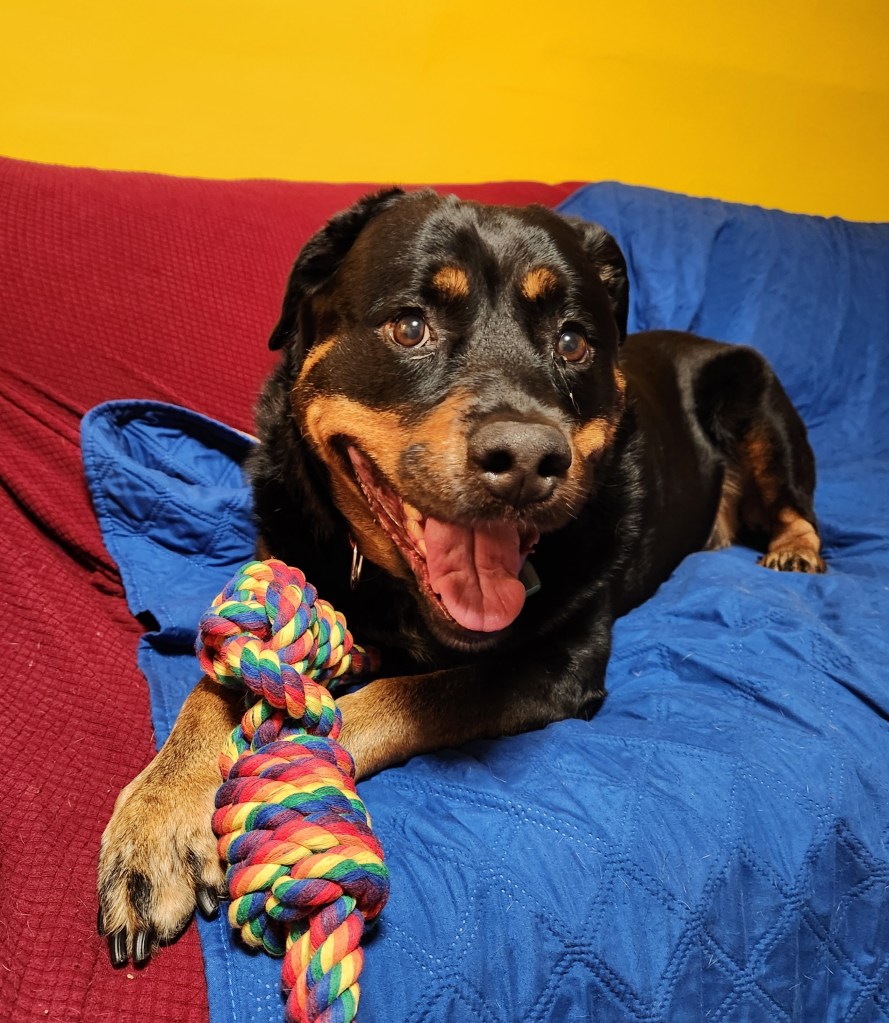
Image shows Maite lying on the couch with her rainbow pull toy between her paws. She has a big, open mouthed smile on her face. The colors are interesting (to me) because the wall behind her is yellow, the cover she is on is blue, and underneath that is the red couch. Very bright. Very Caitlin. – Martha

We’ve now been in our house for about three years.

We have the best next-door neighbor ever, “Uncle Wayne,” who calls himself the Mayor Of the Street. He is hilarious and always keeps an eye on us. Martha, in particular, knows all the dogs and their families, too.

We also hosted a block party, and now have a great sitter and walker for Maíte. So I feel like we are slowly but surely finding some community.

WRITING

This part saddens me: I have done literally NO writing. No Facebook posts, but also, for the first time in my life, I don’t have any story ideas, either. It’s super saddening. I did NaNoWriMo successfully for the first time in 2023, but flunked out midway in 2024 … and the stuff I did in 2023 wasn’t that great.

STAY TUNED

Hopefully, I can stay on this wagon and get back in the posting / writing groove! Think good thoughts for me!

If you made it this far, I shall send you e-hugs and rainbowz!