But why? Martha’s take

This weekend I recorded a video of myself singing so that I could hopefully avoid the terror and tragedy of the choir audition. I seriously despise a “solo” choir audition.

Why, oh why do choir directors require solo auditions to join the choir? I totally understand that if I wanted to do a solo, I would need to audition…alone. That makes perfect sense to me. But believe you me, I will NEVER request a solo.

Once, many years ago, the choir I was in sent a small group around to do some caroling. About 12 of us walked from shop to shop in a neighborhood that had a lot of little antique stores and sang traditional winter songs. Some were wintery, like Jingle Bells, some were more religious like Hanukkah Blessings. One of the songs was a Christmas song, which I, personally, had sung thousands of times, since I was a child. My mother watched that movie every year, had multiple records with it that she played year round. Suffice it to say, I know the song. Our director invited me to sing a solo – a single line. Twelve words. I had been singing for many years by then and I was like, well, this is my chance. I know the song well, we’ll be in a small group, I’m going to go for it! And let me tell you that when time it was time for my line, my throat just closed up! Luckily there was a lovely person in the group with us who caught it and started singing the line, and I was able to join her. When we left that first shop, she and I had a quick conversation and I told her, tearfully, that I just could not do it. She said she was happy to help and she did, but EVERY time, y’all, EVERY time I had the same sensation. Even though she was there to get me started. Even though it was very low stakes. Most of the shops only had one person in them, the person behind the counter, and they were all very gracious when we came in and sang. But I just could not do it.

I get that exact feeling when I do an audition. In the last few years I have auditioned maybe 6 times. My prepared song is one that I have sung a capella many, many times (with a group) over the course of 20 years. I know it WELL. And yet, almost every time I forget the words mid-way through. It’s not a difficult piece and my voice is, you know, decent. But I get so stressed out every time!

And besides my own extreme response – why, why do directors care what I can do on my own, without music, in an empty room? In a choir, part of what’s needed is that you blend well with other people. That you can stay on your part even if those around you are singing something else. That you can learn the music, stay with the rhythm, come in at the right time. None of that can be tested by making me stand alone and sing you a song.

Also, sight reading! I understand that it’s a useful skill, I do. But in what choir is the director going to hand out a brand new piece of music and then lead the choir out onto the stage to perform it? None that I’ve ever been in. Maybe it makes their job easier if more people get it quickly, but I have never been asked to just read it and perform it in my life (also, I get it if you are a professional singer, but these are community choirs, y’all).  

In one audition last year, someone played a riff and I sang it back. I can do that, and did. But then it turned out he wanted me to listen to 8 bars of music and sing the whole thing back on a la or doo something like that. Uh, no. My brain doesn’t work that way. And also, except for a capella singing, when will I need to do that? Give me 8 bars WITH WORDS and I would probably remember the notes. But why, oh why do I need to be able to do that to be allowed to join the choir? Will there be lots of concerts wherein there will be no time to practice and no words at all in the song? That seems extremely unlikely to me.

For all the many choir directors reading this (hahaha) please feel free to stand me with a couple of your singers (or I can bring along someone to sing with me!) and give me my part. I will happily sing out and stay on my part. Add me in with a few singers and notice how well I can blend and not overpower (unless I have the melody). Listen to how I can follow direction for pace and dynamics.

I sang in a fantastic, large choir wherein we regularly sang in mixed groups (one person from each part standing together vs all the sopranos on one end and the basses on the other end) and managed to know my part. I’m fantastic at memorizing my words. I am attentive to the director and have enough relative pitch to correct myself if necessary while singing. I am good at listening to other singers, too, and asking for help if I need it. All I want to do is sing in a group with music I find interesting and challenging. Wish me luck, y’all.

Here’s a song from Twin Cities Women’s Choir – one of my faves!

But Why?

I taught a kiddo during her third and fourth-grade years who, when asked to do something, would ask, nine out of ten times, “But WHY?”
This wasn’t always rooted in avoidance, although she is human and we were at school, so at times, it understandably was. But at other times, it was legitimate curiosity. Honest bafflement as to why I was asking her to do something which may have seemed, to her, ludicrous, repetitive, tedious, stressful … you pick the adjective. And, I mean, can you blame her? I often wonder why school asks kids to do the many things it asks them to do, in the precise way it insists they must do it.

As I mentioned in some of my Leader Dog posts, working on mobility as a thirty-something made me ask that same “But why?” question from my youth, but with added adult wisdom. And exasperation. And frustration, too, because seriously? WHY!?
I know blind folks personally who really enjoy mobility. Now, to be clear, I do feel like a handful of blind people exaggerate their skills, fake their joy, and subsequently pontificate about the importance and beauty of relentlessly independent travel to put myself and other blind mobility strugglers down. I’m not here for that. But I do actually know and believe the blind folks who cite, with genuine (and charmingly nerdy) enthusiasm, the empowerment and self-determination they enjoy when they puzzle out a new route, city, or trip in a way that feels good to them. Some folks really seem to love jetting out their front door, wandering around with their mobility tools and skills, and seeing (heh) what happens.
I get this. I don’t relate, but I understand. I can imagine that it feels awesome. I believe in that. It’s just so far from my own truth that I’m promptly brought back to my “why” question.
If it doesn’t serve me to struggle my way through a route I don’t know — to use “structured discovery,” as some call it — then why, WHY, would I put myself through it? If I could just as easily take a cab with my Para-Stranded discount, carve out the time to Para-Stranded itself and do work on the way, take Uber or Waymo, ride with a friend and buy them lunch to make up for their driving … why would I not?
I do acknowledge that I have a ton of privilege in this arena. I live in San Francisco, where Para-Transit, though always on its own timeline, is reliable and equitable, charging a flat fare (the same price as the MUNI buses) no matter where in the city you’re going. We’re offered discounted cab fares. Ubers and Waymos are plentiful. I have a sighted partner with a car who often drives and accompanies me places. These are privileges that many blind folks don’t have. Many blind folks, faced with the choice between “wing it” or “don’t go,” are caught between a rock and a hard place, and God do I feel for them. I know how lucky I am. I do. If that were my choice — if I couldn’t get rides and navigate myself to wherever I need to be in a way that works for me — I would feel horribly, terrifyingly stuck. And trapped. And bored. Because, though I’m becoming more and more introverted in my old age, and often stay home rather than go out and socialize, especially in groups or at big, noisy events, I still very much want and need to get out and do things. I often tag along with Martha on errands that have nothing to do with me, just because I like to be out and about … and to be with her, obviously. But I digress, as usual.
Let’s leave out the one very valid answer to my “But why” whining, which is the “You’ll have to do spontaneous, unplanned mobility, because someday, you might be in an area without affordable, feasible access to support, and then you’ll have to figure things out.” Very real, but not applicable to my current situation.
So, as I asked my therapist the other day, I still don’t understand: why would I, Caitlin, force myself to, essentially, self-inflict a dropoff? If, for example, an Uber driver dumps me in the wrong place and is incapable of giving me any useful information (which has happened, several times), what would I gain from pushing myself to conquer the impromptu mission independently, when I’m already in a heightened state of anxiety about the uncertainty of the situation?
When faced with this theoretical situation, I do typically walk around and try to get my bearings. But let’s be real: if someone asks me if I’d like help, I tell them where I’m trying to go and accept a guiding arm, if offered. Let’s also be real: most sighted people aren’t too great at giving clear, calm, informative, relevant verbal directions. And, I’m now learning, crossing a street in San Francisco can land you in a place you didn’t even know existed until that moment. It’s often not as simple as “cross the street at the corner,” and I’m still trying to wrap my head around the many ways street crossings can be so much more complex.
Now, might I flex and ultimately bulk up my proverbial mobility muscles by acclimating myself to the anxiety of wandering around blindly for a few extra minutes? Sure … probably. But again … WHY?
Why is it so often deemed “failure” to accept help? Why is asking for guidance not seen as a valuable tool?
Hannah and Jeffrey give me hope that this is changing. They assured me that asking for information, taking and relying heavily upon my own notes, using my phone, even getting a sighted guide out in the world are all pieces of mobility. Mobility can be, for me, whatever I want or need it to be, in any given situation. Their goal wasn’t independence; it was equipping me with skills and confidence, so I can get myself out of jams. They did that well, and I love that.
I feel more excited and hopeful about working on mobility than I ever have, in my whole life. And yet, I still don’t have a good answer to my multi-faceted “why” question.
For me — just for me, because, of course, mileage will vary for other blind folks — mobility often just feels so … hard. And scary. Tiptoeing, sometimes, toward painful, upsetting, and isolating. For me, it magnifies blindness, pun intended, if and when I think about it too much, or work at it for too long.

In rehashing the drop-off activity with my therapist, I explained that it wasn’t just the scenario itself that rattled me. It was the actual, visceral feeling the setup evoked: that close-to-tears, better-not-stand-still, tight-throated, dry-mouthed, tense-bodied, panicked feeling.
I hadn’t experienced that precise feeling since I’d done drop-offs in my youth … and the horror attached to being mired in that feeling for the first time in so long only exacerbated the feeling.
When asked about how I navigated college as a blind person, I self-deprecatingly explain that I never went anywhere alone … and I didn’t. Disability vans, classmates, a cappella friends, house-mates, sighted guides employed by the campus’s Disability Resource Center, RA’S and TA’S, student proctors and workers … you name it, I found and leaned on them.
In grad school, my dad drilled the routes to my classes with me, as well as the area of campus where I lived for a semester. I navigated independently that semester and got a great confidence boost from it. But living on-campus was too expensive, which pushed me to take Para-Transit. Negotiating their pick-ups and drop-offs on a sprawling college campus was challenging and frustrating, but I adapted.
I’ve always framed these practices as weaknesses, although, of late, I do demand, often defensively, to know why people can’t see the resourcefulness and tenacity behind them. Planning your whole life around how you’re going to get from point A to point B, perhaps especially if point A and point B are so close together that anyone would be going significantly out of their way to support you, can feel embarrassing, pathetic, and shameful. But my people were, are, and continue to be kind and understanding, by and large. I find other ways to give back and to be a good, supportive friend so that, most of the time, I don’t feel overly burdensome.
My therapist surprised me by pointing out that all my planning and scheduling and thinking ahead served a crucial purpose, albeit, perhaps, a subconscious one. It protected me from that anxiety-riddled, claustrophobic “mobility drop-off” feeling.
I had a lot of other things to be anxious about during college and grad school, even if I couldn’t have put names to all of them. On some level, maybe I knew that stacking mobility on top of that preexisting, precarious pile of struggles would have been too much. So I just … didn’t.
And now that I have some more bandwidth, and I’m working on mobility … but in my own way. And not to project independence. If perceived independence for the sighted gaze is the answer to the “why” — and, sadly, I believe it is, for many people — then it’s not MY answer.
I’m working on fostering a little more mobility confidence in service of myself, whatever that looks or feels like for me … full stop.
I appreciated my therapist so much when she pointed out, “The drop-off was just pretend, and you got through it, even if you felt that it didn’t go well. But in real life, you’ve created a system that works for you. You’ve made structures for yourself that feel good. And in real life, you’re doing well.”
I’ll be keeping that reminder close when mobility, as it inevitably does, starts to feel like too much.


Brrrring!

I don’t have games on my phone. I used to do duolingo (before the app got taken over by AI – Atrocious Imaginings) and word games before I knew the level of treachery at the New York Times, but that’s it. Total transparency – I do have insta on my phone. I know it’s also awful in many ways, but I’m far from perfect. And so when I’m on my phone, most of the time is spent messaging folks (we love a voice message around here), watching a youtube (yes, yes, there are problems there too) on how to manage some crochet thing, or reading a book. Plus I call my mom once a week or so. That’s it. My phone spends most of its time in a phone stand.

Caitlin, on the other hand, is VERY attached to her phone. She doesn’t do games either, but she nearly always has it in her hand. She reads a lot on her phone, and she has many more people to text than I do, plus scrolling, and YouTube. Then about a month ago she started using WaterMinder. She really appreciated the gamified way the app got her drinking more water. Every time the reminder splashes, we all sing out WowTER in big voices.

I admit that I give her a hard time about how much she’s on her phone. And she gives me a hard time when I don’t pick up or notice that someone has texted us. (bonus track at the end for more on that) That said, we were pretty comfortable in our two camps, phone-on-stand vs phone-in-hand.

Then a friend of ours was wondering about a gratitude app that we could use and share our gratitudes without too much pressure. Caitlin is kind (and as I said, very attached to her phone) and she went on a search. What did she find? She found Finch.

If you are not aware of this app, the website says:

“Meet your new self-care best friend! Finch is a self-care pet app that helps you feel prepared and positive, one day at a time.

At Finch, our goal is simple: to make daily self-care something you actually want to do — not something that feels like a chore.

We know that building healthy habits can be hard. Life gets busy, priorities shift, and it’s easy to put yourself last. That’s why Finch was created: to be a gentle, encouraging companion that helps you take small steps every day toward a more supported, balanced version of yourself.”

What they don’t tell you here is that there are cheerful chimes and rainbow stones you collect when you complete a goal. And with those rainbow stones you can buy outfits and furniture to decorate your birb house. That’s not a typo, that’s what Finch calls it. You can get micro-pets and bonus points for completing goals in different areas like Connection, Calm, Gratitude (yes, that’s how she found it), Movement and Self-Kindness.

So then wherever I was in the house I would hear this brrring! sound as well as various cheeps and dings. Caitlin thought it might function as the gratitude minder she was looking for and so I downloaded it too.

And guess what? They have some decent psych-science behind what they are doing. And it does work for the Gratitude Goal in that it reminds us to share a gratitude (in the app you cannot message each other – beyond sending Good Vibes that the app writes for you). It turns out the brrrring! sound is really fun (and motivating)! Our friend did a lovely job of decorating and dressing up her birb – and they even had a white-cane for Caitlin and sports headphones for me.

And nowadays if you were able to listen in at our house you’d hear laughter, Maite talking, singing and…brrring! Finching. I still don’t keep my phone quite as handy as Caitlin does, but I do pick it up just to log my goals several times a day. If you decide to join, and you know either of us, let us know so our birbs can be friends!

Image is a screenshot from Finch with Caitlin and my birbs and micropets. The background is a forest scene, green grass, trees, that kind of thing. Caitlin’s birb is on the left with her baby bat. She is holding blue pom poms, is wearing a rainbow shirt and is smiling and dancing. Her thought bubble has what looks like a scared robot. Next is my birb’s pet seal who is quite a bit larger than the bat because I didn’t know I could keep it from growing up so it reached toddler, I think. Then my birb is sitting on the ground next to the seal. My birb is wearing a multicolored striped shirt, red glasses, sporty headphones and has sideswept brown hair. Its thought bubble has a sailboat.

Bonus track: The other day Caitlin left me very early to do things with her mom, and I was supposed to take Maite to the vet. I was so tired, I fell back to sleep after she left, not my usual behavior. When I woke up, I leapt out of bed to give Maite her pre-procedure meds. Then I dressed and took her right outside for her walk so we wouldn’t be late. Back inside, I took a quick shower and got dressed. As I was pocketing my keys and wallet, I unlocked my phone for the address of the vet. Imagine my surprise when I saw multiple missed calls and texts from Caitlin. The vet had called, apparently, while I was blissfully sleeping and then tried her phone. They had to cancel Maite’s procedure and wanted to reschedule. Caitlin then proceeded to call me, text me and call our neighbor to get him to come and knock on our door (he didn’t. or if he did, he did it while we were out walking). I promise you, I would have looked at my phone before I left, but Caitlin really needed that immediate response!

Leader Dogs, Day 6: Final Day

Shout-out to my dad for reading my blog, even though he doesn’t like to read! He was like, “Wow, you really like to write!” Heh … he knows this, but must have forgotten the extent to which I can ramble.

I’m writing this as I fly home. One of my cohort is on the same flight, so we braved the airport together. More about that in a bit.

So Friday was our last day. Hannah and Jeffrey, doubtless not wanting me to worry (which I tooootally would have, so good job on their part), explained that I’d basically be doing a scaffolded dropoff. Hannah would pretend to be a clueless Uber driver. She would give me SOME useful information to locate where I was, but not a full route. Jeffrey would be with me the whole time if I needed help; I’d just need to put up a hand. Hannah would park the car and then join us.

Of course, I IMMEDIATELY started to panic. I hate hate HATE dropoffs. They are my entire worst nightmare.

Now, Jeffrey did say, at the beginning of this week, that we might do a dropoff, IF I was ready. I assume that scaffolding the dropoff was their way of acknowledging my absolute terror and hatred of the activity. But I think, in my head, I assumed they’d do more of a, “Remember that route we did once or twice? Yeah, do that by yourself.”

But, in hindsight, I also think they wanted the route to go well, so I’d feel more confident going home. I could have told them that that was unlikely to happen.

Still, when they proposed the dropoff, I thought to myself, “Well, I’m here, and they’ll be there the whole time … the worst thing that happens is that I panic in the middle and fail.”

They also impressed upon me, in the car, that they wanted me to do my best and push through the discomfort, as much as I could. In just a few days, they don’t know me well enough to know that I rarely give up in the middle, even with things I hate. I mean, okay, with certain people, I’ll just give up and let them help me. But with other things, my pride gets involved, and I don’t want to be seen asking for help, no matter what.

Anyway, my destination was a pharmacy. I had the address. Hannah The Uber Driver gave me some pretendedly-vague directions re: what street she “thought” we’d just passed (“So pharmacy might be behind us”), what street we were on now, and what was around (“There’s an alleyway to the left, and a sidewalk to the right”), etc.

But when I asked, “So when I get out of the car, which direction should I go?” or “Do you have any idea where X street is?”, she demurred.

I hissed to Jeffrey, “What else can I ask her?”

He kind of chuckled and was like, “She just gave you a lot of good information there.”

Well, probably she had … if I was the sort of person who could, you know, hold that in my head and mental-map … while panicking.

So I was kind of upset right from the get-go and was like, “Well, okay, I’ll just … do my best.”

What a horrible feeling (for me) this kind of situation is. I seriously can’t even begin to describe it. At least here, in Michigan, it was nice and quiet, without all the hustle and bustle and terrible racket of San Francisco. But still, my throat and mouth go all dry, I feel like I’m going to cry, and all I want to do is grab the nearest person and just ask them to either guide me to where I need to be or put me in front of a destination so I can get an Uber there.

Again, I’m not ashamed to admit it … but I totally am. And I feel completely compelled to all capitalistically be like, “Whatever, I spent the last ten years of my life fighting tooth and nail to get and keep the job I wanted … what have YOU done with your life?” Which, I know, isn’t even helpful. But I still want to make all kinds of justifications about how mobility never felt accessible or relevant to me, and how can people expect me to do something that makes me feel so fundamentally terrible and unsafe, etc. etc.

Anyway, back to the moment. I don’t even remember all the things that happened. I think first, I just … walked. Now, even as I did that, I knew — I totally knew! — that the right thing to do would have been to stop, think, and try to plan. But I was just like, “How am I supposed to plan when I literally have no idea what to do?”

Now, we were on familiar streets, let me name that. There’s a grid system, and then there are numbered streets, streets with tree names, etc. So all of that was familiar to me. We’d worked with those things. And I quote “should” have been able to do something with that information. But I just … could not. I couldn’t at all take the information Hannah had given me, apply it to what I already knew, and then extrapolate from there to figure out where I ought to head. So I was, quite literally, just “walking blind.”

I think my first plan was to ask someone for directions … but, of course, no one was around. I hit a couple of driveways, didn’t know if they were streets or not, and pulled out SIRI for walking directions. She, of course, was only moderately helpful, but did indicate (sort of) that I was going in the right direction. So I kept going.

Jeffrey, I might add, was right behind me, thank God. And he did talk to me, double thank God. If he’d done the whole, “I’m silently walking ten feet behind you … or am I?” thing, I would have lost my entire shit right there. But he didn’t, because I’d already told them, at the beginning of the week, how I cannot abide that.

Next, I think, was when I ran into (or rather aggressively pursued) some construction workers. This took me off my line of travel, but I didn’t care. As it turned out, they were clueless and didn’t know where the place was, but gave me their best guess. I turned around and went their way (which, thankfully, wound up being correct).

Jeffrey also let me know, at that point, that I was walking in the street.

Me (frustrated): They should have told me that! … Although I guess that’s not what I asked, but still!

They had also told me to cross at the next corner. SIRI told me something different, but I ignored her because (a) I wasn’t convinced she was giving good or particularly accessible walking directions anyway, (b) she said something like “turn right on X street,” and I didn’t know if that was the street I was on, and (c) again, it just seemed more … safe to just keep going and act like I knew what I was doing, even though I knew in my head that that was the opposite of helpful.

I know everyone always says to slow down, stand still, and think … but in the city, you CANNOT do that without everyone swooping down on you, pushing and pulling, and offering help, whether or not you need it.

People are ALSO always saying, “Look confident! Look like you know what you’re doing! Don’t hesitate, or people will mess with you!” I knew Jeffrey was right there and nothing was going to happen to me, but I just felt like I was in total Fight And Flight mode and couldn’t just stop and think.

Anyway, I had no idea what to do. So it wasn’t like I had anything I could pause and think about.

So, I crossed that street and was like, “Ooh, maybe they made this REALLY easy for me and the pharmacy’s right here!”

I blazed up the first staircase I found, which had one of those cloth things hanging at knee-height over its doorway, indicating it was closed. So, undaunted and still hopeful (and ridiculous), I blazed back down the steps and was about ready to ask at the NEXT building when Jeffrey was like, his… I’m gonna pause you right here, friend.”

He and Hannah very kindly talked me through what had happened so far, praised my good arc and my crossings, and whatever other kind things they could think of. They also gave me a couple hints. I was SUPER close to tears by then, but (of course, because I’m me), I acted like I wasn’t and just kept going.

I think I crossed a few more streets (nothing big, just all-quiet all-clears), then ran into some people who were eating outside. They knew where the pharmacy was and confirmed that I was going in the right direction, which amped me up a little.

I kind of forget how everything ended. I seem to recall that I had to cross a bigger street (like, with a stop sign or light), and was appalled that they’d make me do that for a dropoff, haha. But now that I think about it, I seriously don’t remember lining up for and crossing it. Oh, well, whatever, you got the highlights of the thing.

The point is, I got to the pharmacy, with their help.
Again, I was still mega-tearful. Jeffrey, perhaps deducing this, didn’t talk about the dropoff at all but, instead, answered one of my questions from earlier by teaching me an abbreviated cane technique to use in crowded stores. I’ve always just choked waaaay up on my cane, but Jeffrey advised using a pencil-grip. I asked if there was an alternative, because pencil-grip has always been really hard for me to maintain; it feels really unsustainable and makes my fingers hurt almost immediately. Hannah showed me that, instead, I can tuck the top of the cane under my arm, or farther back, more like against my ribs, and then use my standard grip along the shaft, below the handle. That worked really well.

Jeffrey showed me all around the store and had me follow him using this technique. This meant that he was able to steer me around pharmacy junk. He was also telling me all about random things in the store, and I was thinking to myself, “Wait, is this being videoed for his portfolio?” Because he’d also told me, earlier, he still needed videos for his class, and would I mind helping, and I’d said sure. But he’d said we’d do that AFTER the dropoff. So now, in hindsight, I think he was randomly going into vivid detail about the store so I could pull myself together and get my bearings.

Back outside, they had me cross the street again so we could get back to the van. (Again, mind-blowing to me that they don’t just default to, “You’ve just been through a tremendous ordeal; do you want human guide?” But I liked that! I rose to the occasion! Because I COULD do it, with their guidance, and it felt like it gave me some of my confidence back.

Jeffrey did help me a little, although now I can’t remember how … I think just because I was still a little flustered.

At the van, I was just blithely like, “Okay, now we’re going to do sidewalkless technique and your video, right!?” Again, classic Caitlin, to the tune of, “Can we please not talk about this!?”

Jeffrey was like, “One thing first,” and then gave such a sweet little speech about how much he appreciated my courage in doing something I hated, and something I hadn’t done in twenty years. Again, he praised my arc, and said my crossings were great. Hannah echoed him, adding that, even though I’d thought I didn’t know anything useful, there were a few clues I could have used. For example, since we’d been there multiple times this week, I knew that the street the pharmacy was on would be very loud. So, in a few places, I could have listened for a loud street, figured out where the noise was coming from, and made more correct, timely turns than I did. (She said it WAY more kindly than I’m writing it.)

They also did tell me, as I’d known they would, that it behooves us to slow down and make a plan, not just run amuck and not listen to SIRI (again, they said it much more kindly). They also named that my focus seemed to be to hop from one person to another, rather than listening to my own internal sense of direction, or even to SIRI which, they said, did give me correct directions that one time. They said they could tell, a few times, by my body language, that I wanted to go with Option A, but then I second-guessed and went with Option B, when Option A was right.

I think this was actually two conversations: one was IN the Pharmacy, and then Jeffrey stopped me before getting into the van to give me more of the Pump-Up Version, re: “There were many positives you can take away from this experience — many things you did well — and you have a lot to be proud of. I don’t want you to go home and beat yourself up over how this went.”

Of course, again, when anyone is kind to me and I feel fragile and upset, I’m just … a wreck, so I just kind of nodded along. I wasn’t about to beat myself up over how this had gone because, in my mind, there was no way it would have gone any differently than how it did, even with the scaffolding of them nearby and an easy, immediate out, if I’d needed it.

This isn’t to say that I don’t think I could EVER do a dropoff. But I know myself and my skills right now, and unless I know the route, or at least a piece of it, I’m not going to figure it out. Even given street names in a familiar area, I just have such a hard time being able to piece things together and put them into a map. I’ve never had anything even resembling a mental map in my head. The best I can do is write and follow a list of detailed directions: my own, non-image-based map. So unless it’s on my proverbial map — unless I’m familiar with enough elements of it to figure out where a thing lands on my “list-map” — I’m not going to find it. At least, not at this stage.

Still, I appreciated that Hannah and Jeffrey were being so kind, and that they’d had enough faith in me to try this. I truly know and believe that they were doing their best to set me up for success, and that, after only four days of working with me, it would have been impossible to gauge if I was just being self-deprecating when I said I could not do dropoffs. I can understand how some of the things I’m able to do might make me seem like more of a capable, competent traveler than I am … and that’s not me putting myself down. I think I have good spatial sense, and that I got a lot better at crossings and technique this week. But a “structured discovery model,” as many folks call it, just has not worked well for me. And because it was always forced on me, I think being thrust back into that (to me) horrible scenario, even with guardrails and kindness, was really activating.

For Jeffrey’s video, we did some work in an area without sidewalks. I vaguely remembered this from guide dog school; you do a thing called “indenting,” where you follow the sidewalk as it turns, then gauge when it has straightened out and then flag and cross.

Knowing how I always love when my kids do something epic while I’m videoing for evaluation, I asked Jeffrey a bunch of questions, like a nerdy, attentive student (which, in many ways, I am). They were questions I genuinely wanted to know the answers to, but I also knew they’d give him extra time to shine in his video, haha. The benefits of having a student who’s also a teacher in your video!

Also, though not on his video, Jeffrey told me the mnemonic for sidewalkless crossings is, “Ass in the grass,” which made me laugh. (As in, you square off with the grass behind you in order to cross, so, you know, ass in the grass.)

I also cited, for the record, as I had a couple of times before, that I still get completely confused after multiple street-crossings or cross-overs and lose total track of the direction in which I ought to be traveling. Jeffrey reminded me about using the sun as a marker when available, plus listening to parallel traffic and other clues, to get back to my line of travel.

We went back to the main building for our outtake (opposite of intake) interview.

First, I rated myself on various mobility skills, like I did at the beginning of the week; then Jeffrey added up the total. I was shocked that my score had gone from 13 out of 30 at the beginning of the week, to 21 out of 30 now. Jeffrey even said he would have given me more points on a couple items than I gave myself, and Hannah agreed that I’m more critical of my skills than she might have been, if asked to rate me. So that was genuinely nice and uplifting. If nothing else, I think I’ve gained a lot of confidence moving through space solo, and really, truly polished my cane techniques.

We also went through my list of goals; it turned out that we’d worked on almost all of them. Jeffrey definitely talked about stop signs versus stop lights versus controls; that’s always been something difficult for me to analyze by sound at an unfamiliar intersection, and because we were working on so many other things, I didn’t think to ask more clarifying questions and be more intentional about learning it.

Around about this time, Jeffrey mentioned the dropoff again, citing that it had been such a long time since I’d done something like that. For whatever reason, I started trying to remember precisely how long it had been since I’d jaunted off somewhere by myself without family, friends, a driver, or someone immediately to hand, even if it was a stranger, who could help me. That got me remembering when I first got to college at UCSC.

Even though I was terrified to be away from home, with no one I knew, I was also bold. I went off to events, not knowing where they (, who’d be there, or, sometimes, even how I’d get home. I went to the dining hall, where I depended on the staff to help me get food (which was awful because … feeding Caitlin is an art form), and sat either alone, hoping someone would come sit with me, or with randoms.

I had Lannie for some of that, but I was also realizing that the cane might serve me better, and because he had to go home sometimes for a cappella things I didn’t want to bring him to, I did do a lot of that with my cane.


CONTENT WARNING: Non-graphic mention of assault below. Skip to the next three stars, or use Find for the word “somehow,” if you need to skip.

I was thinking about all that and realized the inevitable: that when I was sexually assaulted (though not violently) in November of my freshman year of college, by someone I thought I was a friend, my mobility confidence took a big hit. Not that the assault happened while I was out and about — it happened in my room — but I became so much more sensitive to being grabbed, pulled, and just SEEN, after that. I relied SO MUCH on Acquire and classmates to be my buffers, to keep me insulated from strangers and their unsolicited grabbing and “help.”

I couldn’t tolerate the risk that someone would grab or touch me unexpectedly, and it happened SO MUCH. It still does. People are often surprised, because I was and am such a touchy-feely person, but when I was raw and mentally frightened like that, I would lash out at people, sometimes even hit them, when they put hands on me unexpectedly. And I know that people who grab blind folks without consent DESERVE to get hit. But I don’t like feeling volatile like that. And I hate who I became after that even more: a person who, when alone, walks around tense and on-guard, and is much more likely to freeze and just let people haul me around.

It truly can feel like being constantly retraumatized, constantly reminded that my body isn’t mine, that I have little to no control over what happens to it. The most foolproof solution, then, was never to put myself in the position where I’d be overwhelmed with all those feelings, and reminded of the vulnerability that often runs hand-in-hand with blindness. That meant not taking chances, not doing mobility solo, not moving through space alone without someone to run block.


Somehow, all of this was running through one side of my brain while I was still keeping up with Jeffrey and Hannah and genuinely absorbing what we were talking about re: mobility this week. But at some point, all the thoughts just became really overwhelming.

The only words I could get out were, “I know a lot of it is all in my head.”

What I meant by that is that so many people have told me that, actually, I’m good at mobility. I have the skills. I even have the confidence, to some degree.

I know they’re right, that my fear and dread are in my head, that I CAN do it. I just don’t WANT to do it. At times, I feel like I can’t do it, like it’s just too raw and scary to be in the world alone especially presenting as I do: young, female, and disabled. Because, if two people who I thought were friends took physical advantage of my trust and vulnerability — and they did — then how am I supposed to have faith that the rest of the world will be kind?

Some days, I can, and I do. But on other days, and in some situations, especially when I feel powerless and like I don’t know what to do, I just … can’t. And maybe, if I wanted to work and work and work on it, I could force myself to do better and feel better. But I just don’t know if I want to.

This is why I get so mad when people, blind and sighted, say things like, “If you don’t have all the skills, you won’t get anywhere in life as a blind person.”

First of all, being successful can look like a million different things. And so can mobility. I’ve gone to conferences by myself, without knowing anyone. I’ve flown by myself countless times. I’ve taken the bus from San Francisco to LA. I get to my job every day, sometimes with Martha and sometimes on Para-Stranded. When I need to get there, I make it happen.

I can find my way just about anywhere I want to go. And I’ve done all that while doing my best to keep myself feeling secure and comfortable. Even if it means extra time on Para-Transit, extra planning, extra creative thinking, I’ve done it … and I don’t mind doing it, because that works best for me. And I think innovation and ingenuity ought to be worth just as much as always doing mobility, quote, “independently.”

My choices are respected to some people, but many others can (and do, often to my face) scoff, shake their heads, and tell me I’m not doing blindness right, or respectably, and that I’ll essentially grow up someday and “see” the error of my ways. But truly, now, I don’t care about that … at least, most of the time, I don’t.

My number one job in life is to preserve my own sanity. That doesn’t mean I won’t ever push myself, try new things. Clearly, I’m willing to push myself. If I weren’t, I never would have done this program. Even five years ago, I never would have done this program.

I wanted to be better, to do better, and I did. But I think I also still need to make peace with the fact that mobility is tangled up in a lot of really upsetting things for me: things I never really worked on, or brought to therapy, because there always seems to be so much else going on … and, yes, probably just because I don’t want to talk about them.

Anyway, since all I could get out was, “I know it’s all in my head,” Jeffrey and Hannah did what they could to speak to that. I think they thought I meant that I let other people’s voices influence me, and that people discourage me or don’t believe I can do things. Which is funny, because, actually, it’s completely the opposite. People are always telling me (some kindly, and some in a Blind Police-like way), that I have the skills to be better, and that it’s just will, not skill, holding me back. I can’t, off the top of my head, think of anyone of note, who knows me well, who doubts my capabilities. And I know I’m lucky to have that. I am. But it also means that, often, I worry that I’m falling short, that I’m disappointing people.

So yeah, it was heavy, and a few tears sneaked out … but of course I wasn’t about to go into all of this and open up a whole therapy session nobody signed up for.

Okay, on to the lighter stuff.

We worked together to set three goals for the next thirty days, at which point Hannah will call me to check in. Jeffrey The Best Intern Ever will be off on his next adventure, but Hannah did say she’d share my progress with him.

CAITLIN’S THIRTY-DAY GOALS

1: Plan a route with at least one crossing.

I know myself; if I could get away with it, I’d do a route without a crossing. But I’m challenging myself. SEE!?

My hope is, perhaps, to Para-Strand or cab to Destination A, hang there, then learn a route to another high-interest place, Destination B, that’s technically walkable from A, but which I’d typically take another cab to get to, if I were by myself, to avoid a solo route. Like, say I go to a restaurant I like, and then want to pop across the street to a Walgreens to get something. That would be perfect, and would avoid a one-minute Uber ride.

I’m crossing my fingers that Martha can think of a reasonable, high-interest scenario that doesn’t have too many terrifying street crossings between the two destinations. If I get really used to it, I do think that’s one thing I could do by myself, with a ride on each end. But I’d want to run it a time or two first.

2: Go to the beach or on a short hike, using my new Dakota disc and Jumbo Roller-Ball tip, to see which works best when.

I’m hoping Martha will be excited for this, because she loves to hike, and I’ve hitherto been whining that it’s boring. But I’ll have more fun if I can play with my new tips and do some solo walking to practice my skillzzzz!

3: Use Para-Transit to get to the mall; then, plan and perform a route to two stores.

— I seem to recall that Para-Transit usually has a designated entrance and pickup spot for our malls, which will actually be helpful as a home base for planning a route.

Martha’s allowed to help me with this one. Actually, I assume she’s allowed to help me with all of them. But I quibbled this one a bit, because I think it will take me longer to learn routes in the mall, with all its hustle and bustle and ruckus. Jeffrey said that planning and performing the route can happen at the same time, with or without any type of guidance. I’m down with that.

After outtake, I got a Leader Dog sticker for my cane (Hannah said it was the best job she’s ever done re: sticking it onto a skinny cane without getting bubbles in it), and Jeffrey gave me my own Dakota disk. Yay!

Then I went back to my room, had a good little cry to Martha and our friend Amy on Signal, and went to our last lunch. It was bittersweet because one of our cohort lives in Michigan, so was being picked up right after the graduation ceremony. So it was our last time partying down as a fivesome.

The graduation event was very sweet. They had it in the Banquet Room, with fancy tablecloths and those cool scallop-edged paper placemats I was obsessed with as a kid (okay, I still think scallop-edged paper is cool). One of our cohort pointed out to me that they were gilt-edged; you could feel the shiny goldness at the edges of the scallops, too!

The ceremony itself was quick. Lots of accolades from the instructor who ran it re: our bravery for coming so far, for pushing ourselves, and for being dedicated to making our mobility skills better. Most of us said a few words, and a couple of our cohort cutely cried (yay for feeling emotions in public! I need to learn from those folks.)

All our names were announced, and we each got a Leader Dog pin on a graduation card.

I vividly remember how pathetic my speech was when I graduated with Lanniekins (I was too overwhelmed with feels to speak eloquently), so I fully intended not to give a speech this time. But since we were all sitting at a table, and I wouldn’t have to get up and be awkward, I did give a little speech (we all did), expressing how proud I was of our cohort, how neat it was to hear everyone’s stories, and how I’ll definitely be telling all of blindkind about this program, its top-notch instructors, and the way this program truly treats us as individuals and enables us to work on our own unique goals, rather than some cookie-cutter model of what we “should” learn and “should” be doing.

Craig from the kitchen made me another chocolate-syrup-with-a-dash-of-vanilla sundae, and I’d brought my dark Oreos to crumble into it, much to everyone’s amusement. Everyone else had Italian sodas and various other snackies, and we took a group picture. I took a pic with Hannah and Jeffrey, too, and gave them each a big old squeezy Caitlin-hug before they left. I couldn’t believe how much I’d come to like and trust them over the week. I mean, they’re mobility teachers! (Kidding, kidding.) But seriously, it was very hard to say goodbye to them without breaking down.

Then we had delicious pork for dinner (it was soooo tender and juicy, and had little fat pockets throughout, plus yummy seasoning and crispy edges … I think it was my favorite meal there … even better than the sirloin steak, which tasted too smoky for me). Then I talked to my mom and Martha and, you know, did my Finch app before going to bed at 8:30, because I and my buddy Bill had to leave at 5:15 to catch our 8:45 flight.

Even though I gave my leftover snacks to the college kid in our cohort, I still had a job squeezing everything into my huge backpack. I’m not a good packer, especially when I’m impatient and can’t be bothered, so I’m sure I didn’t do myself any favors. But I got it all in. We had a driver and a driver-in-training from a contract company, so not a Leader Dog volunteer, but they were both lovely and so kind. I’d just been decrying my hatred of airport people’s insistence on putting blind folks in wheelchairs when we don’t need them, but I conceded to do it this time, because it would help Bill and me stick to together.

Remember the annoying guy who walked me off the plane when I got here? The one who was complaining about how heavy my backpack was (even though I offered to carry it) and whined about not getting any tips all day? I even tried to be funny and be like, “You should get a FitBit and give yourself a daily challenge! That might make it more fun!” and he was like, “No, I just want someone to buy me a FitBit as a tip.” Weak.

Well, the people Bill and I had were even worse! There were two of them, each pushing a chair, and they were sooo rude and ableist. They were complaining to each other about how much they hated their jobs, how to cheat the system so you can get sick days when you really just don’t feel like coming to work, how they want more tips, how their bosses were all trash, etc. They were even saying how much they hate having to help people with aisle chairs, which is SO unkind! Like, did they just think we couldn’t hear? And, again, I’m at their mercy, so I didn’t feel like I could confront them. The guy kept saying, “I’m not even trying to be offensive …” But bro, you ARE offensive! This whole conversation is offensive! I was just glad Bill and I have been dealing with this stuff forever, so we weren’t hurt or upset by their asshattery, but a person newer to blindness might really have been impacted, especially because it’s such a rude awakening coming from Leader to the airport and coming back to the real-world.

Oh, also, there was this gem:

Me: Could you all please keep an eye out for a family bathroom?

Girl (to Guy): Does she have to go to the bathroom?

What the heck?

Anyway, we shook them off at the gate (or, rather, they ditched out immediately as soon as we didn’t tip them), and we got great directions from some other guy (with a clockface! he knew his stuff!) to the security desk, and got seats together.

Now, Bill is very patiently sitting here while I frantically blog, and in between, we’re chatting about odds and ends. Also, Bill says to add that I forgot the peanut-butter sandwich Leader packed for me. I totally did forget it; it wouldn’t fit in my backpack. I was gonna carry it along, but then I forgot to snag it!

But now, I’ll go be a good neighbor and chat with Bill some more.

Squeeee, I will be reunited with my Martha and my Maíte soooo sooooon! I may never un-hug them! This was the longest I’VE left home, abandoning them behind me.

Thank you all SO MUCH for following along my journey. Here’s hoping I can continue blogging and don’t fall off the wagon again!

Remember to subscriiiiibe if you haven’t!

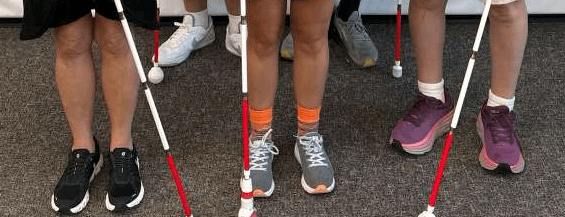
Image shows Caitlin and her O&M cohort – from about the knees down. In the front row are three pairs of tennis shoes, black, blue and purple and three white canes. In the back row are two more pairs of tennis shoes and two more white canes. The back left cane has a spherical tip, the back right has a marshmellow tip. Although the image doesn’t show their faces, I’m certain they all look proud and accomplished. :)

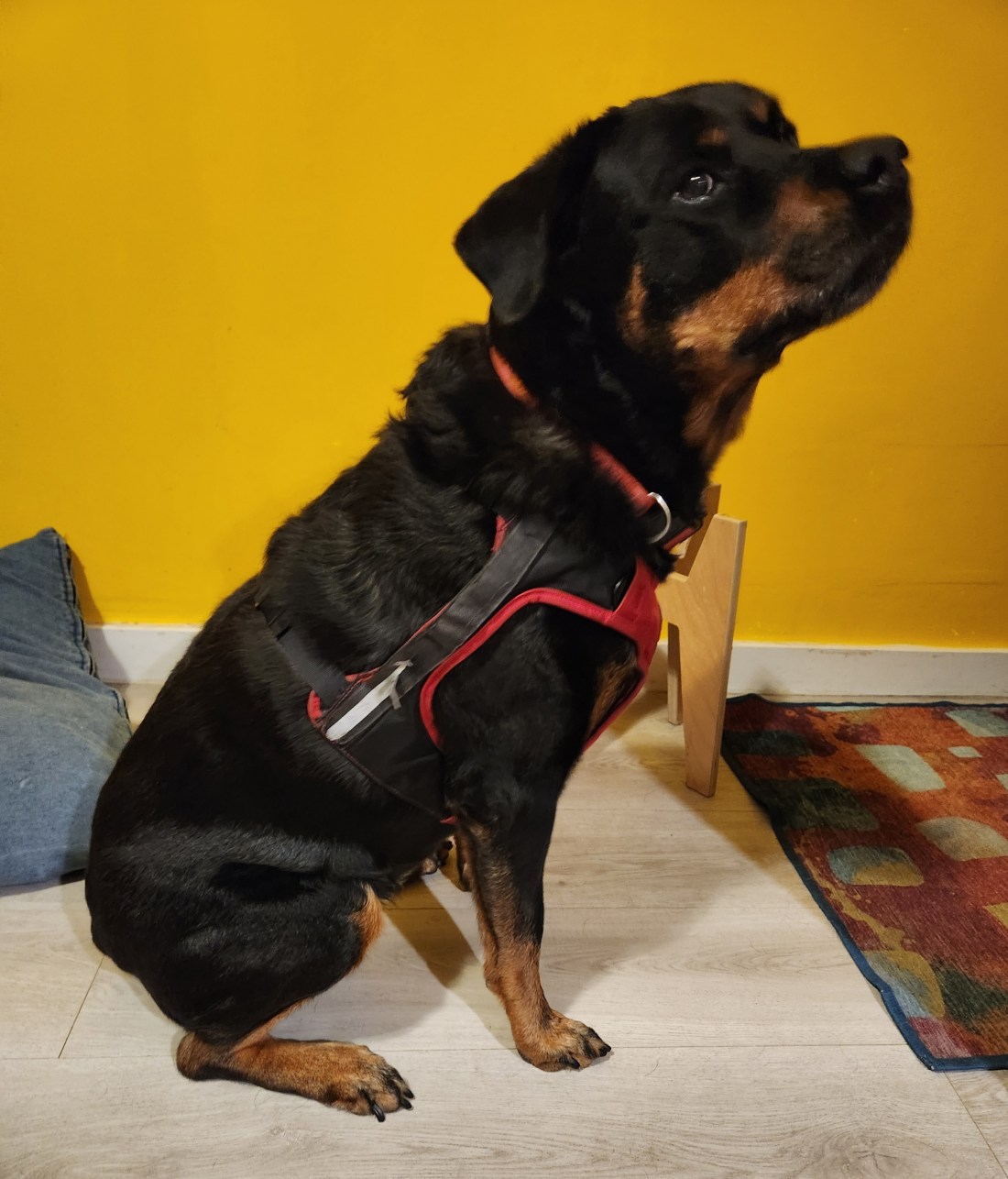
I’m ready!

Total transparency: I love reading her posts, but I’d just as soon as she came home now. :)

When we were getting ready for Caitlin to leave, I was like, “I’m going to record a million videos!” To her credit she was not immediately irritated that I was blaming her for my lack of videos lately, instead she said something supportive like, “Oh, you like that!”

I am NOT blaming her for my lack of videos, but you know, since she’s on summer break, she’s…around! During the school year, I’m sitting in my office, doing my things, and if I have a break, I might doodle around and end up making a video. Or at least thinking about one. But when she’s on break, I’d rather come out and see what she’s up to. We like to eat lunch together, even though we eat very different meals. We like to walk the Maite together, or get in the hot tub. It’s not like I’m not working, or getting work done, but the very real space and energy that goes into writing/creating something isn’t happening. Even writing this and my other post – I think in part that is happening because she isn’t here. Which is a little sad but also worth knowing.

ANYway, y’all will not be surprised to learn that I did NOT, in fact, record a million videos. Or even one. A friend of mine predicted this, saying that when her family left 2 days before her on a trip, she also thought she would get a lot done. Instead, she spent her time sort of spacing out, wandering around the house (not the whole time, obviously). I was like, No, that won’t happen to me. Because I’m humble.

Then leaving choir rehearsal (which can I just say I was SOOOO tired after a migraine today and spending too much time in traffic, I still went because it’s so fun to sing with people again!) I really wanted to debrief with Caitlin. Only she wasn’t there. So I decided I’d send her a schedule-sent Signal when I got home. Then I pulled into the garage and checked to see if she had been online recently. I didn’t really expect it given the time difference and ALL THAT WORK she is doing, but I checked anyway. While I was checking, I momentarily forgot she was gone (I know, I know, that seems ludicrious, but I am telling the honest truth) and thought, I better get upstairs because she and Maite are waiting for me… then remembered that Caitlin is gone.

Yeah, I’m ready for her to be home.

Leader Dogs, Day 5

Shout-out to my therapist for exhaustively reading this entire blog and making notes on all the reasons she’s proud of me, all the times she laughed, all the things she took the time to search up, and all the things we could talk about in future. She is truly the best, and I adore her and appreciate her beyond words.

Today for breakfast, I got a choco-chip muffin, and Jeffrey encouraged me (kindly) to try quinoa chocolate bark. Apparently, I tried this before, with Martha, on airplanes! But this one was homemade by the chef, and it was way tastier. It was a similar taste and texture to those chocolate / espresso coffee beans I used to snarf from Trader Joe’s: chocolatey and bitter and kinda … gritty. Shocking that I liked it, but I did!

Hannah had meetings, so Jeffrey and I did a quick route-plan, then reviewed and practiced a lot of the key take-aways from yesterday.

* I think I forgot to write yesterday that I’d somehow never really computed that we line ourselves up to cross along the inner curb because the traffic is closer to the outer curb. I mean, I guess I knew that … but not in those exact words. Necessarily. So you just listen to which side your traffic’s on, and then focus on the inner curb accordingly. MAGIC HACKS!

* This one took Jeffrey a couple tries to explain. When and if I veer while crossing a street, and my cane bumps a full curb on a left angle, that most likely means that, when I Go Go Gadget, the up-curb will be on my right, and vice versa. This may not always be true, but is a good place to start. We also talked about doing Go Go Gadget arm minimally at first, then extending farther on each side if I don’t immediately find something. If I go big first, I might miss the domes, since they’re often much closer than I think (IE, the veer is often not that big).

* Again, we practiced not moving my feet when I find the domes and using the traffic to check alignment on more simple crossing. For more complex crossings, I first line up with my shoulder lined up to the APS pole (we went from forearm to hand to shoulder because I am me and need Caitlin-specific choreography). Then, once I’m lined up with the pole, I use the traffic to confirm. This freaked me out a little because I’m usually not on the domes! I just have to trust the surge to guide me! I could also edge forward a LITTLE toward the domes, but carefully, so I don’t lose the magical position!

* Jeffrey reminded me again that it’s okay to wait until I get a parallel surge that I like. It’s okay to wait, take my time, and listen to one or more cycles to ascertain what’s going on and to make sure I’m lined up right.

* We also practiced using the traffic to get back on, or maintain, our line of travel. I always knew about this, but didn’t think as much about it in terms of avoiding sidewalk junk. Jeffrey pointed out that, typically, you get around sidewalk junk most safely by moving AWAY from the traffic. Maybe that should have been obvious, but, again, I just never thought about it that way.

* In terms of parallel surges, we talked about “The Golden Goose” surge, where the cars aren’t just tearing up to the intersection and passing through, but have been waiting for their turn, and are accelerating. This is complicated by the fact that (a) a lot of new cars idle very quietly, causing me to think no one is waiting and that they might be a new arrival, rather than an accelerator, and (b) in busy intersections or areas with lots of noise, it can be hard (for me, anyway) to differentiate.

* Funny moment:

Me: This car’s waiting for me, huh? But I want my all-quiet, all-clear.

Jeffrey: Right. What can you do to encourage him to move on? (Without thinking, I whirled around and pulled up my cane, acting like I was going to leave.)

Jeffrey: Ahh, don’t move those feet!

Me: Ahhh, I forgot!

Jeffrey: Look down or look away, but don’t move those feet.

Me: Should I look, you know, in the opposite direction? Or in their direction, so they know that I know they’re there?

Jeffrey: I think “nose to ground” is a good reminder.

After our water break back at the downtown lounge, we spent some more time with the Wheatley boards. Those are the big felt-covered boards with plastic strips for streets, blocks for intersections, little squares with bumps for truncated domes, little cars and people, etc. These can be velcroed in whatever place you want, to build intersections, simulate crossings and movement of pedestrians and cars, etc. It really seems like an art form to me when these instructors just built complex intersections in a trice.

We did a review of complex lighted intersections. Like with yesterday, Jeffrey took the time to explain things like lanes, different scenarios, being careful about cars that might turn unexpectedly and what can be done, etc.

We then did a quick walk to a complex intersection. It sounded SO wild, but Jeffrey made it clear that we were just going to listen, not cross. He wanted me to be able to hear it in person after we’d simulated and discussed it with the board. Hannah was also able to join us on this leg of the journey, which was great, because she and Jeffrey often tag-team and riff off each other with extra tips, ideas, suggestions, and noticings.

After lunch, we went to the mall, because I’d asked for techniques for the mall, stores, etc.

Best line:

Jeffrey (as Hannah cranks some music): Is this that song y’all were singing earlier? “Lifestyle Of Evan Williams?”

Me: Ahahahahahaha!

Jeffrey: Something about … Dean Williams?

Hannah: “Dear Evan Hansen.”

Jeffrey: Oh, is that what it was?

Me: My dad calls it “Dear Evan Handsome,” if that helps.

In the mall, we talked about using sounds as markers, which sounds like a good idea until you think about all the competing sounds in malls: fountains, mall music, people talking, echoes, music coming from individual stores, etc. Now that I look at it, that list actually doesn’t seem that intense, but it all adds up and becomes a lot. We practiced escalators and went up to Nordstroms. I was going to try soliciting verbal directions to the bathroom from a salesperson, but some customer who reminded me uncannily of my mom was taking forever and a day at the counter.

Me: Can you just pretend to be a stranger and I’ll practice with you?

Jeffrey (turning into his alter-ego, Joffrey The Boy King from Game of Thrones, which he’d told me about): Helloooo, madam, can I … (sketchily) help you?

Hannah (amused): Oh, no …

Me (trying to stay in Caitlin character): Can you please give me verbal directions to the women’s bathroom?

Joffrey (sinisterly): Yes. I’d loooove to. (breaking character) Okay, no, that got creepy.

Me: Ahahaha it was great.

Jeffrey: Okay, Joffrey’s gone, I’m back.

Hannah and I also practiced bathroom tips, but their Nordstroms bathroom was waaaay more straightforward and chill than ours. Still, good notes: try to stick with one wall at a time (not just flail around and go in wild circles, like I frequently do, in search of the stalls); trail the walls with the back of a hand; be mindful that sinks may stick out; etc.

Jeffrey also showed me one of those enormous marbles that rolls around and around in water. I can’t explain it now, but Martha showed me one at the county fair. They’re so wild!

We also talked about how malls seem totally, ridiculously insurmountable to me, but I could pick out a couple of stores and plan a route beforehand. And because they are cool, Hannah and Jeffry reiterated that human guide is a tool in my toolbox! So if I want to do that — if that makes the most sense, like if I just want to browse a mall and not get hung up on every single piece of mall junk — that’s an option.

Hannah also noted that many malls open before the actual stores open, and that would be an ideal time to practice, map out routes, etc., like when I used to practice my routes for school in the summer, or after school. Much easier to learn the route without people swarming everywhere.

On the drives to and from, we talked about odds and ends, from why I became a SpEd teacher, to my attempts to find something noise-canceling that doesn’t make my hearing feel weirdly occluded, to their experiences doing extensive training under blindfold. One of the ladies in our cohort also did a route with a blindfold and poignantly said to me, “I have so much respect for you, Caitlin, because my blindfold comes off, and yours doesn’t.” My “best straight guy friend,” Mitch, from college, said something similar after he did a Dining In The Dark-type simulation, and it really just warms my heart when people empathize in that way. I know people have big feelings about simulations, but when they’re paired with training, education, and-or exposure, as in these cases, I really do think they have their place, teaching empathy but not pity.

I was going to take a nap, but one of our crew texted our thread and told us there was ice cream in the piano lounge, and another told me there was an Oreo-type thing that I’d probably like … and she was right! At dinner, Jeffrey delivered my mail: a brailled letter from Martha (and Maite). Soooo cuuuute! I may or may not have gushed and bragged a bit about how sweet and brilliant she is. Everyone was properly touched.

We had fun chats about favorite desserts and adventures of the day, and I told the group that I, very suddenly, felt a huge influx of big feelings about leaving. I was a wreck after leaving guide dog school because I’d bonded so much with the cohort. And when I left LA after the “Dreaming In Color” summer, I was more sad than I think I’ve ever been in my life. For weeks! I cited that it’s not just about leaving the people and the, like, vibes, which is hard enough; it’s also about leaving a world that feels built for us, where blindness and visual impairment is normal, where we’re understood, respected, and treated well. It can feel very hard to leave that, especially when there are stressors at home, and when you feel some anxiety about preserving and keeping up what you’ve learned, as with guide dog school, but this time on your own (until you teach your people the things you learned, so they can support). The crew, of course, got this.

I forgot to mention that I tried the jumbo roller cane tip today and liked it as a lighter option. It doesn’t hop over cracks like the Pathfinder and Sensaball, but it does pretty well and is much lighter. I bought one at the RA office so I have it as an option.

I also did my best to take pics of the braille rails, wall of snacks (with its braille labels), and fridge (with the braille labels on its shelves) for my therapist. We’ll see how I did.

And, as ever, I’m zonking out! Only one more day … nooooo! I feel like I’ve been here forever!

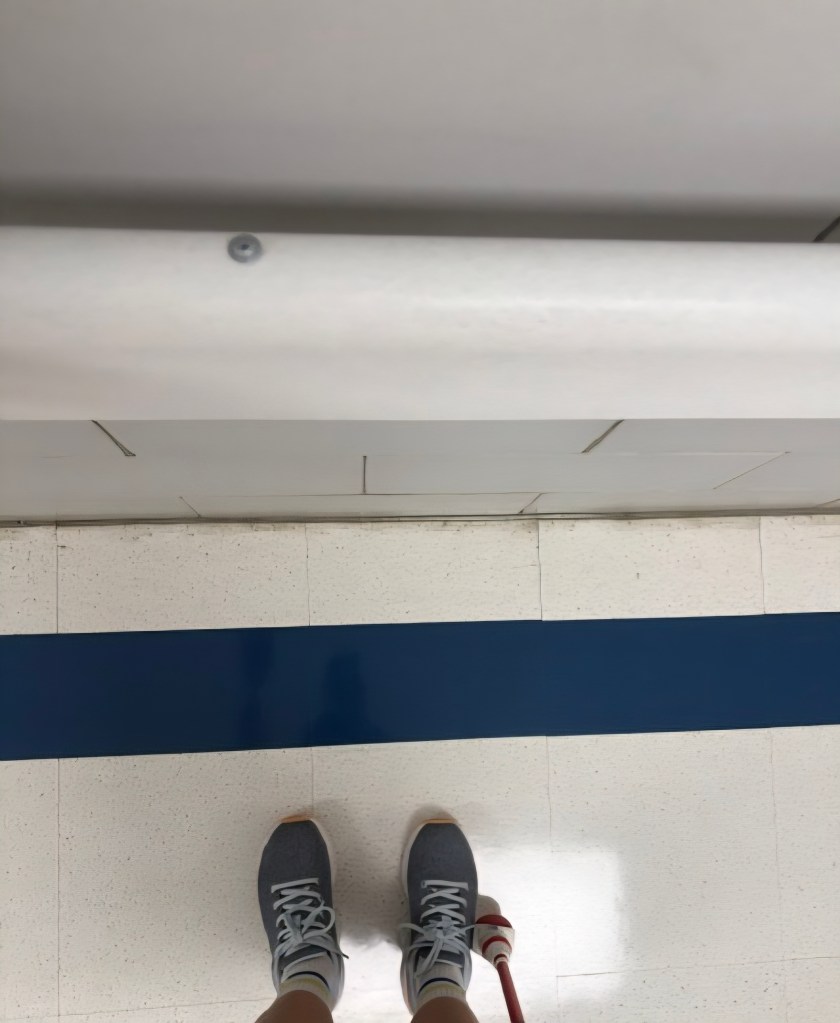
Image shows a bird’s eye view of a white painted hand rail with a “bump dot” screwed into it. Underneath it, on the floor, is a dark blue line running parallel to the wall, very visible against the white floor. Presumably for folks with some vision can use it. Unless it’s for the guide dogs? Next in the picture are Caitlin’s two feet, in their special, ankle-saving shoes and pride socks. Next to her right foot is her cane – the bottom section is red and it has a cane tip I don’t recognize on it. It’s red and white but I don’t think it’s the Sensaball. I’m doing my best, people. Caitlin is long abed and I’m posting this after choir practice. Which was awesome.

Leader Dogs, Day 4

Jeffrey and I wanted to poll the sighties:

QUESTION: IF there were no streetlights, pedestrian heads, etc., would you know how to cross the street? In other words, do you actually understand how traffic works and when is the most optimal time to cross? Jeffrey thinks that, actually, very few sighted folks would cross the street particularly safely or optimally without the “ped heads,” as he and Hannah call them.

After breakfast (bacon and toast for me, nomnom), we did more street crossings. I wrote out some routes and mapped them out on the mobility velcro tactile board thing. The board is confusing, but I comprehended enough to follow my own directions with very little help, which is more than what usually happens!

I also tried flagging straight up and down instead of side to side, which was a little easier, less choreography-like, and saved me some time. Time is worth its weight in gold when you’re trying to cross a street.

I did get a LOT better about planting my feet when I don’t cross perfectly straight. This way, I don’t run the risk of running in the wrong direction of the up-curb and spending more time in the street; rather, I plant my feet, do a Go Go Gadget sweep to either side, and inevitably find the curb.

At the end of the first half of the morning, I crossed a street (an easy one) in front of some Leader Dog volunteers who, I think, were there for Distraction Wednesday, waiting to squeeze squeaky toys and distract the guide dogs so they could practice ignoring temptation. But there were no dogs around, so they were just chatting, and when I got across the street, they cheered very extravagantly. I felt kind of silly about it, because it was what Derek and I call a “baby street,” and I was crossing on an “all quiet, all clear,” and everything like that, but it was still cute.

I’ve also gotten Jeffrey into the habit of doing “up top” and “down low,” which seems to amuse him. I also definitely did a happy dance at one point yesterday and Jeffrey was like, “Um … step a little more forward so you don’t accidentally dance into the street.” Heh.

For the second chunk, we headed toward one of the much more complex crossings. I also practiced listening for, and paying attention to find clues that would help me avoid mixing up driveways and intersections with weak curb-cuts, no truncated domes, etc. I was also especially careful on my “all quiet, all clears,” because I totally missed an approaching car during one and was horrified, even though Jeffrey and Hannah insisted that it had not been a dangerous error. Of course I totally know they won’t let me die, but … when even a simple crossing seems fraught, I start having these existential thoughts of, like, “Why do blind people even cross streets independently when we could literally die?” I know, I know, I can’t say stuff like that or my Blind Pride Card will get taken away. And I know sighties can get hit, too. But it’s just where my mind goes when I do mobility. It can all start to feel so complicated and exhausting, which can feel unfair because sighties don’t have to worry about any of it, and then it can put me in a frustrated, stressed-out, angsty headspace.

The big crossing had an audible signal that gave hecka directions: the name of the intersection, the cardinal direction, a countdown as you cross, etc. It was also set up in such a way that I could press my hand parallel to the sign and use that as a backup tip for getting myself aligned. Because I am me, the choreography of doing that was difficult, because it seems most folks use their forearm, but I couldn’t coordinate that without standing way far away and torquing my body oddly. The flat-hand, and a reminder to stand closer to the sign, not closer to the domes, helped.

With the APS and the parallel surge, most of the crossings went fine once I was used to it. Still, I haven’t crossed a street like that without a guide in years. I’m not ashamed to admit it. (Okay, yes, I’m totally ashamed to admit it, but I oughtn’t to be, because whatever.)

Some Big Crossing things:

* The APS might indicate that it’s safe to cross, and it technically is. But we still want a strong parallel surge, where the traffic has been waiting and has JUST accelerated. My favorite thing about the parallel surge is that, essentially, you can follow it across the street … like a guide! But also, besides following it to the other side, you can use it to help you maintain your line of travel. So you can’t just (cough) blindly follow the APS (yes, Jeffrey and I made that pun … or joke … or whatever we wanna call that).

* What I love about the surges (that they guide you) is also tricky, though, because, obviously, you also can’t get too close to them. But you have to be careful not to get too far away, because then you’ll go into traffic. It’s a delicate balance. That I’m not used to. So you can’t let the cars get any closer to you than they are when you start off from the curb, but you also can’t flip out if you discover they ARE too close to you, because then you’ll get annihilated by the other cars.

* I think I was also getting hung up on the feeling that my feet really needed to be in the precise right position when I aligned myself to cross. Which, I mean, they do … but I just needed some reminders that I can let a cycle or two go by, listen to the parallel traffic, and adjust my alignment as necessary. I think I’ve internalized the sense that waiting a few cycles is, you know, weak and shameful and indicative of garbage mobility skills.

* Hannah taught me a life-hack when I complained that the audible signal poles in SF are often literally, like, five feet away from the curb-cut. If you wait for the perpendicular traffic to go, “run” to the APS (Audible Pedestrian Signal), press it, and come back, you’ll have the maximum amount of time to get yourself re-set up to cross. So after all this, and to some extent during it, I was feeling low-key toasty / tearful / stressed out. Jeffrey and Hannah were great and reminded me to “shake it off,” which is totally a thing Martha and I often cite. Dogs do it for a reason! It literally enables you to complete the stress cycle. Also, if either of them had, you know, even asked, “Are you doing okay?”, I probably would have cried, so I was super grateful that they followed my lead and just kept rolling. I’m one of those people who just disintegrates at the first expression of comfort and sympathy in the face of impending tears, haha. And I despise crying in front of people. After a few crossings, and a lot of encouragement, Jeffrey, because he now knows me from sitting at our dining-room table three times a day, said he was going to buy me ice cream. So kind.

Again, the way the Leader Dog crew do not default to guiding continues to surprise me, which only reinforces to me how accustomed I’ve become to being guided out in the world. They still managed to give me a break by giving me verbal directions to the ice cream place right behind our crossing, but I was still walking solo. As it happened, Hannah told me that the shop had a mini chocolate-chocolate cupcake, which was absolutely perfect. And I think it speaks to Jeffrey’s and Hannah’s bossness that (a) they freaking got me a cupcake, and (b) I was actually able to eat and enjoy it, even after all that stress. Believe me, that’s not always the case, even if I’m given a perfect chocolate thing!

Jeffrey wants to eventually do mobility with kids, and I told him that, if he keeps doing kind things like taking people to get cupcakes and ice cream, he will be perfect at it. I commented that I could have been so easily bought and motivated by going to pizza, ice cream, whatever … but, often, the stringent rules around where mobility teachers could take me meant that we couldn’t do much that was relevant. So of course I didn’t get as much out of lessons as I could have, especially in later years, when the rules became stricter and my abhorrence of mobility got more intense.

Ooh, the last thing I learned in the morning was that it’s best practice to have my cane proceed me as I exit a door. I guess I always kind of felt like, “Well, I already came in, so if that went fine, then the exit will go fine.” But, especially in SF, anything can happen on sidewalks. Or there could be a step which I forget about because something ridonc happened while I was inside the building. You never know!

After lunch, doubtless deducing that I was a little fried, we went to the beach and I got to try the Dakota disc cane tip. I always assumed it would be more like a wheel standing on its end, but it’s actually more like a baby frisbee, and it bounces over sand, snow, and grass really nicely. I super-liked it. My SensaBall and PathFinder tips do okay, but because they’re more like suitcase wheels, they have a harder time than a disc on those textures. When I hit the sand with the Dakota disc, it felt so deliciously swishy in the sand that I ran down the beach. Jeffrey and Hannah were sweet and let me, although Jeffrey pointed out later that, really, for safety, unless a sightie’s around to ensure that there are no giant holes, sand castles, or picnic spreads, my reaction time would not be good, so it’s not ideal to go running blithely all over the beach. But they let me, because they are kind. Although Jeffrey did tease that, if I accidentally ran into the water, he wasn’t going to stop me. But obviously I didn’t … even though the water sounded more like a splashy little puddle than the ocean, which was new for me.

Hannah and I also talked a little about bathrooms, because I cited them as another stressor, especially since I have bathroom anxiety, try to put off going because I hate asking for help, and then am often in a panic and need to go fast, especially when I’m not with someone who’s able to go into the same bathroom as I am, or when there’s not a single-stall bathroom available (I know there’s a better word for that kind, but I can’t think of it … the ones that don’t have stalls!). Hannah said we can practice in the Leader Dog’s lobby bathroom tomorrow, and that she always reminds clients to try sticking with the walls rather than wandering through the middle, trailing with the back of your hand because EW, and also remembering that the accessible stalls have doors that go inward and tend to be on either end of the lineup. I tend not to use the accessible stalls anyway, because I don’t need them and a wheelchair or guide dog user might, and also because it’s just one more giant open space to navigate.

We also walked on a trail, where I liked the jumbo roller tip; it’s lightweight and did well in the dirt and hopping away from the grasslines. It didn’t do quite as well as the Sensaball or Pathfinder, but its lighter weight means that it and wrist, and would be less tiring on a hike. Same with the Dakota Disc. But the Dakota Disc is hollow, so if it gets punctured by something sharp, it will die. It also isn’t meant for everyday use, unless you’re in the snow, and it’s not meant to go on concrete. It’s hook-style, though, so is very easy to swap in and out as needed.

As we drove back, we had a good, honest talk about taking an arm versus trying to walk by myself. Let me add that I brought this up willingly, which I have hitherto never done with a mobility teacher because, you know, I worry they might spontaneously combust when I ask why anyone would bother using their cane when they could walk with a guide, other than to prove that they can? I mean, it wrecks conversations, slows your companions down, trips people, makes people stare, causes random sighties to freak out and grab you and scream if your cane touches anything, etc. But after this week, I genuinely feel like I do want to do a little more walking solo out in the world with other people … because I can. And because a guide isn’t truly, always necessary … it’s just easier. But walking solo also feels … empowering. In a way. Sometimes. I don’t know. I’m unpacking it.

Both assured me that whether I go solo or with a guide is ultimately my choice and can be based on the situation. We talked about how certain family and friends might be better at working on this with me (IE, people who can and will glare at other people who look like they want to interfere, who will be patient and interested in the process, who can strike that balance between helping and standing back, etc.). Jeffrey also pointed out that, now that I’ve refreshed my technique, and my arc has improved so drastically (he repeatedly commented that I hadn’t needed a prompt and was doing well), solo travel might feel less cumbersome.

Speed-through of the rest of the night: we had a tour of the Canine Center and the gift shop. I asked for all the braille things, and the gift shop people were excited because they said they don’t get a ton of people who are into Braille. I brazenly informed them that I’m the biggest braille fan in the world. Because I have no shame. Or modesty.

The canine center was really interesting and we learned a ton of factoids, most notably that (if I remember right) it takes less than three freaking months for puppies to gestate and be born. I could not! What in the world? How!?

My Dark Oreos came, and I gave people samples, including Craig from the kitchen, who made me another fake-chocolate sundae, into which I crumbled my Oreos. Delish.

Then we had a little lecture (optional) about Meta Glasses and Be My Eyes. I thought it would be more about using them for mobility, because I know people do, but none of the other folks seemed very familiar with either service, so it was mostly just introductory stuff. It was super cute to hear their amazement, though. And, as our presenter pointed out, Meta and BME can be a tool in the mobility toolbox, but ought to be primarily a confirmation, not a guide, because they’re unreliable, can hallucinate, glitch, etc.

I promised Jeffrey I wouldn’t stay up late blogging because I was sooo tired this morning (he was amused that he was advising a teacher, of all people, not to stay up late). Off to bed I go, so I can get my eight hours. Sweet dreamzzzz and more tomorrow, if I can stay on sched!

PS. I’m not editing these posts at all, so sorry (not sorry).

words from home

I don’t know about y’all, but I love reading these posts. Many of you probably know that in the very beginning of our friendship, Caitlin and I did a LOT of writing together. We met at a school we were both working at and as summer began, we decided to start our own writing group, just the two of us. We agreed we would write for 10 minutes every day, and send that writing via email to one another. I looked forward to reading her words every day. Sometimes we’d exchange emails beyond that, usually related to what one of us had written. After a while I asked, “Do you do texting?” which now seems hilarious to me, knowing how very much Caitlin texts, and also because it NOW feels like, doesn’t everyone text?

And of course she said, “Yes, absolutely,” and the texting began. We texted so many, many times a day. I used to use an app that allowed me to download my texts and seriously there were thousands of texts before we even began officially “dating” or whatever you want to call it. Speaking for myself, all those words were a real part of falling in love.

We moved in together when the shelter-in-place started in California (thinking it was going to be ‘just a few weeks’) and the texting mostly stopped. I mean, we did still sometimes text each other from the other room when we were each online, working. Sometimes texts were like, What is going on in there?! or Would you please get the dog out of my area?

Fast forward to today and living together means that most of our communication these days is spoken (unless I’m out of town). There are still SO MANY WORDS. We talk a lot! We both have things to say and of course, Maite has plenty she wants to say, too.

And we still write together, although nowadays at the end of a writing sprint, I usually read what I wrote aloud and Caitlin usually makes me wait till the piece she is working on is done. Which means I get to read a lot fewer words on a regular basis, so reading these along with y’all is a real treat for me. I love her turn of phrase and have laughed out loud for real with each of these posts. I love to read what’s going on in her mind in conversations. (I miss those FB posts about things her students said to her!) And I am glad to read about how it’s going out there as she does her thing in a completely unknown place. Bonus points to the person who added those Oreos to her ice cream.

Elbows and Etiquette

One of my fave “coffee shops” in SF is Christopher Elbow Chocolates. It’s in Hayes Valley, which is kind of fancy-pants and pretentious, but it’s freaking delicious, and it was close to where I used to live with my dad. I was introduced to this spot by my friend Kate, who’s a braille teacher, and I still go there with her every so often. I also used to take OK Cupid dates there back in the day, partly because of the comfy seating and close-but-not-too-close-to-home location, but also because the staff were always so friendly, respectful, and accommodating.

I went to Elbow last week to catch up with Kate and had an interesting set of interactions that I thought it might be cool to share.

1. My Para-Stranded driver was very kind: an English-language learner who seemed extra concerned about my well-being because Elbow doesn’t have an easy drop-off spot for the big bus. After escorting me across the street and to the door, he seemed hesitant to leave—not at all in a creepy way, but just a concerned way.

2. This is where one of the staff, whom I’ve interacted with often but wouldn’t necessarily have known by voice, greeted me with, “Oh, hi! We haven’t seen you in a while!”

I don’t know if she did it intentionally, but it served the dual purpose of (a) reminding me that I knew her and (b) assuring the driver that I was in good hands.  As disabled folks know, worried non-disableds tend to listen MUCH more to other non-disableds’ reassurance than to OUR assurance … which, of course, is silly, because don’t we know ourselves best? No shade to this driver, though—he was sweet—although I kind of wondered what he planned to do as a means of helping me further? The shop is small. It’s not like there was a staircase I could fall down or anything.

3. I finished greeting the staffer, clarified that I was remembering her name right, and explained that Kate, whom she also knows well, would be coming soon. “Is it okay if I just hang out and wait for her?”

“Of course,” she said genuinely.

Out of habit, I found myself waiting for her to rush out from behind the counter, probably in a panic, and then flounder to guide me. I knew her well enough to know that she wouldn’t grab or pull me, but I found myself automatically bracing to be manhandled anyway. At this point, it’s just reflex to brace when I’m out in the world alone.

Interestingly, and awesomely, she didn’t actually do anything! She assumed competence! In response to that, I, on autopilot, almost asked for her to come and guide me to a chair. But then I remembered just how small and straight this place was, and how devoid of anything that I could damage in any way. It struck me, in a flash, how used I am to letting other people guide me, even when I really don’t need the help, because I’m so afraid of either getting in other people’s way, or appearing inept just by using my cane and doing something in a way non-disableds perceive as “different” or even “too slow.”

“Is anyone sitting back there?” I asked instead.

“Nope,” she replied cheerfully, “it’s all yours.”

And I took my left turn and effortlessly navigated directly to where I needed to be. No hiccups.

Every once in a while, I have these reminders. I remember another one, at my first teaching job. I was called to the phone in a colleague’s classroom while he, myself, and a third colleague were having a meeting across the room from the phone. I expected him to rush across the room and manhandle me to the phone, but he didn’t. I expected him or the other teacher to panic and have an entire fit as I clanked and clattered my way through the thirty-plus empty desks and chairs. But they didn’t. And I reached the phone fine. Maybe with some noise and flailing, but fine. And is it really a crime if I hit a desk or take a little longer? Totally not.

I tell the kids all the time, in response to their appalled gasps when the cane hits something, “It’s okay, that’s what the cane’s SUPPOSED to do. It bumps into things so I don’t have to.”

But I think I forget to remind myself about that sometimes.

I’m so wary of being perceived as hapless just for doing things “the blind way” that I think I sometimes sell myself short. But it feels so good when I’m able to do something simple for myself. And if people flip out about it, I can remind myself that that’s about them and their inexperience with disability. It doesn’t have to be something that I shoulder, take responsibility for, or feel shame about. We may look like we’re struggling, but more often than not, we aren’t, and I will be helping blind-kind more by letting myself flail a bit than by taking the path of least resistance when it’s not always necessary.

4. When Kate and I ordered, the staffer, as she always has, brought our stuff to us, which was very kind. I do think she does this for other folks, and that it’s not just a disability thing. However, she added an extra touch. I’d ordered drinking chocolate (the darkest possible), which is very rich, very thick, and very hot when it arrives.

“I usually fill people’s drinks to the very top,” she explained, “so they get all of what was in the blender. But I thought it might be easier to just give you the rest of the drink in the blender container instead, so you wouldn’t have an overflowing cup.”

I can imagine some blind-kind being pissed about this and going into a rage, railing at her, saying that they can very well drink the same damn drinks as sighted people, thank you very much. But I, personally, have a hard time holding very hot, very full cups gracefully. I appreciated the gesture and told her so.

5. After a delightful visit with Kate, I took Stranded home. The driver was new and couldn’t find my house. Martha wasn’t home and I was already late to feed the dog, so I asked the driver if he could just park and make sure I was in the right vicinity before leaving. He agreed to this, and we were, in fact, not far from my place.

Once we’d found my house, he very sweetly noticed that our trash cans were out and offered to bring them in for me. I thanked him and told him that wasn’t necessary, but that if he could wheel them slightly closer, I would go ahead and pull them in myself right away. This, I explained, would eliminate the need for me to flail all around the general area of the trash cans with my cane, trying to find where the bins had been left.

He understood this and followed my instructions to the letter, respecting my autonomy and giving just the amount of help I’d asked for. Even when I wrestled a little extra hard with the recycling bin, which is bigger and more unwieldy, and which I wanted to nestle in a spot I could more easily find when I opened the garage door to wheel it in, he was already walking away and didn’t comment. It shouldn’t be a novel thing when people genuinely hear me, but it is, so I always notice and appreciate it just that little bit more.

In closing, I just want to note that I’m not asking for advice or criticism for how I handle myself and mobility-related situations. I know I’m not perfect. No one is. I’m just sharing this because I find it interesting, and in the hopes that it may help someone else whose approach and struggles may be similar to mine.

Peace, hugz, and rainbowz to any and all who want them!

Image is of a cup of hot chocolate on a saucer. There is a spoon that has clearly already been in the chocolate. The cup and saucer are sitting on a tiny wooden tray, just wider than the saucer. To be clear, this is NOT TJ’s hot chocolate. I got this image from Unsplash (shout out to the photographer, Ashkan Forouzani) and thought it would make a nice addition. For sighties.

WELCOME, PLUS A LIFE UPDATE!

Hi, people!

So, in case you are either (a) fully sighted with no blindies in your corner and-or (b) living under a rock, you oughta know that Facebook, in addition to all its inherent security and political badnesses, is becoming a regular trash-heap of accessibility problems. The most heinous of these include having to go through ridiculous work-arounds to do things as simple as composing a post, writing a comment, or being able to know what link we’re clicking on before we leave Facebook. Again, basic things. Totally unacceptable that these issues have been dragging on for literal months. Non-disableds would not stand for this.

As you can imagine, this app inaccessibility, combined with the fact that Facebook Mobile (on the computer, not the phone) is now also a cluster, has made me less and less inclined to post status updates. Therefore, ergo, and henceforth, the plan is to move gradually away from Facebook and more toward blogging. Will it work? No one knows. But it definitely won’t work if I don’t try!

Let’s break it down into nice paragraphs. I’ll even do little fake titles / headings. Mostly for the sighties. I think they like that. But I’m not doing formatting.

WHY A BLOG?

A long time ago, Martha and I thought it might be fun to blog together. Do you like our cute title?

Dots: speaks, of course, to my love of all things braille.

Doc: Have you met Doc Martha? She blogs and Instas already, but hopefully she’ll bring some Doc Martha Magic, as I call it, over to this little corner of the Interwebs.

Roc: The cool shorthand way of spelling “rock,” which is for Maíte, the Rock Wilder (Rottweiler). She is our eight-year-old dogter and we love her. She enjoys raw meat, singing, chasing “creachers” to the best of her abilities, and “para-ambulations.” She may guest-post on here occasionally, if she’s not too busy “ressing” in the “tsunchine.” Plus, we, all three of us, rock. And enjoy rocking out.

Most updates, I imagine, will be more brief and topical, but I have a few life updates that I think it will be helpful to fill you folks in on so you know where we are these days in Caitlinworld. I’m also not going to update on, you know, seemingly everything in ways I once did, but more things that feel more sharable for, and consumable by, the general public.

SCHOOL

This is my ninth year of teaching. It is ridonculous. Like, seriously, I don’t even know how that happened.

To make a very, very long, nine-year story short, I’m still having problems with our school district, to the point that I was pushed out of a school due to accommodations-related reasons. Last year, for the first time, I taught a special-day class for third, fourth, and fifth grade students with mild to moderate disabilities, in the hopes that the main accommodation issue would be less prevalent. In fact, the issue was still prevalent, and a bunch of other issues in that setting compounded it, most notably never being fully staffed.

Our school district is infamous in the news for its struggles and, thankfully, school sites seem to understand that, with almost a decade of special education teaching under my belt, I’m actually a useful staff member to have on their team, in spite of the fact that, you know, I can’t see things. This year, I’m back teaching small groups of kinders through fifth graders at a little elementary school that’s actually walkable from our house. The children are delightful, and some of the most hardcore, dedicated learners I’ve ever had. We haven’t had a special educator at our school for the past two years, so from the get-go, my crew, by and large, were extremely eager to receive the support.

I know some of us, myself included, miss kid-quotes! Kid-quotes make the world go ’round, don’t they? I have gotten out of the habit of putting them in a palatable format; I just tend to scribble them in my daily notes and across my lesson plans. And I haven’t made up kid-names in ages! But I will keep chewing on the idea of bringing them back. Maybe in, like, a weekly or monthly digest?

ARFID

As some of the long-time Facebookers may recall, my therapist was able to give me an official diagnosis of ARFID, or Avoidant Restrictive Food Intake Disorder. For the uninitiated, ARFID is often handily explained as “more than picky eating.” It’s when people struggle to eat typically, due to low interest or appetite, fears of choking or becoming ill, and-or sensory-based things like flavor, color, texture, etc. For me, it’s mostly about texture and poor hunger cues.

The texture component has been present for as long as I can remember, but the interoception piece, I think, worsened during the shelter in place, when eating was much less structured. School and being out and about in the world tends to help me with scheduling my eating; I just never really thought about it that way.

Long story short, after the shelter in place and returned to school, I had unintentionally lost a lot of weight, due to eating both less food and less frequently. I worked on it over the summer, got some guidance from providers familiar with ARFID, and joined some ARFID Zoom groups. Things got better for a while, but got worse throughout the school year. ARFID on its own was difficult enough, but last year, we were extremely short-staffed, and I wasn’t used to teaching the special-day class.

By the end of March, I’d lost so much appetite and weight that even Kaiser people were concerned, and I was referred to a partial hospitalization program in the city. I had to go on medical leave for the rest of the school year, and was at the program for eight hours six days a week. That gradually decreased as I was able to work on my eating.

Because ARFID is such a relatively new disorder, there aren’t really best practices on how to address it. I ended up trying a new med, which increased my appetite drastically and helped me put on weight rapidly, but it made me feel absolutely miserable. I quit the med after about a month, but it took a while to taper down, which was very unpleasant. But I’d put on enough weight and learned enough new skills that I got sprung from the program.

The folks at the program were pretty kind, and … well, you all know me, I brought my signature joy as best as I could. If nothing else, being able to focus on eating and not stress endlessly about school helped, and then I had the whole summer to stay in good patterns.

This school year has gone so much better, and I’ve kept up with eating … knock wood. My main takeaways have been to just TRY to eat, even if I don’t think I’ll be able to. And to eat whatever feels doable, even if it’s not what I quote “should” be eating. Relatedly, we have banned the concept of “junk food” in this house. It has been renamed to “simple” food, which you say with a French accent and hair-tossing. I will do a video of it sometime.

So that’s the ARFID update. Oh, also, we’ve been doing some fun videos of me trying new things, but, thankfully, the program did not force me to eat different things. They encouraged me to eat a higher volume of my “safe foods,” which was a big relief. I’ve never felt motivated to eat, quote, “normally,” and my blood tests have always been okay, thanks to vitamins and, at some points, iron.

OUR LITTLE FAM

Image shows Maite lying on the couch with her rainbow pull toy between her paws. She has a big, open mouthed smile on her face. The colors are interesting (to me) because the wall behind her is yellow, the cover she is on is blue, and underneath that is the red couch. Very bright. Very Caitlin. – Martha

We’ve now been in our house for about three years.

We have the best next-door neighbor ever, “Uncle Wayne,” who calls himself the Mayor Of the Street. He is hilarious and always keeps an eye on us. Martha, in particular, knows all the dogs and their families, too.

We also hosted a block party, and now have a great sitter and walker for Maíte. So I feel like we are slowly but surely finding some community.

WRITING

This part saddens me: I have done literally NO writing. No Facebook posts, but also, for the first time in my life, I don’t have any story ideas, either. It’s super saddening. I did NaNoWriMo successfully for the first time in 2023, but flunked out midway in 2024 … and the stuff I did in 2023 wasn’t that great.

STAY TUNED

Hopefully, I can stay on this wagon and get back in the posting / writing groove! Think good thoughts for me!

If you made it this far, I shall send you e-hugs and rainbowz!