Leader Dogs Day 3

I forgot to mention the tragedy of yesterday! Sighties who know me will attest that I am always wearing my Braille notetaker in a cross-body fashion. Alongside that, I have a little side-bag, which holds all the things that a purse would hold if I had one: ID card, credit card, money, lip balm, antibacterial, thumb drive, etc. As iPhones have gotten bigger and bigger, I’ve also stowed my phone in the pouch on the front of this side-bag. Hilariously, the types of little side-bags that work best from me are usually meant for camera accessories! But now, because I need to hold my cane on my right side, closer to my body, guess what’s in the way? The freaking side-bag. And I don’t want to have to wear a little backpack or purse or cross-body bag all the time, because, between Braille notetaker and cane, I already feel encumbered enough as it is. Ugh. So I have no clue what I’m going to even do with my whole life and aesthetic.

And the other part of the tragedy is that, for now, I think the rhinestones on my cane made it slightly heavier. The Sensaball and Pathfinder tips, which I adore, also make my canes heavier. So now that I need to rewire my wrist and forearm muscles to accommodate holding the cane closer to my body and higher up on its handle, the cane feels heavier and harder to control. I’m using a plain cane for now, and hoping I can build up my muscles enough to go back to a bling cane. Because what will my aesthetic even BE if I can’t have a tricked-out cane of glitter and rainbow explosion and vibes!? Hashtag devastation!

Anyway, I’ll figure all that out in good time … on to today!

Most folks had some fancy-ish breakfast, but I got two buttered toasts (yes, Derek, I know toast is not a countable noun, in case you’re reading), and a sausage patty. Hannah, Jeffrey and I got to take a shiny new van downtown, complete with that delicious new-car smell.

Jeffrey (mock-appalled): What’s that left hand doing?

Me: Um … getting into the car?

Jeffrey: Remember to anchor!

Me (genuinely appalled): What if I hit the new van!? I cannot!

Hannah: It’s totally fine to hit the van.

Me: … … … Nooo!

Again, I’ll do highlights, avoiding some of the most mobilityish mobility stuff.

* We worked on several intersections, including a crooked T, and practiced waiting for the all-quiet, all-clear and listening for near parallel traffic. I was introduced to the concept of “blocker cars” and “musher cars,” as a means of differentiating which cars “block” you from oncoming traffic, and which cars could “mush” you to death.

* There’s this thing that frightened sinsist on you crossing the street, even if you’re trying to listen to the traffic and don’t want to cross at this moment. This can look like honking, shouting, or just … silently lurking. Forever.

The three of shooing drivers away:

1. Lowering your head slightly

2. Looking away

3. Walking back the way you came and realigning yourself, simultaneously signaling to the sightie that you don’t intend to cross

Me (as a clarifying question, which I stated rather than asked): So we aren’t waving people on anymore.

Jeffrey (with a tone that suggests he’s quizzing me): Why?

Me (flustered): I don’t know, it was a question.

Jeffrey: No, you’re right, I’m asking you why we don’t wave people on.

Me: Because … if they die, they’ll sue us?

Jeffrey: Correct. Generally, I’m not comfortable with blind people directing traffic.

Me: Seems reasonable.

* I have a distinct memory, when I was practicing my route to audition for guide dog school, of Mr. C yelling, “P! A! T,” which stood for Protective Arm Technique. Now, we call that Upper-Hand And Forearm.

Jeffrey: Nice job with upper-hand and forearm right there!

Me: Oh, I … I didn’t even really do it, I just kind of … put my arm out.

Jeffrey: It was about halfway there.

Me (aggressively trying to do it correctly): Like this!?

Jeffrey: A little higher … protect the moneymaker. — Moneymaker meaning … your face. Clearly.

* I think I had a bit of a breakthrough with cut-backs, but just now, when I tried to write it, I don’t quite know how to explain. Heh. I’m sure we’ll work on it more.

* We worked on some problem-solving in the field:

Me: The sidewalk here has, like, come to a dead-end. Of death.

Jeffrey: So what can we do?

Me: I don’t know? Turn around?

Jeffrey: Have you ever seen Anchor Man?

Me: … … ” No?

Jeffrey: They put question marks on his teleprompter, so he reads everything like questions, even his own name.

Me: Ahahaha, that’s totally what I do.

 Jeffrey: Even if you’re not sure you’re right, you can state it like it’s true.

Me: I’ll try!

Later, after Jeffrey gave me a clue, and I got around the dead-end by climbing a staircase:

Hannah: You’re on a boulevard now.

Jeffrey: What was that reason we learned for why it’s called a boulevard?

Hannah: It has more trees … and businesses.

Me: I never knew that.

Hannah: We didn’t, either; we had to look it up.

Me: Ooh, truncated domes! Wait, am I lined up right?

Jeffrey: Ahhh, don’t move those feet! That’s the number-one rule!

Me: I thought that was just for … other things? … Questionmark? Anchor Man?

Jeffrey: Ahahahaha nice.

* It will surprise very few of you to know that, at the precise moment something unforeseen (cough) happens on a route, I do not, in fact, plant my feet. Ever. I do the opposite … namely, lashing out with cane and free arm and free hand to figure out what in the heck is going on, and swinging around wildly all over the place. Jeffrey impressed upon me that, of course, the more I move, the more off-course I’m likely to get. And it was true that, often, I was either still totally fine and following my line of travel, or just a touch off-course, which would be easily corrected if I could just, you know, find some chill.

My other temptation, for some reason, is to grab the cane in a double-handed vise-grip, I think because I subconsciously think that gives me more reach and control. If I don’t do that, the left hand’s flailing around to ascertain information. But by the end of the day, I shocked even myself with my ability to just stop, take a minute to think, and then either search more calmly for landmarks or clues, or simply to do some narrow sweeping to see if I can hop back on to the correct line of travel.

* Hannah and Jeffrey both normalized that it’s totally okay to ask someone for help crossing a street, and also pointed out that, often, if there’s a business nearby and it’s a route you travel often, you can solicit help from employees who may start to know you. Martha also had this idea in the neighborhood, but it hasn’t worked out … yet. But I loved the reminder!

* It’s also very strange-feeling to be learning mobility in a calmer, more residential area. I’ve been in SF so much, and had so little mobility training there, that I just … forgot that calmer streets existed, that some sidewalks aren’t rife with hazards and sidewalk junk, and that I actually do remember a lot of mobility things. They just aren’t as applicable in the city, which is a whole different beast. This part of Michigan is much more like my hometown in its characteristics, so I feel much less out of my element here, even with the larger crossings (which we didn’t get to until the afternoon).

* There’s a balance I had trouble striking. Sometimes in the world, there’s not a well-defined curb-cut, much less truncated domes. But also, in the world, there are driveways. So often, when I’m trying to follow a line of travel along a sidewalk, and I pass a driveway, especially if there’s a change in the texture of the pavement, which there often is, and especially if there’s a lot of noise or no noise, I’m freaking out, thinking I’m wandering blithely into the street. This is, of course, where listening to the traffic in the street alongside me comes into play, as well as tapping into other landmarks. I still often catch myself stopping too soon, trying to analyze, and subsequently losing my line of travel … or, if it really is a flare leading to the street, misaligning myself. So we’ve been practicing this.

* And might I remind you that, in addition to these things, I’m trying to remember to keep my arc narrow, to relax my wrist and arm and shoulders, and to not choke up on my cane? Although Jeffrey did say that my arc and my grip were great today, so it’s already sticking … but it’s still on my mind, even as I try to catalog these other things. Luckily, Jeffrey and Hannah get this … and also applaud me for taking copious notes, rather than thinking I’m ridonculous.

* Joy Explosion: We ran into a guy walking two retired Leader Dogs, and he let me pet them. OMG, I literally fell to my knees and gave one of them a full-on hug. And she was all wet, too, because presumably they’d been playing in the sprinklers, but I had zero cares about that. I miiiiiss Maíte-hugs! The day was also super humid, with only occasional breezes, and between the heavy air and, probably, my mega-focus and intensity, I was SO sweaty! Seriously, I’m typically not a sweaty person unless it’s, like, ninety degrees, but my whole entire forehead was drenched, soaking my bangs, and I could feel sweat running down my spine, which I haven’t felt to this extent since I was in sixth grade and trying (and failing spectacularly) to do Track and Field in freaking June! All of this would have been fine, except I was starting to get a blister on my thumb from strangling my cane in the new way I’m working on holding it. And that blister was also probz from sweating so much. As Maite, voiced by Martha and me, would say, “That’s asgusting!”

Hannah and Jeffrey are like Scouts, though, and had a whole first-aid kit. Hannah bandaged my finger to cover the blister, but I was SO sweaty that the Band-Aid literally just … peeled off. Hannah also said they have tennis tape, like what’s used in the mainstream world for racket handles, and that that might help me get a better grip. (They also had canes with alternative handles, but none were short enough for me, heh.) This gave me funny flashbacks to guide dog school; the harnesses with the more ergonomic, detachable handles had just come out, and I was the first (and I think only) one in our class to get one before they were officially given out, because my freaking hand was so small that the standard harness was hurting it. This caused so much gentle mockery from my classmates … as seems only fair.

By that point in the morning, I was having a hard time keeping a narrow arc because controlling the cane with minimal thumb action was getting harder. It was about time to leave anyway, and Jeffrey and Hannah impressed upon me that taking care of this situation now equated protecting the rest of the week, which I appreciated.

Once we got back to campus, I went to the RA’S office, and they bandaged me up more intensely, with some elaborate criss-cross doctor way of securing the larger Band-Aid. And they helped me get a yellow Gatorade, because NECESSARY! I felt a little fried after that, but I amped up again after getting a grilled cheese for lunch (and found out that Jeffrey eats very similarly to me, which is boss), and (even more thrilling) Jeffrey giving me the choice of what color tennis tape I wanted to wrap my handle in. Cane bling seriously always makes my life. I chose purple … obvi.

I’m getting tired, so just a few highlights from the afternoon that might be interesting to you people:

* When I’ve learned routes, I’ve literally written things in my notes like, “Stand with left foot two inches from the upper-left corner of the truncated domes for optimal crossing.” This way, I don’t have to worry that I’m lined up correctly to cross … at least, not as much. What I didn’t know is that I can hit the domes, plant my feet (the number-one rule), and then use my Go Go Gadget right arm to find the inner curbs on either side, to help me line up. (I mean, maybe I was taught this, but either I forgot, and-or we didn’t do it precisely this way.) But it made lining up feel so much more methodical and so much less like guesswork and praying to the mobility guru above.

* We did a ton of work with those mobility kit things with the velcroed, plastic intersections and blocks and people (I forget what the kit is called). I always despised those so much as a kid and, sure enough, it took a good forty-five minutes for what Jeffrey was explaining with the materials to make sense, but by the end, they clicked! Sort of. As Jeffrey put it, “We’ll see if it’s still there in the morning.”

I explained that it’s always just been so, so hard for me, almost impossible-feeling, to (a) imagine an entire street layout, complete with all the lanes and curbs and intersecting streets and on and on, and then (b) hold that in my mind long enough to figure out what the heck I’m supposed to do with it to get to some elusive destination off in the distance. Jeffrey genuinely seemed to get this. It was nice feeling like I could say this and have it understood and believed, rather than feeling like I was just making excuses. Not that any other mobility teachers ever made me feel that way … I think I just make MYSELF feel that way. So the validation was appreciated.

* Oh, also, in the morning (because I’m running out of sufficient steam to scroll up), we were going to practice veering, but then (of course) I stopped veering. Hilarious. But, oddly, if I flag a certain way (almost, like, with Caitlin choreography), I go straight … and if I flub that, I veer. Interesting.

The rest is just mobility stuff that I’m too tired to write about and which probably isn’t interesting to the vast majority of you. But also, Jeffrey very kindly offered to hold my cane for me when a siren came so I could cover my ears, aww! He can stay.

Then, our crew had a meeting with the Leader Dog counselor, who also talked with me before class re: anxiety and ARFID. She was lovely, and I felt like our cohort became immediately closer after just sharing that single, vulnerable hour.

I took a shower (seriously, I’ll probably have to shower every day once lessons are done), and then we had a really fun, raucous dinner. I feel like everyone’s personalities are really coming out more, and there’s a lot of laughing, teasing, and sharing, both the hard and the silly. This was a staple of guide dog school, too, and it’s so sweet and singular.

Also, shout-out to one of the kitchen staff, Craig. First of all, at lunch, when I asked him to please refill my thermos, he also cleaned it for me, so thoroughly that I could smell that delicious whisper of bleach. Not like, you know, there was bleach in it! Just like … someone had done a boss job actually cleaning it, rather than just rinsing it, like I often do when I’m in a hurry. And like I certainly would do if I had, like, thirty freaking blind people asking for thirty different things in my dining room.

THEN, tonight, everyone got some fancy sausage thing with trifle for dessert, but I heard Craig telling someone else they could have vanilla ice cream. I have been longing soooo desperately for ice cream since I got here!

So it went like this:

Craig: Caitlin, would you like trifle?

Me: No, thanks, but … did I hear that you have ice cream?

Craig: Yes, I can make you a sundae with vanilla and chocolate syrup.

Me: No chocolate?

Craig: No, sorry.

Me: Okay, but can you please put so much chocolate syrup in the vanilla that it, you know, forgets it was ever vanilla?

 Craig (laughing): Yes, absolutely, I totally get you!

(As Craig leaves ) Me (to the table): Dang, too bad the volunteer who’s getting groceries comes tomorrow! If I had my dark-chocolate Oreos, this would be perfect.

(Five minutes later, Craig returns, gives sundaes to each of the two folks sitting on either side of me, and…)

Craig: Caitlin, I put LOTS of chocolate syrup, and there were some mini Oreos left over from Kids Camp, so I put those on top for you.

Me: Oh … my … God, thank you! Seriously I cannot thank you enough right now, I might cry, I want to hug you!

The table, of course, was amused … but I was so serious! It’s the little things! It really is! He didn’t have to do all that! Also, it was delicious.

Then my Leader Dog mentor called to check on me, and one of our cohort, who was mourning the scratchy toilet paper alongside me, brought me a roll of soft TP from a pack the RA had given her. Everyone is seriously so kind.

Okay, I am soooo tired and meant to be in bed like … an hour ago. Hugs and rainbow joy to all, and more laterz.
ACCESS INTIMACY AND ADULTING

Mia Mingus, a disabled activist of color, coined the term “access intimacy” some time ago. I remember stumbling across it and feeling that awe that comes with finally finding a label or phrase which perfectly encapsulates an experience that’s integral to your make-up as a person. To summarize very briefly, access intimacy refers to the comfort and ease disabled folks may feel, either with other disabled individuals or with non-disabled people who have truly become allies.

Being disabled, as is now becoming more widely understood and talked about, means constantly trying to function and find acceptance in a society which is not made for us. Even as a child, before I had language for any of this, I knew who I felt safest, happiest, and most myself around. My dad affectionately created the term “dealing” to encompass the things I often requested: a sighted guide, support around accessing the foods I could tolerate, visual descriptions, answers to my many questions. Even within my family, there were people who did this, if not technically “better” than others, with a certain warm, effortless finesse that I’d certainly never taught. I’m not sure that I’d know how to teach it, even now, though that’s not to say it can’t be learned.

In elementary and middle school, I often had my birthday parties at the roller-skating rink. I took turns skating with everyone. Everyone. It was easy, an unspoken given. Similarly, in college, I could rely on every member of my a cappella group to fill in proverbial blanks. Of course, some became my friends outside of singing, while others remained groupmates. Still, though, everyone understood me on a basic level: not just my needs, but also my strengths. I was expected to pull my weight and contribute, and I wouldn’t have had it any other way.

In my mid-twenties, I realized that my attachment to people — my difficulty in accepting that, sometimes, people come into our lives for a reason and a season — was rooted in more than simply being sensitive. It takes a higher level of trust, as a disabled person, to let someone in: to be vulnerable enough to name your needs and allow them to be met, without shame, by someone who may not fully share your experience. This is especially true when a disabled person takes the plunge to let a non-disabled person in. Teaching about disability, even in an incidental way, is labor. So losing access to that connection you’ve worked to build, as a disabled person, can naturally feel like a multi-layered loss.

Now that I’m a thirty-something, I think about this concept from a slightly different angle. I find myself waxing nostalgic about friendships like high school, college, and shared activities, where interacting with people on a daily basis automatically facilitated access intimacy. I’m lucky enough to be in touch with many of these folks, but times have changed. We’ve moved to different places, lived through different situations, and, in many cases, grown away from one another in such a way that meet-ups can sometimes feel awkward, even though mutual understanding and respect are still indisputably there.

People often say that friendships are harder in adulthood. Aside from neighborhoods and workplaces, it can be hard to find clear-cut pathways to create new connections. As a disabled adult, I both crave those connections and also, often, feel too tired and dispirited to summon the initiative needed to build them. And I do think that disability plays a part in this: a double-edged sword, of sorts. Those true connections can be harder to forge, but they can be so much more rewarding because of the work all parties must put in. I intend to remind myself of this whenever I question whether or not the effort is worth the outcome.

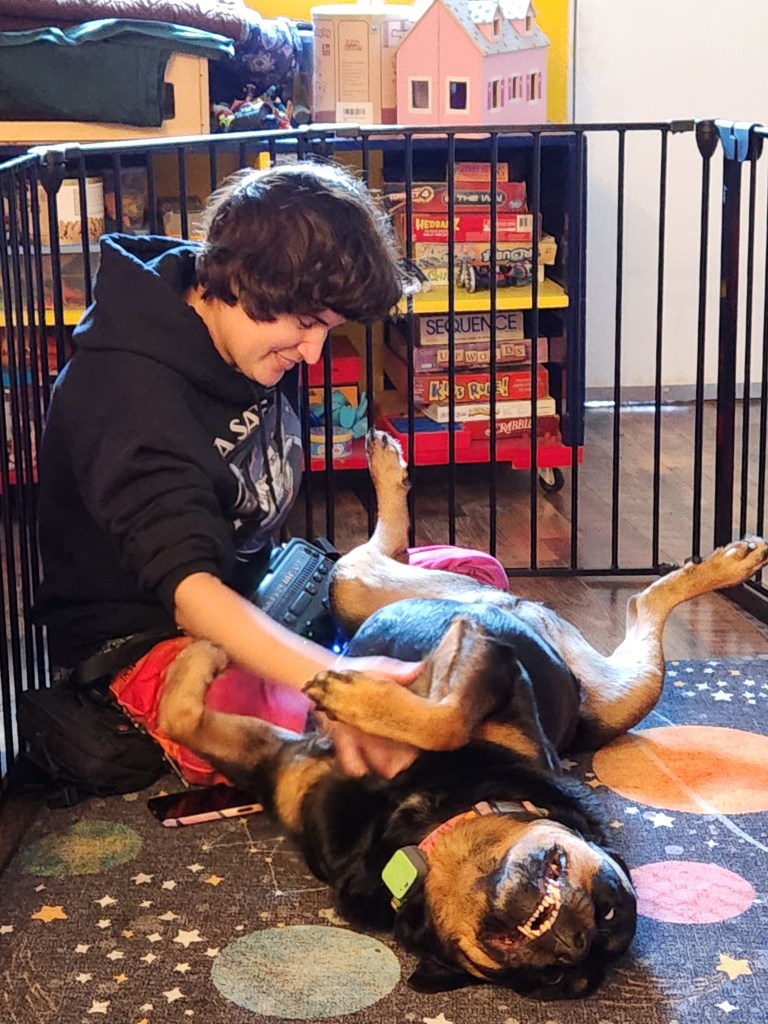
Image shows TJ (Caitlin) sitting on the floor on a space-themed rug, inside a huge baby gate setup with Maite the Rottweiler laying on her back right in front of her. TJ has her Braille Sense in her lap and is wearing her “I am a safe space” hoodie (which is also space themed, complete with an astronaut – although they are not visible). Maite’s mouth is a little bit open, teeth showing, but her face is very relaxed, complete with the whites of her eyes visible. Behind them are shelves with board games, a toy house and other toys. Everyone’s access needs are being met.

NAME GAME


HINT: Skip to the end if you're wondering why Martha calls me "TJ."

For as long as I can remember, I wanted a nickname. For whatever reason, I've always connected nicknames with words like "blindie," blind jokes, and the right to (with consent) guide me in an unconventional way. All these things have to be earned.
In the same way I despise outer-circle folks going around pontificating about "blindies," teasing me for a "blawkward" (blind plus awkward) moment, or steering me by the shoulders, I have always chafed at people's insistence on calling me "Cait," "CJ," or, God forbid, "Caity," unless they've expressly been told that I liked it.

I wonder if I connected these ideas because, in the same way people project false familiarity around blindness, I feel that people have attached nicknames to me as a means of declaring friendship, connection, or even ownership that isn't really there. Or maybe it's just because, as a blind kid trying to cut it in a sighted world, with extracurriculars, blind stuff, and (then unidentified) ARFID sprinkled over a typical childhood, I felt like I had so little autonomy.

As a kid, I was Caitlin to just about everyone. Very early on, my dad nicknamed me Trouble, or its derivatives, Troub and Troublemaker ... but that was very much his nickname alone. No one else used it until, years later, entirely unaware of my dad's nickname for me, my seventh-grade science teacher also awarded me the same label.

"Cait" and "Caity" were exclusively family names, with only my grandparents and Aunt Linda allowed to use "Caity." My grandpa, with his affinity for Spanglish mixed with the occasional German from my grandma, called me "Diablito," or "little devil." In hindsight, I found it interesting that he didn't use "Diablita"; perhaps this was a nod to my wild-child, tomboyish behavior. I wish I'd thought to ask him before he passed away in 2012.

By fourth grade, I was taking nicknaming into my own hands. My infamous Deraitland bestie, Derek, myself, and some other friends sometimes invented languages. In one, "Caitlin" backwards became "Niltiac," pronounced sort of like "Nil-shyack." In another, "Caitlin" in braille, upside-down, became "Itincoma," which I loathed and Derek, subsequently, used often in an attempt to rankle me.

The nickname I lusted after constantly was CJ, for my first and middle initials. Derek, happily, was DJ, a nickname which I used a lot. CJ never really took, but for a time, we became "Coodge" and "Doodge," with the double Os in "book." But these were very much Deraitland names, and perhaps with good reason. I could be misremembering, but they may have been a nod to our constant fixation with imitating the speech synthesizers of the time. Though CJ and DJ would not have been read as "coodge" and "doodge," those names were reasonable approximations of how a screenreader might have misread them.
By fifth grade, I was going totally rogue. I brailled and typed "Cat Hernandez" on all my papers, as though it was my given name. When some grown-ups would obligingly write "Cat" but never call me that, I tried Kit, Kit-Cat, and, in a final, desperate attempt, C. Nothing worked.

"Cait" and "Caity" remained staples with the family; my dad added "It" and "Little It" to Troub and Trouble; and my sister, for reasons I now can't remember, called me Poopsy. My mom, when I was being particularly cute, would call me her "Little Lamb Chop," which I liked only because I loved both lamb chops and the show Lambchop's Playalong. But such a nickname was too sappy for public consumption.

This seems like a logical time to pause and state that I have no problem with the name "Caitlin." It fits me. I'm especially grateful my parents picked the spelling they did, not only because I prefer the way my spelling looks in braille to that of all the others, but also because it enables me to make my albeit somewhat confusing crack, "Caitlin: remember, two Is but cannot C. Get it? Two EYES but cannot SEE," which, if you don't think about it so hard that you wonder whether the "cannot" means you ought to use a K and not, in fact, the correct C, helps people spell my name correctly.

No ... in spite of the fact that there's no good story behind my name, other than that it went well with Courtney, my older sister's name, and that my dad had heard the name and thought it was, quote, "nice," I like my name. I think, though, that I did sometimes come to associate it with being in trouble. Maybe it was because people couldn't wave, make eye contact, or get to me visually, but often, even today, when I hear my name called, even in a casual way, I immediately panic and think that I'm in trouble. Sad, but perhaps true ... and possibly a reason why I always longed for a nickname that wasn't restricted to a certain crew of friends.

In college, I tried to start out as CJ with my a cappella group. A few people used it somewhat, but in more of a tongue-in-cheek way, not as a true nickname. Amusingly, a label which did stick was "Cajherna," derived from my collegiate e-mail address, which I had not chosen. Apparently, there were so many C Hernandezs that the system spat out the second letter of my name, my middle initial, and the first part of Hernandez. I had to dictate my school e-mail address so many times when signing in at events that my a cappella group, claiming it sounded like a sneeze, began to call me that every so often. Another of the Acquire contingent, Andrea, also took to teasingly calling me Button, which came to light because of a random guy who, upon seeing us in Safeway and recognizing us from busking, said, "I remember you all singing, and I had to stop and tell you ... you're just as cute as a button." Some casual ableism there, as he must have known we were both college students and still insisted on treating me like a disabled child. However, as with "blindies," we took the comment and turned it into something fun.

Some other in-group names:
* Dez: short for Hernandez, from a later Acquire member, Caroline, and later adopted by the CRE Outreach (now Arts Up LA) boys.
* MC, PC, LC: standing for "Poor Child," "My Child," and "Little Caitlin," respectively: all nicknames my dad came up with in the era of texting, again poking fun at people's insistence on feeling sorry for me or infantalizing me, even when nothing is wrong.
* Little: What my sister started calling me, after getting me a braille bracelet which read "little sis." (She, of course, is Big, which appalls my mom, because some people are still laboring under the delusion that being big is bad. I might add that, though she's taller than me, Courtney is actually more delicate / small-presenting.)
* Ti-Ti: What my niece has called me every since she could talk ... technically from the Spanish Ti­a, although no one in our family speaks Spanish meaningfully, and I doubt the kid even knows that ... I was just always Ti-Ti. It would be so weird if she ever called me Caitlin.

The thing with nicknames, though, is that, beyond lamenting frequently that you want one, you can't force people to come up with the perfect, awesome, organic encapsulation of you. And then, once they find one, you can't coerce other people into using it ... and even if you could, it might seem weird, or nonsensical, depending on the origin of the nickname.

Which brings us to Martha, and TJ.
So you all know our adorable eight-year-old Rock Wilder (Rottweiler), Maite. Mighty Maite. Big Maíte. Fubu (For Us, By Us). Big Rock. Ruccoon (after Rocky Raccoon). And on and on.

Since Maite was already Martha's "dogter" before I came on the scene, I became "Stepmom" to her. If you've heard any of our videos or recordings, or read transcripts, Maite has a very distinct way of speaking, a little like a kid with some speech quirks, sound additions and deletions, and some unexpected ways of mixing and garbling words and terms. So Stepmom became "Tep Mom" ... and, because I, of course, had told Martha about my quest to be "CJ," CJ, in Mai­te-speak, became "TJ." And because Martha is Martha, TJ stuck more than CJ did, because Maíte is such a talkative fixture in our house.

Now, because I'm a rule-following people-pleaser, I did object, "But TJ has to stand for something. It's too confusing to explain, otherwise. How about Trouble Junior? Trouble has always stuck, and Maite is clearly the biggest troublemaker in our house."
To which Maite, of course, responded, "That is not no true story, Tepmom, GAH!"

But TJ stuck ... and now you all know the story. And while I would prefer for you to just call me Caitlin, I'm always open to new nickname ideas, should they arise. Just make sure you've earned it, and that I've approved, before you go shouting it all over the place.

Tiny Dose of Hope

Lately I find myself sitting with a feeling of absolute disbelief with a side of despair. I haven’t posted much about what’s going on in the world because I feel like I don’t always understand what’s happening, but I do regularly repost videos and posts on insta from sources I trust. These are folks who have done their research, and I appreciate their work so much. Having an explanation can give us a place to work from – a way to identify where we might have agency. And a sense of agency is important. When we fall (or are pushed) into the feeling that nothing we do will make a difference, we are immobilized. For individuals, feeling like we don’t have voice or choice increases anxiety and/or depression. It decreases creativity and motivation. It can keep us from trying new things, from food to ideas. It adds a sense of hopelessness – of being stuck. There are people with more power than you or I that like nothing better than when people feel stuck and without recourse.

This week I heard about the 48 Counties in Totonicapan that gather together monthly to decide what best for the people in that region, and it gave me a sense of hope. That organizing does work. That what we do can make a difference.

I’m always interested in what gives other people hope. Let us know in the comments!


If you are interested in following other folks: @ykreborn @lynaevanee @resmaamenakem @blairimani @ibramxk @wkamaubell @sogoreatelandtrust @asianmentalhealthcollective @prentishemphill @missxtinab

Image shows the wall of a shop covered in brightly colored shirts from the market in Totonicapan.

The thing is…

…wherever you go, there you are. TJ (Caitlin) calls me The Ruiner, and it’s a title that I hold with pride. IYKYK. However, noticing racism, ableism, sexism and other oppressions takes a toll. TJ and I went on a cruise, y’all, and I had no idea what to expect. Neither one of us has ever done it, but this was our idea of a vacation that combined travel with a special interest, so we decided to go for it.

I’m not sure why I was surprised to find that this floating hotel was a small microcosm of the US. Or maybe a slice of rich mostly United Statesians. Yes, there were people there from other places, but we mostly ran into yt people from the US. Also, if you are looking for the highlights, you’ll have to scroll to the picture at the bottom.

The whole trip started out rocky because they (the cruise line AND the Star Trek folks) refused to make the printed material accessible to Caitlin. All they had to do was email her the things! I know that those documents exist in e-form, because they were printed out and left in our rooms every day. I’m guessing they were printed before we left shore, so they could have, in theory, emailed her everything before we left. Yes, I know things can change, but they could have said, This is how things stand right now, and the schedule is subject to change. It’s not that hard. And I suspect that kind of accommodation would be helpful for many people, not just blindies.

And speaking of accommodations – I saw a number of so-called service dogs on the boat. I know, I know, there’s no way to tell from over where I am what those dogs were there to do. There are MANY ways a dog can provide a service that I would not be able to see. That said, I saw several that I had serious doubts about. The thing is, if I had doubts, other people also had doubts. I’m not saying people cannot have their service dogs with them. At all. But there are people who game the system and convince someone that their dog qualifies. If that dog then behaves badly, it makes it that much harder for people with actual service dogs to get access later.

Meanwhile….colonizer vibes were everywhere. Almost all of the people working on the ship were BIPOC. Wait staff, cleaners, stewards and cooks, all BIPOC and working with a level of invisibility that I found super uncomfortable. Passengers (mostly yt) walked past them without a word, so much so that when we greeted people they seemed surprised that we noticed them. We heard one woman tell the wait staff that he needed to have his eyes checked, and asked if he was blind because he jokingly told her he needed to see her ID when she ordered wine. I met someone just before the trip who had worked on cruises before and they told me that they don’t make much money and that tips would likely be appreciated – but twice employees told us that the tip was too high, and tried to give it back.

The whole thing was extremely wasteful, too. Given that the food is included, I knew there would be waste, but it was more than I imagined. We made it to breakfast just once (it was a vacation, y’all. Don’t judge) and as we were going out I saw a man scooping yogurt out of the cup and into a bucket. Straight to the trash. I get it, once they’ve put them into those cups with fruit, they can’t save them for the next day, but there were another dozen cups waiting for him. Every day I saw many people leaving piles of food on the table as they left the dining area.

The steward was prepared to change our towels twice a day! And sheets once a day. I told him that wasn’t necessary for us, but walking down the corridor our room was on I saw people removing piles of towels and linens from the same rooms every day.

Image shows TJ gleefully petting a dolphin. She was the only one in our group that got to tickle a dolphin and the resulting vocalizations were awesome.

All of these things are present in my everyday life – but on a boat out in the middle of the ocean – there was no respite. I loved being able to spend pretty much every minute with TJ. I was happy to watch her enjoy the Wave Rider and go down the water slide. I enjoyed some panels and Tim Russ jamming with his band. We got to hang out with dolphins which, while also fraught, was a fantastic experience. We walked around holding hands for hours every day. We read and talked and laughed. I love her dearly and appreciated every minute of our time together. AND I was VERY ready to get off that boat at the end of the trip. TJ and I really have co-created a life that I love, and I feel fortunate for every minute of it.