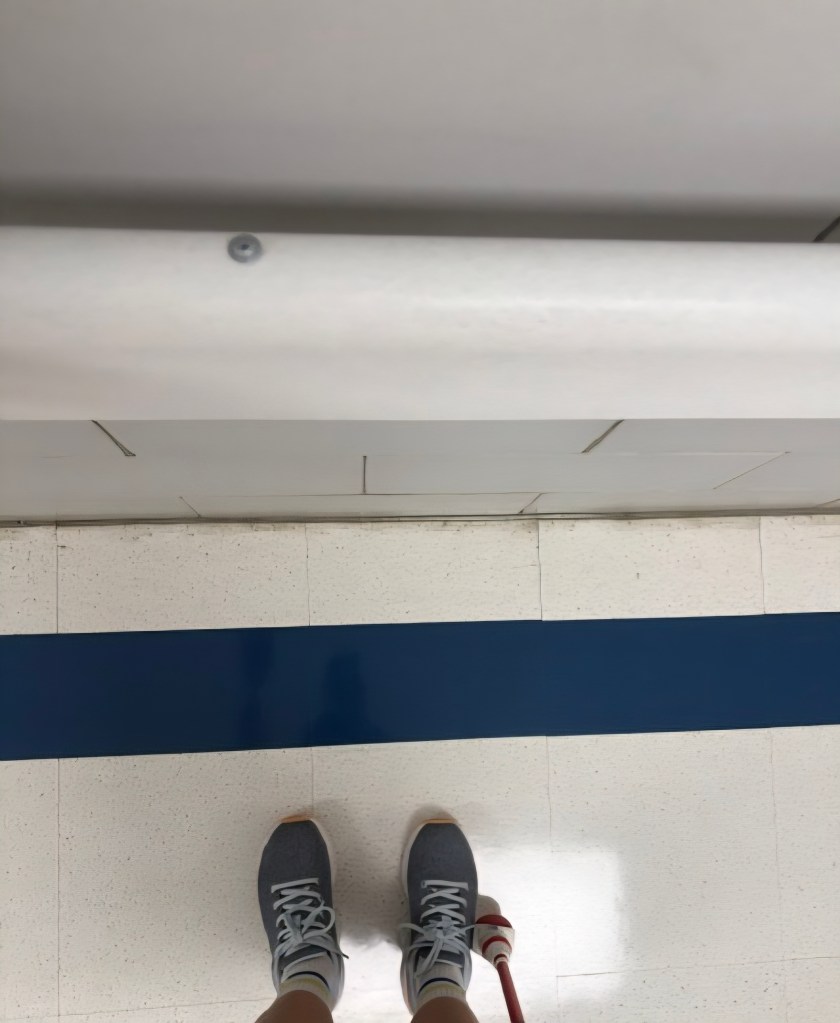
Leader Dogs, Day 2

Let me just say right now what a fantabulous job the kitchen is doing with my ARFID. Like, seriously, I have never been catered to (pun intended) so thoroughly (a) without either someone else or myself having to do a boat-load of extraneous advocacy, and-or (b) without feeling like I’m a huge, babyish burden.

Between the jet-lag, nerve-citedness, and my inability to sleep on any pillow ever besides my own (I really should invest in a travel pillow, but I bet that wouldn’t work right either), I wasn’t too hungry for breakfast. The sausages were delicious, though, and I already requested milk and water for every meal. It just so happens that I’ve felt a little sluggish in my body of late, and because soda is an easy scapegoat, I have blamed him and am divorcing him forthwith, at least for the time being. Just when there’s a shelf literally Braille-labeled “Pepsi” in the RA’s office, calling to me. Anyway, the kitchen staff also checked in with me, knew all about my safe foods (I sent them a list, but I often do that and people just willfully disregard it or think I’m exaggerating), and basically said they’d give me Caitlin-food substitutions (IE, plain chicken, burgers, peanut-butter-no-jelly sandwiches, etc.) in place of the fancy things I won’t eat, which is pretty much every meal here, because guide dog schools, like I said, are basically akin to resorts … and are also way better than the literal cruise I went on last year, which had me subsisting on milk, salami and cheese slices, and soft-serve from one floor and Oreo crumbs Martha spirited from a whole different place on the ship.

I also continue to love the Braille Rails, as I call them. Just having those bump-dots and all the Braille labels as reference points is so cool.

After breakfast, we got buddied up with our 1:1 instructors, but because I am a lucky duck, I get TWO instructors: Jeffrey, who’s an intern (he’s almost done!) and Hannah, who my friend, Alexis told me was awesome! They were both incredibly sweet, understanding, and hilarious from the get-go, which quickly put me at ease. I mentioned my anxiety around mobility, and all of my “anti-goals,” as I call them: dropoffs, instructors following you silently, etc. Jeffrey was very clear that I’ll have a say in everything we do, AND he added that a dropoff at the end of the week might be a good confidence-builder IF I decide I want to do it. That thought, of course, is beyond horrifying right now, but I shall not pass judgment until I get to Friday … or I guess Thursday.

I also talked about my general feeling, whenever I do solo mobility, that I’m in the way, slowing people down, appearing clumsy and incompetent, etc., and that I struggle with advocating for my own bodily autonomy in the face of a stranger or a frenetic situation. It was really nice to air these grievances and feel truly understood and respected.

I also mentioned that I have no idea if my cane technique is ideal, or even if my cane’s length was ideal, so we started out using a few different canes. We settled on one that, I think, is slightly longer than the one I brought, which I remembered later is my shortest one. I got a shorter one to accommodate my love for the Pathfinder and Sensaball tips, which are free-wheeling and, as I once said to a friend, “bounce over cracks with tremendous alacrity.” I love these tips, but they increase both the weight and length of the cane. AND, as it develops, I’m very tense in the way I hold my cane. Hannah had me laughing when she called it a “dinosaur arm,” and Jeffrey cited “Go, go, gadget.” This is why we all vibed.

Some fun news is that I nailed stairs, and that, actually, aside from my needing to choke up less on the cane handle and work on narrowing my arc, my cane technique is not rusty enough to give me tetanus. Considering that I haven’t had consistent O&M (I literally just wrote M&M, oops) since I was eighteen, and from sixteen to eighteen was with a guide dog, not a cane, I’m actually surprised I don’t have more egregiously bad habits than I do.

My arc has been an issue ever since I can remember. Teachers used to tease that it looked like I was clearing the way for ten people. I’ve gotten better at keeping it within my shoulders, but it still sometimes goes a little far to the side. This is a problem because, for example, if your cane’s way off to the left and straggling its way back to the right, something might hit me on my right side while the cane’s trying to catch up. So if the arc’s narrower, it has less ground to cover and will keep me safer in my little bubble.

The tricky part is that, between narrowing the arc, needing to relax my wrist and elbow while holding the cane closer to my body, and holding the cane closer to its top rather than further down the handle, my arm and wrist were complaining a bit. Hopefully, it’s just a new sensation, and as it becomes muscle memory, it will be easier on my weak little spindly wrists.

Another thing I asked about, because I literally promised someone I would (although now I forget who I promised!), was how to instruct a panicked, untrained sightie in guiding me through a doorway. Because doors open so many different ways, people are rushing, they’re often crowded areas, etc., I find that this is a place where many guides just freak out, flail, grab, push, pull, abandon, etc. It turns out that the life hack is to encourage the guide to do the narrow-passage technique and continue guiding as normal. I’m excited to see if instructing in this way will stop people from feeling awful about how doorways inevitably go.

I cited some other things I want to work on, but I imagine we WILL work on them and they’ll come up then, so I won’t go on and on. We walked the practice course twice to cement the relaxed shoulder, all-in-the-wrist technique, and reviewed the dorm one more time.

I then had a delicious peanut butter sandwich for lunch, which honestly was just so … calming and predictable, haha. I also discovered that the braille schedule on the bulletin board in the hallway had been tacked up upside-down, which caused some hilarity.

For the afternoon session, we went to the downtown to the training center there. The mobility stuff gets a little more technical here, but I’ll share some cool stuff we worked on:

* Anchoring: I somehow had never heard of this or been taught it. Essentially, when your cane touches a doorway, you keep its tip flush with the doorway while lifting the cane so that it’s pressed vertically against the door. You can then use the cane, not your hands and fingers, to feel for a doorhandle. This could prevent some nasty bites from hinges or hasps or whatever all else doors are made of, although I suppose you also have to still be careful not to get hit in the face.

Similarly, you can use anchoring at curbs. I was always taught, when hitting a curb, to do a big, side to side sweep before stepping up. The anchoring technique involves bringing your feet close to your cane tip as it anchors to the step, then lifting your cane to gauge the step’s height, as well as the area just at the top of the step, enough for you to step up safely. Then, and only then, can you go on your merry way. This gives you a better sense of how high up the step is, and also prevents you from blazing up curbs while swinging your cane wildly in a sweep as you chase after it, the way I was doing.

* Cut-backs: Another thing I never heard about! Basically, cut-backs confirm that you’re maintaining your intended line of travel after crossing a street, rather than veering off into a sidewalk or alley. I’m still kinda figuring these out, but essentially, this gets you away from the street, and involves shorelining until you find the “opening” back to the sidewalk.

* I was introduced to the genius term “sidewalk junk” to refer to things like trash cans, parking meters, and random signs, which I loved. In turn, I kept unintentionally using ostentatious words like, well, ostentatious. And circuitous. And lackadaisical. Which amused Jeffrey … who promptly also started punning.

* I told Jeffrey that I was going to write about this experience in my blog, and he rallied that he needed to video-tape part of our lesson for his mobility exam portfolio thing. Seems only fair.

* Apparently, in quieter areas, if you cross crookedly, you don’t need to leap up onto the sidewalk like a scalded cat and start springing around trying to find the curb-cut. You can stay in the street, as long as you’re safe, and feel around with your cane to see if you’re close to the curb. Who knew?

* The Three Rules Of Street Crossing:

1. Plant your feet, as though they’re in cement. Jeffrey said “see-ment,” which Martha also says, which made me  grin and emulate him.

2. Extend your cane across your body. This is called a diagonal, which does make sense, but for some reason, I literally forgot about five times what this step was called. It was unclear. My brain was probably shorting out from having had more mobility than I’ve seen (pun) in years.

3. Flagging: I just learned this one when I had a couple O&M lessons last year. This asks you to get drivers’ attention by decisively extending your cane and indicating that you’re beginning to walk. Both in high school and last year, I was taught to go really big with this, and when I’m asked to go big, I go big. I think I almost hit Jeffrey with my wild flagging … which is not surprising, because I smacked someone’s car roof last year when I learned this. Jeffrey told me that, like with my arc, I can go smaller and that, if I start on the right, I , which is where my cane seems to like to be when I start to cross a street.

4. Take a big first step, and then pick up that pace!

* I practiced soliciting assistance across a street from Hannah, who pretended to be a wrist-grabbing newb with no experience of blind-kind. We had a good little talk about bodily autonomy and not being afraid of inconveniencing sighted people in general, whether they’re guiding or getting in my way, as I travel. True, but hard for me to internalize.

Those were the highlights! Tomorrow, we’ll do some route-planning and intersections, maybe lighted ones. We just did “all quiet, all clear” crossings today, to practice the mechanics. Other folks did way more complex stuff, but I’m internalizing what Hannah and Jeffrey impressed upon me: that, literally, we’re all on our own path, and that building confidence and skills that feel helpful to me is all that matters.

Can I also just say that it’s super weird to me not being guided everywhere the instant I struggle? I mean, I fully own that I am extremely guilty of letting myself be guided even when I don’t need it … again, mostly because, the second I take a wrong turn, it feels like sighties everywhere have a whole fit and scurry over to save me, which often involves touching and grabbing. So it’s become so easy for me to just … avoid all that and let myself be guided. But there’s no grabbing here! People give verbal directions when asked, and I feel simultaneously looked after and more independent for having taken on that extra ten seconds of fumbling … because it’s not really fumbling, it’s just finding my way there, and who cares what it looks like? It’s wild to me how I can and do totally believe this for other people, but have such a hard time with it for my own self.

I appreciate Jeffrey and Hannah for making mobility fun again, and told them so. There was so much laughter, talking, and silliness, and yet, we got a ton done. They were so kind, encouraging, and complimentary, and I feel so hopeful in light of that. As I told them, I do want to learn, and I do want to be better at mobility than I am. It just never felt particularly relevant to me, nor did I feel like I was able to understand it. They talked some about how the approaches to mobility are changing, and taking into account that a one-size-fits-all approach isn’t ideal in many cases.

In closing, we had a fun, tasty dinner … I ate a whole chicken breast and garlic bread, which is a lot for me in what has the potential to be a high-stress, intense week, without anyone here I know. At guide dog school, they literally called my mom to make sure I wasn’t going to die because I was eating so little and running myself so ragged. Granted, I wasn’t diagnosed with ARFID yet, so didn’t get any food accommodations, and it was a whole month, and I was a nervous wreck, but still! I love not having to worry about food on top of everything else. AND they gave me a cup of milk to-go for my room. So kind.

And now I have written these blogs while intermittently getting up to dance and sing to everything from “Dear Evan Hansen” to Disney jams, and it’s definitely time to get to bed. Sweet dreams and more tomorrow, assuming I still have the strength, haha. But I feel great, and am so, so happy that I took this plunge and that I’m being supported and taught in a way which feels fun, consensual, and accessible to me.

Stay tuned!

Leader Dogs, Day 1

This was my travel day, but a lot still happened at Leader, so it gets its own post.

First of all, y’all’s friend Caitlin’s alarm-setting math went like this:

Me (to self): Okay, my flight leaves at 8:35 AM. That means I should be at the airport by, like, 6:45. So I’ll set my alarm for 5:45 AM, be showered and dressed by 6:15, check my packing list one more time, and I’ll be good!

In case you, like me, aren’t a math person, I’ll make this very clear: I apparently assumed that I was going to magically fly to the airport in about ten minutes.

Luckily, we actually did get to the airport around 6:30, because I was faster than expected, and Martha is always ready for action at a moment’s notice, so she was set way before I was.

Just for funzies, the person at the airport wanted to give us a hard time about gate passes, KTN numbers, etc., and kept doing the, “Will she need a meet-and-assist? Will she need a wheelchair?” Shockingly, even though I’m often infantalized in scores of other ways, this isn’t one that happens to me often. Martha, and most of my people, always ignore, I answer, and the asshattery stops there. But this time, even though Martha had stepped back to literally put herself out-of-frame, and even though I was answering very pointedly, the “Does she” questions kept coming. It was too early to duel about it, but between that, my BrailleSense getting kidnapped for literally ten minutes at security until I blind-card whined, “That’s my braille notetaker and I need to get on my flight,” and the flight attendants and my seatmates not responding helpfully to my bids for access, I was pretty ready to be in a blindie space and take a break from sighted nonsense. Oh, and there was also the employee who tried to force my hand onto her shoulder for sighted guide, the flight attendant who tried to haul me down the airplane aisle by the wrist, and the so-called meet-and-assist who insisted on carrying my backpack even though I told him I’d do it, then panted exaggeratedly like he was going to die, and whined about how no one had tipped him all day and his job was so hard. Bro, let me carry my brick of a backpack like I asked and your job will be less hard, I promise.

Luckily, my volunteer driver from Leader Dogs, Doug, was lovely. He gave me the lowdown on all the things Leader Dogs and, because he told me he and his wife are avid cruisers, I regaled him with the horror story that was Martha trying to keep me from starving to death on Royal Caribbean’s Star Trek cruise last year (I should really do a blog post about that, but TLDR, their food was appalling … like, seriously, summer camp food and college dining hall food were way better).

I was the last of the O&M crew to arrive, and because I jumped from San Fran to Michigan and there was a three-hour time difference, it was already dinnertime. I’m not a great traveler at the best of times, and my nerv-citedness just exacerbates that. Luckily, the first RA I met, Diane, took my mini-flip-out about “What? How is it dinner?” right in stride by telling me I could have a half-portion and spiriting me into the dining hall.

In my experience, being in blindness-centered spaces is kind of a double-edged sword, triple if parents are factored in.

Edge 1: It’s so nice to be among people who know the struggle.

Edge 2: It also kind of magnifies blindness, because along with the presumed competence comes more flailing and productive struggle, which can feel awkward to someone like me, who tends to allow others to help as a means of avoiding looking like a doofus.

Edge 3: If parents, or blindness professionals, or high partials are around, I sometimes feel this low-key pressure to impress, to be competent, to not fumble, to not need help … because it can feel like the other blindies around me don’t need as much as I do.

Sure enough, right away, I managed to displace the cups in the cup dispenser in the RA’S office when I washed my hands, follow Diane into the dining room awkwardly with my “Oh no I’m in a blind space and don’t want to trip anyone” panic, and then not being able to stow my cane in the nifty little broom-holder apparatuses they use on the backs of the chairs here. Rose, one of the kitchen staff who’s also a Leader Dog client, stepped in so kindly to help me and was like, “It’s because all your bling makes your cane so much thicker. Have you been watching Molly Burke?”

This both amused me and horrified me because … no shade, but I’m not a fan. And I never thought my bling would make me seem like one? I mean, not to brag, but I’ve been rocking a cane since 2013. I started a revolution (no pun intended … Revolution is a cane company)! But, no, it was funny, and she did manage to show me a hack to get my cane to comply.

It developed that the O&M crew have our own table, and that we have two retired teachers, one person who lives in Santa Cruz, and one who’s going to college to become an elementary-aged teacher. So, you know, the group was basically constructed just for me, clearly. Everyone was super kind and friendly, and filled me in on the info they’d gleaned by arriving way before me.

After dinner, Diane acclimated me to the dorm. The raddest thing is that there’s a railing system along the hallway with bump dots … so, as you’re trailing, you feel a bump dot, which cues you to read the braille and raised large print above it, which tells you what’s ACROSS the hallway, which, of course, also serves as a landmark for your side of the hall, too. I’ve never seen any system like this before and I was so into it!

The whole experience was also giving me the warmest, fuzziest Guide Dogs For The Blind feels, since I went there in 2006 … which I was horrified to realize, for the first time, was twenty freaking years ago. TWENTY! I am thirty-six! What even is life? I had Lannie twenty years ago. Twenty! Okay, I’ll stop.

But anyway,

Like many guide dog schools, this one feels like a legit resort: Alexa in your room will read your daily schedule and meals to you ahead of time, as will the old-school phone turned new-school; outlets, drawers, hooks, and counter space everywhere; a freaking ginormous desk and chair; a recliner; you name it. And don’t even get me started on the freaking Snack Wall. Anyone who knows me knows that I subsist largely on goldfish crackers, chips, and store-bought treats. If you’ve ever seen Martha’s and my snack wall, just know that the Leader Dogs one puts ours to shame, mostly because mine is, of course, restricted to Caitlin-foods only. This one has, like, ever candy, chip, or bar you could ever want … except, strangely, not Fritos, but this can totes be forgiven.

They also left a surprise Leader Dogs backpack and water bottle on a hook for each of us … and offered to put a Braille-on “CAITLIN” label on mine. So cuuute! These little touches never fail to melt my soul, like when the Braille Challenge people gave us labeled shampoo, conditioner, and shaving gel bottles that one year.

My phone was janked up, so I wound up going back to the RA office after unpacking, and they not only fixed my phone but gave me the WiFi and a yellow Gatorade, because the braille label just said “Gatorade Assorted” and I cannot. Only yellow forever, please and thank you … and it’s great because normies tend not to like yellow, so I bet I’ll be helping everyone out.

And then I talked to my mom, texted my dad (who just moved to Kentucky and was subsequently in my time zone), and had a good-night chat with Martha and my precious giant baby Rock Wilder, Maíte the Magnificent, whom I miss desperately. Seriously, if I don’t get to hug a dog sometime this week, we may have a problem. I have gotten so attached to my dogter that it’s probz not ideal. And Martha keeps sending me adorable clips of her snorfling and toe-tapping and snoring. So much better than weak pictures, right!?

Also, just saying, I’m still loving the Finch app, and I’m getting to check off all my exercise goals while I’m here! So if you have Finch and wanna be friends, come join myself and “The Mouth,” named after the famous YouTuber (ahahahaha YouTuBird!) who is basically a ventriloquist genius. Search him up if you have not.

Stay tuned for Day 2; if I can keep up my writing flow, I’ll catch up tonight.

Also, in case anyone cares, Alexa is playing me the Dream Street album, and it is two-thousands-bubblegum-tastic and I have no shame.

Okay, more laterz. Huggles if wanted.

Into the maelstrom

Y’all. This world is…something else. I am still moved to tears on a regular basis about what we (the US as well as other countries) are doing in the name of…what? Capitalism? I don’t understand, honestly, how people can continue to act as if nothing is happening. I am doing all the things I know how to do in terms of boycotting and avoiding companies. I am speaking up whenever and where ever I can. And yet I still feel…hopeless. And ridiculous as I try to make videos and write stories for children.

This week I read One Day, Everyone Will Have Always Been Against This, by Omar El Akkad. It’s a deeply personal look at the ongoing crisis in Gaza and the way we, as part of Western civilization are managing – whether we are complicit, witnessing or actively looking away. It was a tough read.

And yet, it’s not all dark. He writes about things people are doing, boycotting and walking away from jobs, students denouncing their universities and others refusing to participate with their dollars in other ways. He writes about the responses of those in power – their shock and dismissiveness. Here’s a quote:

“The idea that walking away is childish and unproductive is predicated on the inability to imagine anything but a walking away from, never a walking away toward—never that there might exist another destination. The walking away is not nihilism, it’s not cynicism, it’s not doing nothing—it’s a form of engagement more honest, more soul-affirming, than anything the system was ever prepared to offer.”

Even as I continue to participate in the ways I have been, I am going to shift my own language away from the things I’m resisting. From now on I want to focus on the things I’m turning towards, smaller businesses, local community and building stronger interpersonal networks. I’m turning towards the arts and whatever joy and understanding I can muster. What are the ideas you are turning towards in this maelstrom?

Image is of a lightning storm at night – it’s dark and cloudy and the lightning looks pink.

Sticks and Stones

Ever had a child swear at you? No, not that kid, not the kid that you just told, “Close the chromebook,” or “Time for bed.” I’m talking about the child who swears at you and then afterwards you are left thinking, “What did I do?”

Swearing is an important part of communication, and I am a fan. I know not everyone is, but I find that it can convey a sense of community (in the right circumstance) and of course, adds emphasis to what we’re saying. There is a whole continuum of swearing, with people who swear so much that the emphasis part of that gets somewhat diluted, and people who never utter swear words, and I respect that choice.

Children swearing, though, is often seen as distinctly different. Some people believe that children should not be allowed to swear, and if we do pretend we cannot hear them swearing on the playground, that at the very least they are NOT to swear at adults.

I generally have a pretty relaxed attitude about it. I have long told children that if they are going to swear in front of me (in my office or in my own family), they can swear ABOUT things, but they may not swear AT people, or call them by swear names (no calling names is a regular rule in my office, so “swear names” is just a continuation of that rule). When kids are following those rules, I really don’t mind when they swear. Even if they are mad at me and using all kinds of swears.

Why doesn’t it bother me much? It doesn’t because I know if a child is throwing around those heavy words, they must feel pretty powerless. I understand that even adults who use those words in the context of a power differential, real or perceived, are doing so in order to exert some power of their own.

Full transparency – it does bother me more with teens and adults – but I still think that words used in an effort to hurt say much more about the person saying them than they say about me.

Image shows Maite laying on the deck from last summer. Her tongue is out and she looks relaxed. She is a great swearer.

NAME GAME


HINT: Skip to the end if you're wondering why Martha calls me "TJ."

For as long as I can remember, I wanted a nickname. For whatever reason, I've always connected nicknames with words like "blindie," blind jokes, and the right to (with consent) guide me in an unconventional way. All these things have to be earned.
In the same way I despise outer-circle folks going around pontificating about "blindies," teasing me for a "blawkward" (blind plus awkward) moment, or steering me by the shoulders, I have always chafed at people's insistence on calling me "Cait," "CJ," or, God forbid, "Caity," unless they've expressly been told that I liked it.

I wonder if I connected these ideas because, in the same way people project false familiarity around blindness, I feel that people have attached nicknames to me as a means of declaring friendship, connection, or even ownership that isn't really there. Or maybe it's just because, as a blind kid trying to cut it in a sighted world, with extracurriculars, blind stuff, and (then unidentified) ARFID sprinkled over a typical childhood, I felt like I had so little autonomy.

As a kid, I was Caitlin to just about everyone. Very early on, my dad nicknamed me Trouble, or its derivatives, Troub and Troublemaker ... but that was very much his nickname alone. No one else used it until, years later, entirely unaware of my dad's nickname for me, my seventh-grade science teacher also awarded me the same label.

"Cait" and "Caity" were exclusively family names, with only my grandparents and Aunt Linda allowed to use "Caity." My grandpa, with his affinity for Spanglish mixed with the occasional German from my grandma, called me "Diablito," or "little devil." In hindsight, I found it interesting that he didn't use "Diablita"; perhaps this was a nod to my wild-child, tomboyish behavior. I wish I'd thought to ask him before he passed away in 2012.

By fourth grade, I was taking nicknaming into my own hands. My infamous Deraitland bestie, Derek, myself, and some other friends sometimes invented languages. In one, "Caitlin" backwards became "Niltiac," pronounced sort of like "Nil-shyack." In another, "Caitlin" in braille, upside-down, became "Itincoma," which I loathed and Derek, subsequently, used often in an attempt to rankle me.

The nickname I lusted after constantly was CJ, for my first and middle initials. Derek, happily, was DJ, a nickname which I used a lot. CJ never really took, but for a time, we became "Coodge" and "Doodge," with the double Os in "book." But these were very much Deraitland names, and perhaps with good reason. I could be misremembering, but they may have been a nod to our constant fixation with imitating the speech synthesizers of the time. Though CJ and DJ would not have been read as "coodge" and "doodge," those names were reasonable approximations of how a screenreader might have misread them.
By fifth grade, I was going totally rogue. I brailled and typed "Cat Hernandez" on all my papers, as though it was my given name. When some grown-ups would obligingly write "Cat" but never call me that, I tried Kit, Kit-Cat, and, in a final, desperate attempt, C. Nothing worked.

"Cait" and "Caity" remained staples with the family; my dad added "It" and "Little It" to Troub and Trouble; and my sister, for reasons I now can't remember, called me Poopsy. My mom, when I was being particularly cute, would call me her "Little Lamb Chop," which I liked only because I loved both lamb chops and the show Lambchop's Playalong. But such a nickname was too sappy for public consumption.

This seems like a logical time to pause and state that I have no problem with the name "Caitlin." It fits me. I'm especially grateful my parents picked the spelling they did, not only because I prefer the way my spelling looks in braille to that of all the others, but also because it enables me to make my albeit somewhat confusing crack, "Caitlin: remember, two Is but cannot C. Get it? Two EYES but cannot SEE," which, if you don't think about it so hard that you wonder whether the "cannot" means you ought to use a K and not, in fact, the correct C, helps people spell my name correctly.

No ... in spite of the fact that there's no good story behind my name, other than that it went well with Courtney, my older sister's name, and that my dad had heard the name and thought it was, quote, "nice," I like my name. I think, though, that I did sometimes come to associate it with being in trouble. Maybe it was because people couldn't wave, make eye contact, or get to me visually, but often, even today, when I hear my name called, even in a casual way, I immediately panic and think that I'm in trouble. Sad, but perhaps true ... and possibly a reason why I always longed for a nickname that wasn't restricted to a certain crew of friends.

In college, I tried to start out as CJ with my a cappella group. A few people used it somewhat, but in more of a tongue-in-cheek way, not as a true nickname. Amusingly, a label which did stick was "Cajherna," derived from my collegiate e-mail address, which I had not chosen. Apparently, there were so many C Hernandezs that the system spat out the second letter of my name, my middle initial, and the first part of Hernandez. I had to dictate my school e-mail address so many times when signing in at events that my a cappella group, claiming it sounded like a sneeze, began to call me that every so often. Another of the Acquire contingent, Andrea, also took to teasingly calling me Button, which came to light because of a random guy who, upon seeing us in Safeway and recognizing us from busking, said, "I remember you all singing, and I had to stop and tell you ... you're just as cute as a button." Some casual ableism there, as he must have known we were both college students and still insisted on treating me like a disabled child. However, as with "blindies," we took the comment and turned it into something fun.

Some other in-group names:
* Dez: short for Hernandez, from a later Acquire member, Caroline, and later adopted by the CRE Outreach (now Arts Up LA) boys.
* MC, PC, LC: standing for "Poor Child," "My Child," and "Little Caitlin," respectively: all nicknames my dad came up with in the era of texting, again poking fun at people's insistence on feeling sorry for me or infantalizing me, even when nothing is wrong.
* Little: What my sister started calling me, after getting me a braille bracelet which read "little sis." (She, of course, is Big, which appalls my mom, because some people are still laboring under the delusion that being big is bad. I might add that, though she's taller than me, Courtney is actually more delicate / small-presenting.)
* Ti-Ti: What my niece has called me every since she could talk ... technically from the Spanish Ti­a, although no one in our family speaks Spanish meaningfully, and I doubt the kid even knows that ... I was just always Ti-Ti. It would be so weird if she ever called me Caitlin.

The thing with nicknames, though, is that, beyond lamenting frequently that you want one, you can't force people to come up with the perfect, awesome, organic encapsulation of you. And then, once they find one, you can't coerce other people into using it ... and even if you could, it might seem weird, or nonsensical, depending on the origin of the nickname.

Which brings us to Martha, and TJ.
So you all know our adorable eight-year-old Rock Wilder (Rottweiler), Maite. Mighty Maite. Big Maíte. Fubu (For Us, By Us). Big Rock. Ruccoon (after Rocky Raccoon). And on and on.

Since Maite was already Martha's "dogter" before I came on the scene, I became "Stepmom" to her. If you've heard any of our videos or recordings, or read transcripts, Maite has a very distinct way of speaking, a little like a kid with some speech quirks, sound additions and deletions, and some unexpected ways of mixing and garbling words and terms. So Stepmom became "Tep Mom" ... and, because I, of course, had told Martha about my quest to be "CJ," CJ, in Mai­te-speak, became "TJ." And because Martha is Martha, TJ stuck more than CJ did, because Maíte is such a talkative fixture in our house.

Now, because I'm a rule-following people-pleaser, I did object, "But TJ has to stand for something. It's too confusing to explain, otherwise. How about Trouble Junior? Trouble has always stuck, and Maite is clearly the biggest troublemaker in our house."
To which Maite, of course, responded, "That is not no true story, Tepmom, GAH!"

But TJ stuck ... and now you all know the story. And while I would prefer for you to just call me Caitlin, I'm always open to new nickname ideas, should they arise. Just make sure you've earned it, and that I've approved, before you go shouting it all over the place.

Connections

I just want to start by saying that I am addicted to my phone as anyone else (TJ probably takes the most heat for this, so my apologies, honey) given the right circumstances. I know that it isn’t our fault, that phones and apps are designed to make us want them, to feel like we need them. They use dopamine against us, as well as the brain’s tendency to focus on the negative (some info on this from Tristan Harris).

I didn’t know much about this until my mom called me one day pretty upset over some puppies that had been found in bag in a field.

Me: Wait, which puppies? Who found them?

Mommy: I don’t know, I don’t think they were speaking in English.

Me: (suspicion creeping in – she once spent at least 10 tearful minutes telling me about a horse being treated miserably before I recognized the 1946 movie Black Beauty) Where did you see this?

Mommy: Tube! (which is how she refers to YouTube)

I looked up the video, discovered it was at least two years old, found the original poster and the follow up video that most of the puppies survived and made it into happy homes. After…

Me: How did you start watching that video, anyway?

Mommy: Well, I was looking at cute puppies, you know, like Blessing (her Pomeranian at the time). They are so funny and small! And then another video and another and then this one. Oh, so sad.

YouTube claimed at some point to make changes to the algorithm but who knows?

All of that to say, I know this isn’t about poor choices or some inborn “addictive tendency,” or even “this generation.” The whole thing is very much designed to keep us online.

Once I realized it, I have done what I can to resist it. I rarely open Tube except for specific videos. I don’t turn on notifications on my phone. I keep the ringer (all sounds, really) turned off on my phone. I have used various apps (I know, ironic, right?) over the years to keep track of my time online or to shut down automatically at 9 pm. I have the timer set on my phone these days to turn off social media after 20 minutes. It almost always surprises me when it pops up.

Meanwhile, I was recently out of town and stayed with a local family. Luckily, my housemate was terrific – we connected right from the first day. We spoke every day, sometimes for literal hours at a time. Then I got sick. My host family and housemate were rightly concerned about getting sick themselves and so I was more or less quarantined in my room.

I listened to audiobooks, but often I do that while doing other things, like chores or driving. I found myself unlocking my phone over and over again to do random searches (some prompted by the book but others just random things that popped into my head). I had to stop and reverse many times because I wasn’t really listening. I found myself reading an email from REI – like ALL the little blurbs. Did I mention I had very little internet? Yeah, that was what was saving me from social media. Without the near endless scroll of social media what I had was: incessant checking of email, reading emails I would usually just delete, crossword puzzles, other word puzzles and incessant checking of email.*

What was missing from my days that led to this drastic change in behavior? People. Like my awesome housemate (plus all my people at home). Humans are hard-wired for connection – we crave it more than food – and not having any was leading me to look for it in my phone. Sadly, mostly what I got from my phone were advertisements – both the obvious and the more subtle. It’s true I also had Signal messages and WhatsApps that helped so much, but I really did refresh my email feed every time I picked up my phone.

You might be asking, what’s your point, doc? My point is, if you notice people around you (because I’m sure you would never) who seem a little too interested in their phones, consider what points of human connection they have access too. For some folks, online connection is the bulk of their contact with other humans. If you aren’t sure, think about how you could help increase those points. TJ and I hosted our first block party about a month ago and we are planning a second one next month, in part to build just that, a bit of human connection. Showing up to events at your local library is another option – those events are harder to continue to host if no one shows up!  Just by attending, you are helping maintain access points for others. Hosting a game night, or inviting people to a live music event – there are so many options. As humans, we need other humans. Let’s do what we can to create and maintain these human connections. What do you do to connect?

*I know I said this twice. It really was incessant

Image shows a red background with multiple rows of cell phones with white screens.

WELCOME, PLUS A LIFE UPDATE!

Hi, people!

So, in case you are either (a) fully sighted with no blindies in your corner and-or (b) living under a rock, you oughta know that Facebook, in addition to all its inherent security and political badnesses, is becoming a regular trash-heap of accessibility problems. The most heinous of these include having to go through ridiculous work-arounds to do things as simple as composing a post, writing a comment, or being able to know what link we’re clicking on before we leave Facebook. Again, basic things. Totally unacceptable that these issues have been dragging on for literal months. Non-disableds would not stand for this.

As you can imagine, this app inaccessibility, combined with the fact that Facebook Mobile (on the computer, not the phone) is now also a cluster, has made me less and less inclined to post status updates. Therefore, ergo, and henceforth, the plan is to move gradually away from Facebook and more toward blogging. Will it work? No one knows. But it definitely won’t work if I don’t try!

Let’s break it down into nice paragraphs. I’ll even do little fake titles / headings. Mostly for the sighties. I think they like that. But I’m not doing formatting.

WHY A BLOG?

A long time ago, Martha and I thought it might be fun to blog together. Do you like our cute title?

Dots: speaks, of course, to my love of all things braille.

Doc: Have you met Doc Martha? She blogs and Instas already, but hopefully she’ll bring some Doc Martha Magic, as I call it, over to this little corner of the Interwebs.

Roc: The cool shorthand way of spelling “rock,” which is for Maíte, the Rock Wilder (Rottweiler). She is our eight-year-old dogter and we love her. She enjoys raw meat, singing, chasing “creachers” to the best of her abilities, and “para-ambulations.” She may guest-post on here occasionally, if she’s not too busy “ressing” in the “tsunchine.” Plus, we, all three of us, rock. And enjoy rocking out.

Most updates, I imagine, will be more brief and topical, but I have a few life updates that I think it will be helpful to fill you folks in on so you know where we are these days in Caitlinworld. I’m also not going to update on, you know, seemingly everything in ways I once did, but more things that feel more sharable for, and consumable by, the general public.

SCHOOL

This is my ninth year of teaching. It is ridonculous. Like, seriously, I don’t even know how that happened.

To make a very, very long, nine-year story short, I’m still having problems with our school district, to the point that I was pushed out of a school due to accommodations-related reasons. Last year, for the first time, I taught a special-day class for third, fourth, and fifth grade students with mild to moderate disabilities, in the hopes that the main accommodation issue would be less prevalent. In fact, the issue was still prevalent, and a bunch of other issues in that setting compounded it, most notably never being fully staffed.

Our school district is infamous in the news for its struggles and, thankfully, school sites seem to understand that, with almost a decade of special education teaching under my belt, I’m actually a useful staff member to have on their team, in spite of the fact that, you know, I can’t see things. This year, I’m back teaching small groups of kinders through fifth graders at a little elementary school that’s actually walkable from our house. The children are delightful, and some of the most hardcore, dedicated learners I’ve ever had. We haven’t had a special educator at our school for the past two years, so from the get-go, my crew, by and large, were extremely eager to receive the support.

I know some of us, myself included, miss kid-quotes! Kid-quotes make the world go ’round, don’t they? I have gotten out of the habit of putting them in a palatable format; I just tend to scribble them in my daily notes and across my lesson plans. And I haven’t made up kid-names in ages! But I will keep chewing on the idea of bringing them back. Maybe in, like, a weekly or monthly digest?

ARFID

As some of the long-time Facebookers may recall, my therapist was able to give me an official diagnosis of ARFID, or Avoidant Restrictive Food Intake Disorder. For the uninitiated, ARFID is often handily explained as “more than picky eating.” It’s when people struggle to eat typically, due to low interest or appetite, fears of choking or becoming ill, and-or sensory-based things like flavor, color, texture, etc. For me, it’s mostly about texture and poor hunger cues.

The texture component has been present for as long as I can remember, but the interoception piece, I think, worsened during the shelter in place, when eating was much less structured. School and being out and about in the world tends to help me with scheduling my eating; I just never really thought about it that way.

Long story short, after the shelter in place and returned to school, I had unintentionally lost a lot of weight, due to eating both less food and less frequently. I worked on it over the summer, got some guidance from providers familiar with ARFID, and joined some ARFID Zoom groups. Things got better for a while, but got worse throughout the school year. ARFID on its own was difficult enough, but last year, we were extremely short-staffed, and I wasn’t used to teaching the special-day class.

By the end of March, I’d lost so much appetite and weight that even Kaiser people were concerned, and I was referred to a partial hospitalization program in the city. I had to go on medical leave for the rest of the school year, and was at the program for eight hours six days a week. That gradually decreased as I was able to work on my eating.

Because ARFID is such a relatively new disorder, there aren’t really best practices on how to address it. I ended up trying a new med, which increased my appetite drastically and helped me put on weight rapidly, but it made me feel absolutely miserable. I quit the med after about a month, but it took a while to taper down, which was very unpleasant. But I’d put on enough weight and learned enough new skills that I got sprung from the program.

The folks at the program were pretty kind, and … well, you all know me, I brought my signature joy as best as I could. If nothing else, being able to focus on eating and not stress endlessly about school helped, and then I had the whole summer to stay in good patterns.

This school year has gone so much better, and I’ve kept up with eating … knock wood. My main takeaways have been to just TRY to eat, even if I don’t think I’ll be able to. And to eat whatever feels doable, even if it’s not what I quote “should” be eating. Relatedly, we have banned the concept of “junk food” in this house. It has been renamed to “simple” food, which you say with a French accent and hair-tossing. I will do a video of it sometime.

So that’s the ARFID update. Oh, also, we’ve been doing some fun videos of me trying new things, but, thankfully, the program did not force me to eat different things. They encouraged me to eat a higher volume of my “safe foods,” which was a big relief. I’ve never felt motivated to eat, quote, “normally,” and my blood tests have always been okay, thanks to vitamins and, at some points, iron.

OUR LITTLE FAM

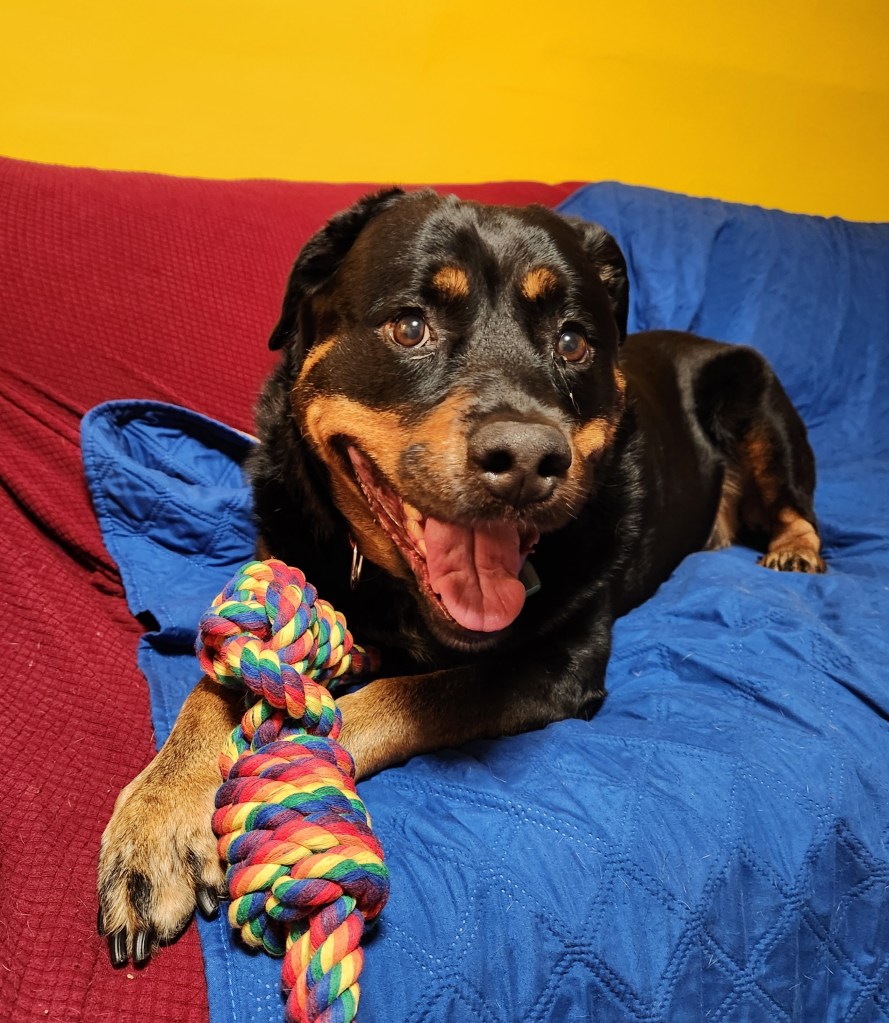
Image shows Maite lying on the couch with her rainbow pull toy between her paws. She has a big, open mouthed smile on her face. The colors are interesting (to me) because the wall behind her is yellow, the cover she is on is blue, and underneath that is the red couch. Very bright. Very Caitlin. – Martha

We’ve now been in our house for about three years.

We have the best next-door neighbor ever, “Uncle Wayne,” who calls himself the Mayor Of the Street. He is hilarious and always keeps an eye on us. Martha, in particular, knows all the dogs and their families, too.

We also hosted a block party, and now have a great sitter and walker for Maíte. So I feel like we are slowly but surely finding some community.

WRITING

This part saddens me: I have done literally NO writing. No Facebook posts, but also, for the first time in my life, I don’t have any story ideas, either. It’s super saddening. I did NaNoWriMo successfully for the first time in 2023, but flunked out midway in 2024 … and the stuff I did in 2023 wasn’t that great.

STAY TUNED

Hopefully, I can stay on this wagon and get back in the posting / writing groove! Think good thoughts for me!

If you made it this far, I shall send you e-hugs and rainbowz!