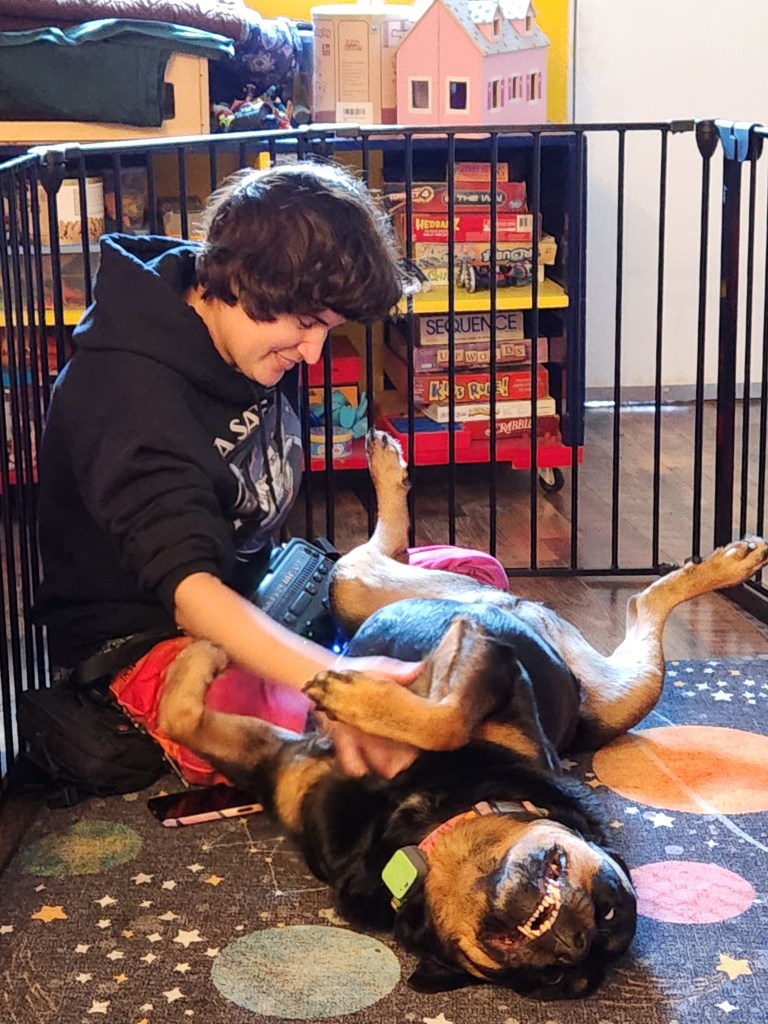
I’m ready!

Total transparency: I love reading her posts, but I’d just as soon as she came home now. :)

When we were getting ready for Caitlin to leave, I was like, “I’m going to record a million videos!” To her credit she was not immediately irritated that I was blaming her for my lack of videos lately, instead she said something supportive like, “Oh, you like that!”

I am NOT blaming her for my lack of videos, but you know, since she’s on summer break, she’s…around! During the school year, I’m sitting in my office, doing my things, and if I have a break, I might doodle around and end up making a video. Or at least thinking about one. But when she’s on break, I’d rather come out and see what she’s up to. We like to eat lunch together, even though we eat very different meals. We like to walk the Maite together, or get in the hot tub. It’s not like I’m not working, or getting work done, but the very real space and energy that goes into writing/creating something isn’t happening. Even writing this and my other post – I think in part that is happening because she isn’t here. Which is a little sad but also worth knowing.

ANYway, y’all will not be surprised to learn that I did NOT, in fact, record a million videos. Or even one. A friend of mine predicted this, saying that when her family left 2 days before her on a trip, she also thought she would get a lot done. Instead, she spent her time sort of spacing out, wandering around the house (not the whole time, obviously). I was like, No, that won’t happen to me. Because I’m humble.

Then leaving choir rehearsal (which can I just say I was SOOOO tired after a migraine today and spending too much time in traffic, I still went because it’s so fun to sing with people again!) I really wanted to debrief with Caitlin. Only she wasn’t there. So I decided I’d send her a schedule-sent Signal when I got home. Then I pulled into the garage and checked to see if she had been online recently. I didn’t really expect it given the time difference and ALL THAT WORK she is doing, but I checked anyway. While I was checking, I momentarily forgot she was gone (I know, I know, that seems ludicrious, but I am telling the honest truth) and thought, I better get upstairs because she and Maite are waiting for me… then remembered that Caitlin is gone.

Yeah, I’m ready for her to be home.

Leader Dogs, Day 5

Shout-out to my therapist for exhaustively reading this entire blog and making notes on all the reasons she’s proud of me, all the times she laughed, all the things she took the time to search up, and all the things we could talk about in future. She is truly the best, and I adore her and appreciate her beyond words.

Today for breakfast, I got a choco-chip muffin, and Jeffrey encouraged me (kindly) to try quinoa chocolate bark. Apparently, I tried this before, with Martha, on airplanes! But this one was homemade by the chef, and it was way tastier. It was a similar taste and texture to those chocolate / espresso coffee beans I used to snarf from Trader Joe’s: chocolatey and bitter and kinda … gritty. Shocking that I liked it, but I did!

Hannah had meetings, so Jeffrey and I did a quick route-plan, then reviewed and practiced a lot of the key take-aways from yesterday.

* I think I forgot to write yesterday that I’d somehow never really computed that we line ourselves up to cross along the inner curb because the traffic is closer to the outer curb. I mean, I guess I knew that … but not in those exact words. Necessarily. So you just listen to which side your traffic’s on, and then focus on the inner curb accordingly. MAGIC HACKS!

* This one took Jeffrey a couple tries to explain. When and if I veer while crossing a street, and my cane bumps a full curb on a left angle, that most likely means that, when I Go Go Gadget, the up-curb will be on my right, and vice versa. This may not always be true, but is a good place to start. We also talked about doing Go Go Gadget arm minimally at first, then extending farther on each side if I don’t immediately find something. If I go big first, I might miss the domes, since they’re often much closer than I think (IE, the veer is often not that big).

* Again, we practiced not moving my feet when I find the domes and using the traffic to check alignment on more simple crossing. For more complex crossings, I first line up with my shoulder lined up to the APS pole (we went from forearm to hand to shoulder because I am me and need Caitlin-specific choreography). Then, once I’m lined up with the pole, I use the traffic to confirm. This freaked me out a little because I’m usually not on the domes! I just have to trust the surge to guide me! I could also edge forward a LITTLE toward the domes, but carefully, so I don’t lose the magical position!

* Jeffrey reminded me again that it’s okay to wait until I get a parallel surge that I like. It’s okay to wait, take my time, and listen to one or more cycles to ascertain what’s going on and to make sure I’m lined up right.

* We also practiced using the traffic to get back on, or maintain, our line of travel. I always knew about this, but didn’t think as much about it in terms of avoiding sidewalk junk. Jeffrey pointed out that, typically, you get around sidewalk junk most safely by moving AWAY from the traffic. Maybe that should have been obvious, but, again, I just never thought about it that way.

* In terms of parallel surges, we talked about “The Golden Goose” surge, where the cars aren’t just tearing up to the intersection and passing through, but have been waiting for their turn, and are accelerating. This is complicated by the fact that (a) a lot of new cars idle very quietly, causing me to think no one is waiting and that they might be a new arrival, rather than an accelerator, and (b) in busy intersections or areas with lots of noise, it can be hard (for me, anyway) to differentiate.

* Funny moment:

Me: This car’s waiting for me, huh? But I want my all-quiet, all-clear.

Jeffrey: Right. What can you do to encourage him to move on? (Without thinking, I whirled around and pulled up my cane, acting like I was going to leave.)

Jeffrey: Ahh, don’t move those feet!

Me: Ahhh, I forgot!

Jeffrey: Look down or look away, but don’t move those feet.

Me: Should I look, you know, in the opposite direction? Or in their direction, so they know that I know they’re there?

Jeffrey: I think “nose to ground” is a good reminder.

After our water break back at the downtown lounge, we spent some more time with the Wheatley boards. Those are the big felt-covered boards with plastic strips for streets, blocks for intersections, little squares with bumps for truncated domes, little cars and people, etc. These can be velcroed in whatever place you want, to build intersections, simulate crossings and movement of pedestrians and cars, etc. It really seems like an art form to me when these instructors just built complex intersections in a trice.

We did a review of complex lighted intersections. Like with yesterday, Jeffrey took the time to explain things like lanes, different scenarios, being careful about cars that might turn unexpectedly and what can be done, etc.

We then did a quick walk to a complex intersection. It sounded SO wild, but Jeffrey made it clear that we were just going to listen, not cross. He wanted me to be able to hear it in person after we’d simulated and discussed it with the board. Hannah was also able to join us on this leg of the journey, which was great, because she and Jeffrey often tag-team and riff off each other with extra tips, ideas, suggestions, and noticings.

After lunch, we went to the mall, because I’d asked for techniques for the mall, stores, etc.

Best line:

Jeffrey (as Hannah cranks some music): Is this that song y’all were singing earlier? “Lifestyle Of Evan Williams?”

Me: Ahahahahahaha!

Jeffrey: Something about … Dean Williams?

Hannah: “Dear Evan Hansen.”

Jeffrey: Oh, is that what it was?

Me: My dad calls it “Dear Evan Handsome,” if that helps.

In the mall, we talked about using sounds as markers, which sounds like a good idea until you think about all the competing sounds in malls: fountains, mall music, people talking, echoes, music coming from individual stores, etc. Now that I look at it, that list actually doesn’t seem that intense, but it all adds up and becomes a lot. We practiced escalators and went up to Nordstroms. I was going to try soliciting verbal directions to the bathroom from a salesperson, but some customer who reminded me uncannily of my mom was taking forever and a day at the counter.

Me: Can you just pretend to be a stranger and I’ll practice with you?

Jeffrey (turning into his alter-ego, Joffrey The Boy King from Game of Thrones, which he’d told me about): Helloooo, madam, can I … (sketchily) help you?

Hannah (amused): Oh, no …

Me (trying to stay in Caitlin character): Can you please give me verbal directions to the women’s bathroom?

Joffrey (sinisterly): Yes. I’d loooove to. (breaking character) Okay, no, that got creepy.

Me: Ahahaha it was great.

Jeffrey: Okay, Joffrey’s gone, I’m back.

Hannah and I also practiced bathroom tips, but their Nordstroms bathroom was waaaay more straightforward and chill than ours. Still, good notes: try to stick with one wall at a time (not just flail around and go in wild circles, like I frequently do, in search of the stalls); trail the walls with the back of a hand; be mindful that sinks may stick out; etc.

Jeffrey also showed me one of those enormous marbles that rolls around and around in water. I can’t explain it now, but Martha showed me one at the county fair. They’re so wild!

We also talked about how malls seem totally, ridiculously insurmountable to me, but I could pick out a couple of stores and plan a route beforehand. And because they are cool, Hannah and Jeffry reiterated that human guide is a tool in my toolbox! So if I want to do that — if that makes the most sense, like if I just want to browse a mall and not get hung up on every single piece of mall junk — that’s an option.

Hannah also noted that many malls open before the actual stores open, and that would be an ideal time to practice, map out routes, etc., like when I used to practice my routes for school in the summer, or after school. Much easier to learn the route without people swarming everywhere.

On the drives to and from, we talked about odds and ends, from why I became a SpEd teacher, to my attempts to find something noise-canceling that doesn’t make my hearing feel weirdly occluded, to their experiences doing extensive training under blindfold. One of the ladies in our cohort also did a route with a blindfold and poignantly said to me, “I have so much respect for you, Caitlin, because my blindfold comes off, and yours doesn’t.” My “best straight guy friend,” Mitch, from college, said something similar after he did a Dining In The Dark-type simulation, and it really just warms my heart when people empathize in that way. I know people have big feelings about simulations, but when they’re paired with training, education, and-or exposure, as in these cases, I really do think they have their place, teaching empathy but not pity.

I was going to take a nap, but one of our crew texted our thread and told us there was ice cream in the piano lounge, and another told me there was an Oreo-type thing that I’d probably like … and she was right! At dinner, Jeffrey delivered my mail: a brailled letter from Martha (and Maite). Soooo cuuuute! I may or may not have gushed and bragged a bit about how sweet and brilliant she is. Everyone was properly touched.

We had fun chats about favorite desserts and adventures of the day, and I told the group that I, very suddenly, felt a huge influx of big feelings about leaving. I was a wreck after leaving guide dog school because I’d bonded so much with the cohort. And when I left LA after the “Dreaming In Color” summer, I was more sad than I think I’ve ever been in my life. For weeks! I cited that it’s not just about leaving the people and the, like, vibes, which is hard enough; it’s also about leaving a world that feels built for us, where blindness and visual impairment is normal, where we’re understood, respected, and treated well. It can feel very hard to leave that, especially when there are stressors at home, and when you feel some anxiety about preserving and keeping up what you’ve learned, as with guide dog school, but this time on your own (until you teach your people the things you learned, so they can support). The crew, of course, got this.

I forgot to mention that I tried the jumbo roller cane tip today and liked it as a lighter option. It doesn’t hop over cracks like the Pathfinder and Sensaball, but it does pretty well and is much lighter. I bought one at the RA office so I have it as an option.

I also did my best to take pics of the braille rails, wall of snacks (with its braille labels), and fridge (with the braille labels on its shelves) for my therapist. We’ll see how I did.

And, as ever, I’m zonking out! Only one more day … nooooo! I feel like I’ve been here forever!

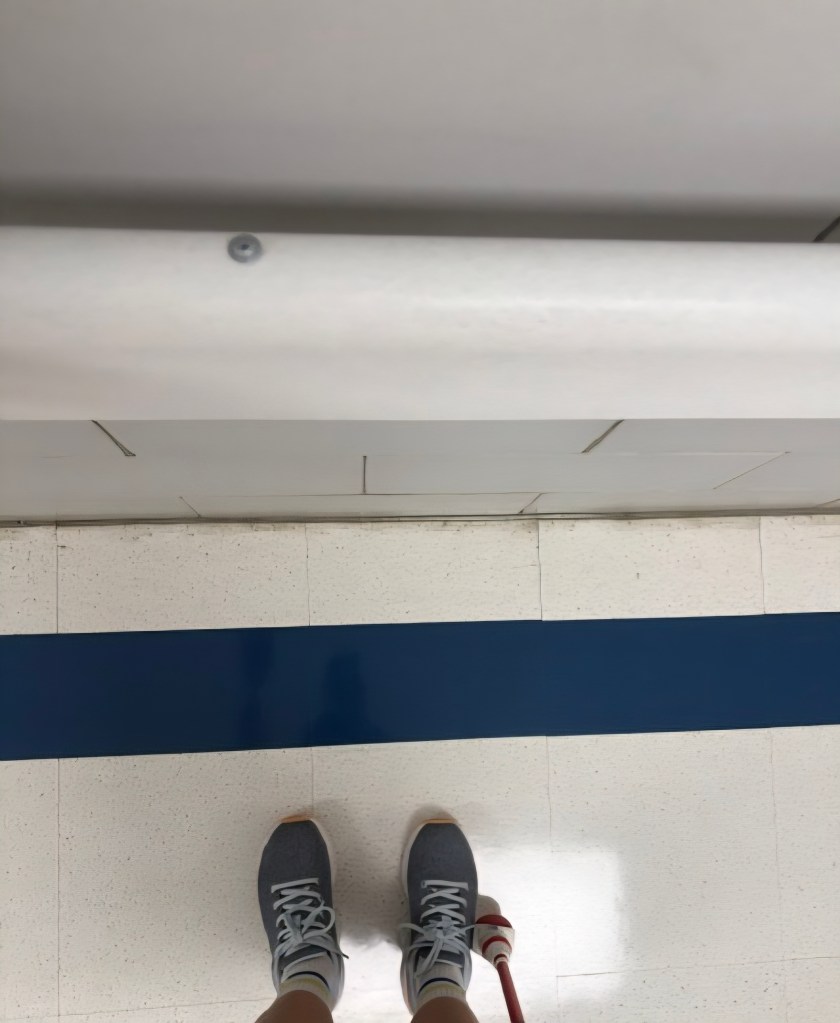
Image shows a bird’s eye view of a white painted hand rail with a “bump dot” screwed into it. Underneath it, on the floor, is a dark blue line running parallel to the wall, very visible against the white floor. Presumably for folks with some vision can use it. Unless it’s for the guide dogs? Next in the picture are Caitlin’s two feet, in their special, ankle-saving shoes and pride socks. Next to her right foot is her cane – the bottom section is red and it has a cane tip I don’t recognize on it. It’s red and white but I don’t think it’s the Sensaball. I’m doing my best, people. Caitlin is long abed and I’m posting this after choir practice. Which was awesome.

Leader Dogs, Day 4

Jeffrey and I wanted to poll the sighties:

QUESTION: IF there were no streetlights, pedestrian heads, etc., would you know how to cross the street? In other words, do you actually understand how traffic works and when is the most optimal time to cross? Jeffrey thinks that, actually, very few sighted folks would cross the street particularly safely or optimally without the “ped heads,” as he and Hannah call them.

After breakfast (bacon and toast for me, nomnom), we did more street crossings. I wrote out some routes and mapped them out on the mobility velcro tactile board thing. The board is confusing, but I comprehended enough to follow my own directions with very little help, which is more than what usually happens!

I also tried flagging straight up and down instead of side to side, which was a little easier, less choreography-like, and saved me some time. Time is worth its weight in gold when you’re trying to cross a street.

I did get a LOT better about planting my feet when I don’t cross perfectly straight. This way, I don’t run the risk of running in the wrong direction of the up-curb and spending more time in the street; rather, I plant my feet, do a Go Go Gadget sweep to either side, and inevitably find the curb.

At the end of the first half of the morning, I crossed a street (an easy one) in front of some Leader Dog volunteers who, I think, were there for Distraction Wednesday, waiting to squeeze squeaky toys and distract the guide dogs so they could practice ignoring temptation. But there were no dogs around, so they were just chatting, and when I got across the street, they cheered very extravagantly. I felt kind of silly about it, because it was what Derek and I call a “baby street,” and I was crossing on an “all quiet, all clear,” and everything like that, but it was still cute.

I’ve also gotten Jeffrey into the habit of doing “up top” and “down low,” which seems to amuse him. I also definitely did a happy dance at one point yesterday and Jeffrey was like, “Um … step a little more forward so you don’t accidentally dance into the street.” Heh.

For the second chunk, we headed toward one of the much more complex crossings. I also practiced listening for, and paying attention to find clues that would help me avoid mixing up driveways and intersections with weak curb-cuts, no truncated domes, etc. I was also especially careful on my “all quiet, all clears,” because I totally missed an approaching car during one and was horrified, even though Jeffrey and Hannah insisted that it had not been a dangerous error. Of course I totally know they won’t let me die, but … when even a simple crossing seems fraught, I start having these existential thoughts of, like, “Why do blind people even cross streets independently when we could literally die?” I know, I know, I can’t say stuff like that or my Blind Pride Card will get taken away. And I know sighties can get hit, too. But it’s just where my mind goes when I do mobility. It can all start to feel so complicated and exhausting, which can feel unfair because sighties don’t have to worry about any of it, and then it can put me in a frustrated, stressed-out, angsty headspace.

The big crossing had an audible signal that gave hecka directions: the name of the intersection, the cardinal direction, a countdown as you cross, etc. It was also set up in such a way that I could press my hand parallel to the sign and use that as a backup tip for getting myself aligned. Because I am me, the choreography of doing that was difficult, because it seems most folks use their forearm, but I couldn’t coordinate that without standing way far away and torquing my body oddly. The flat-hand, and a reminder to stand closer to the sign, not closer to the domes, helped.

With the APS and the parallel surge, most of the crossings went fine once I was used to it. Still, I haven’t crossed a street like that without a guide in years. I’m not ashamed to admit it. (Okay, yes, I’m totally ashamed to admit it, but I oughtn’t to be, because whatever.)

Some Big Crossing things:

* The APS might indicate that it’s safe to cross, and it technically is. But we still want a strong parallel surge, where the traffic has been waiting and has JUST accelerated. My favorite thing about the parallel surge is that, essentially, you can follow it across the street … like a guide! But also, besides following it to the other side, you can use it to help you maintain your line of travel. So you can’t just (cough) blindly follow the APS (yes, Jeffrey and I made that pun … or joke … or whatever we wanna call that).

* What I love about the surges (that they guide you) is also tricky, though, because, obviously, you also can’t get too close to them. But you have to be careful not to get too far away, because then you’ll go into traffic. It’s a delicate balance. That I’m not used to. So you can’t let the cars get any closer to you than they are when you start off from the curb, but you also can’t flip out if you discover they ARE too close to you, because then you’ll get annihilated by the other cars.

* I think I was also getting hung up on the feeling that my feet really needed to be in the precise right position when I aligned myself to cross. Which, I mean, they do … but I just needed some reminders that I can let a cycle or two go by, listen to the parallel traffic, and adjust my alignment as necessary. I think I’ve internalized the sense that waiting a few cycles is, you know, weak and shameful and indicative of garbage mobility skills.

* Hannah taught me a life-hack when I complained that the audible signal poles in SF are often literally, like, five feet away from the curb-cut. If you wait for the perpendicular traffic to go, “run” to the APS (Audible Pedestrian Signal), press it, and come back, you’ll have the maximum amount of time to get yourself re-set up to cross. So after all this, and to some extent during it, I was feeling low-key toasty / tearful / stressed out. Jeffrey and Hannah were great and reminded me to “shake it off,” which is totally a thing Martha and I often cite. Dogs do it for a reason! It literally enables you to complete the stress cycle. Also, if either of them had, you know, even asked, “Are you doing okay?”, I probably would have cried, so I was super grateful that they followed my lead and just kept rolling. I’m one of those people who just disintegrates at the first expression of comfort and sympathy in the face of impending tears, haha. And I despise crying in front of people. After a few crossings, and a lot of encouragement, Jeffrey, because he now knows me from sitting at our dining-room table three times a day, said he was going to buy me ice cream. So kind.

Again, the way the Leader Dog crew do not default to guiding continues to surprise me, which only reinforces to me how accustomed I’ve become to being guided out in the world. They still managed to give me a break by giving me verbal directions to the ice cream place right behind our crossing, but I was still walking solo. As it happened, Hannah told me that the shop had a mini chocolate-chocolate cupcake, which was absolutely perfect. And I think it speaks to Jeffrey’s and Hannah’s bossness that (a) they freaking got me a cupcake, and (b) I was actually able to eat and enjoy it, even after all that stress. Believe me, that’s not always the case, even if I’m given a perfect chocolate thing!

Jeffrey wants to eventually do mobility with kids, and I told him that, if he keeps doing kind things like taking people to get cupcakes and ice cream, he will be perfect at it. I commented that I could have been so easily bought and motivated by going to pizza, ice cream, whatever … but, often, the stringent rules around where mobility teachers could take me meant that we couldn’t do much that was relevant. So of course I didn’t get as much out of lessons as I could have, especially in later years, when the rules became stricter and my abhorrence of mobility got more intense.

Ooh, the last thing I learned in the morning was that it’s best practice to have my cane proceed me as I exit a door. I guess I always kind of felt like, “Well, I already came in, so if that went fine, then the exit will go fine.” But, especially in SF, anything can happen on sidewalks. Or there could be a step which I forget about because something ridonc happened while I was inside the building. You never know!

After lunch, doubtless deducing that I was a little fried, we went to the beach and I got to try the Dakota disc cane tip. I always assumed it would be more like a wheel standing on its end, but it’s actually more like a baby frisbee, and it bounces over sand, snow, and grass really nicely. I super-liked it. My SensaBall and PathFinder tips do okay, but because they’re more like suitcase wheels, they have a harder time than a disc on those textures. When I hit the sand with the Dakota disc, it felt so deliciously swishy in the sand that I ran down the beach. Jeffrey and Hannah were sweet and let me, although Jeffrey pointed out later that, really, for safety, unless a sightie’s around to ensure that there are no giant holes, sand castles, or picnic spreads, my reaction time would not be good, so it’s not ideal to go running blithely all over the beach. But they let me, because they are kind. Although Jeffrey did tease that, if I accidentally ran into the water, he wasn’t going to stop me. But obviously I didn’t … even though the water sounded more like a splashy little puddle than the ocean, which was new for me.

Hannah and I also talked a little about bathrooms, because I cited them as another stressor, especially since I have bathroom anxiety, try to put off going because I hate asking for help, and then am often in a panic and need to go fast, especially when I’m not with someone who’s able to go into the same bathroom as I am, or when there’s not a single-stall bathroom available (I know there’s a better word for that kind, but I can’t think of it … the ones that don’t have stalls!). Hannah said we can practice in the Leader Dog’s lobby bathroom tomorrow, and that she always reminds clients to try sticking with the walls rather than wandering through the middle, trailing with the back of your hand because EW, and also remembering that the accessible stalls have doors that go inward and tend to be on either end of the lineup. I tend not to use the accessible stalls anyway, because I don’t need them and a wheelchair or guide dog user might, and also because it’s just one more giant open space to navigate.

We also walked on a trail, where I liked the jumbo roller tip; it’s lightweight and did well in the dirt and hopping away from the grasslines. It didn’t do quite as well as the Sensaball or Pathfinder, but its lighter weight means that it and wrist, and would be less tiring on a hike. Same with the Dakota Disc. But the Dakota Disc is hollow, so if it gets punctured by something sharp, it will die. It also isn’t meant for everyday use, unless you’re in the snow, and it’s not meant to go on concrete. It’s hook-style, though, so is very easy to swap in and out as needed.

As we drove back, we had a good, honest talk about taking an arm versus trying to walk by myself. Let me add that I brought this up willingly, which I have hitherto never done with a mobility teacher because, you know, I worry they might spontaneously combust when I ask why anyone would bother using their cane when they could walk with a guide, other than to prove that they can? I mean, it wrecks conversations, slows your companions down, trips people, makes people stare, causes random sighties to freak out and grab you and scream if your cane touches anything, etc. But after this week, I genuinely feel like I do want to do a little more walking solo out in the world with other people … because I can. And because a guide isn’t truly, always necessary … it’s just easier. But walking solo also feels … empowering. In a way. Sometimes. I don’t know. I’m unpacking it.

Both assured me that whether I go solo or with a guide is ultimately my choice and can be based on the situation. We talked about how certain family and friends might be better at working on this with me (IE, people who can and will glare at other people who look like they want to interfere, who will be patient and interested in the process, who can strike that balance between helping and standing back, etc.). Jeffrey also pointed out that, now that I’ve refreshed my technique, and my arc has improved so drastically (he repeatedly commented that I hadn’t needed a prompt and was doing well), solo travel might feel less cumbersome.

Speed-through of the rest of the night: we had a tour of the Canine Center and the gift shop. I asked for all the braille things, and the gift shop people were excited because they said they don’t get a ton of people who are into Braille. I brazenly informed them that I’m the biggest braille fan in the world. Because I have no shame. Or modesty.

The canine center was really interesting and we learned a ton of factoids, most notably that (if I remember right) it takes less than three freaking months for puppies to gestate and be born. I could not! What in the world? How!?

My Dark Oreos came, and I gave people samples, including Craig from the kitchen, who made me another fake-chocolate sundae, into which I crumbled my Oreos. Delish.

Then we had a little lecture (optional) about Meta Glasses and Be My Eyes. I thought it would be more about using them for mobility, because I know people do, but none of the other folks seemed very familiar with either service, so it was mostly just introductory stuff. It was super cute to hear their amazement, though. And, as our presenter pointed out, Meta and BME can be a tool in the mobility toolbox, but ought to be primarily a confirmation, not a guide, because they’re unreliable, can hallucinate, glitch, etc.

I promised Jeffrey I wouldn’t stay up late blogging because I was sooo tired this morning (he was amused that he was advising a teacher, of all people, not to stay up late). Off to bed I go, so I can get my eight hours. Sweet dreamzzzz and more tomorrow, if I can stay on sched!

PS. I’m not editing these posts at all, so sorry (not sorry).

words from home

I don’t know about y’all, but I love reading these posts. Many of you probably know that in the very beginning of our friendship, Caitlin and I did a LOT of writing together. We met at a school we were both working at and as summer began, we decided to start our own writing group, just the two of us. We agreed we would write for 10 minutes every day, and send that writing via email to one another. I looked forward to reading her words every day. Sometimes we’d exchange emails beyond that, usually related to what one of us had written. After a while I asked, “Do you do texting?” which now seems hilarious to me, knowing how very much Caitlin texts, and also because it NOW feels like, doesn’t everyone text?

And of course she said, “Yes, absolutely,” and the texting began. We texted so many, many times a day. I used to use an app that allowed me to download my texts and seriously there were thousands of texts before we even began officially “dating” or whatever you want to call it. Speaking for myself, all those words were a real part of falling in love.

We moved in together when the shelter-in-place started in California (thinking it was going to be ‘just a few weeks’) and the texting mostly stopped. I mean, we did still sometimes text each other from the other room when we were each online, working. Sometimes texts were like, What is going on in there?! or Would you please get the dog out of my area?

Fast forward to today and living together means that most of our communication these days is spoken (unless I’m out of town). There are still SO MANY WORDS. We talk a lot! We both have things to say and of course, Maite has plenty she wants to say, too.

And we still write together, although nowadays at the end of a writing sprint, I usually read what I wrote aloud and Caitlin usually makes me wait till the piece she is working on is done. Which means I get to read a lot fewer words on a regular basis, so reading these along with y’all is a real treat for me. I love her turn of phrase and have laughed out loud for real with each of these posts. I love to read what’s going on in her mind in conversations. (I miss those FB posts about things her students said to her!) And I am glad to read about how it’s going out there as she does her thing in a completely unknown place. Bonus points to the person who added those Oreos to her ice cream.

Leader Dogs Day 3

I forgot to mention the tragedy of yesterday! Sighties who know me will attest that I am always wearing my Braille notetaker in a cross-body fashion. Alongside that, I have a little side-bag, which holds all the things that a purse would hold if I had one: ID card, credit card, money, lip balm, antibacterial, thumb drive, etc. As iPhones have gotten bigger and bigger, I’ve also stowed my phone in the pouch on the front of this side-bag. Hilariously, the types of little side-bags that work best from me are usually meant for camera accessories! But now, because I need to hold my cane on my right side, closer to my body, guess what’s in the way? The freaking side-bag. And I don’t want to have to wear a little backpack or purse or cross-body bag all the time, because, between Braille notetaker and cane, I already feel encumbered enough as it is. Ugh. So I have no clue what I’m going to even do with my whole life and aesthetic.

And the other part of the tragedy is that, for now, I think the rhinestones on my cane made it slightly heavier. The Sensaball and Pathfinder tips, which I adore, also make my canes heavier. So now that I need to rewire my wrist and forearm muscles to accommodate holding the cane closer to my body and higher up on its handle, the cane feels heavier and harder to control. I’m using a plain cane for now, and hoping I can build up my muscles enough to go back to a bling cane. Because what will my aesthetic even BE if I can’t have a tricked-out cane of glitter and rainbow explosion and vibes!? Hashtag devastation!

Anyway, I’ll figure all that out in good time … on to today!

Most folks had some fancy-ish breakfast, but I got two buttered toasts (yes, Derek, I know toast is not a countable noun, in case you’re reading), and a sausage patty. Hannah, Jeffrey and I got to take a shiny new van downtown, complete with that delicious new-car smell.

Jeffrey (mock-appalled): What’s that left hand doing?

Me: Um … getting into the car?

Jeffrey: Remember to anchor!

Me (genuinely appalled): What if I hit the new van!? I cannot!

Hannah: It’s totally fine to hit the van.

Me: … … … Nooo!

Again, I’ll do highlights, avoiding some of the most mobilityish mobility stuff.

* We worked on several intersections, including a crooked T, and practiced waiting for the all-quiet, all-clear and listening for near parallel traffic. I was introduced to the concept of “blocker cars” and “musher cars,” as a means of differentiating which cars “block” you from oncoming traffic, and which cars could “mush” you to death.

* There’s this thing that frightened sinsist on you crossing the street, even if you’re trying to listen to the traffic and don’t want to cross at this moment. This can look like honking, shouting, or just … silently lurking. Forever.

The three of shooing drivers away:

1. Lowering your head slightly

2. Looking away

3. Walking back the way you came and realigning yourself, simultaneously signaling to the sightie that you don’t intend to cross

Me (as a clarifying question, which I stated rather than asked): So we aren’t waving people on anymore.

Jeffrey (with a tone that suggests he’s quizzing me): Why?

Me (flustered): I don’t know, it was a question.

Jeffrey: No, you’re right, I’m asking you why we don’t wave people on.

Me: Because … if they die, they’ll sue us?

Jeffrey: Correct. Generally, I’m not comfortable with blind people directing traffic.

Me: Seems reasonable.

* I have a distinct memory, when I was practicing my route to audition for guide dog school, of Mr. C yelling, “P! A! T,” which stood for Protective Arm Technique. Now, we call that Upper-Hand And Forearm.

Jeffrey: Nice job with upper-hand and forearm right there!

Me: Oh, I … I didn’t even really do it, I just kind of … put my arm out.

Jeffrey: It was about halfway there.

Me (aggressively trying to do it correctly): Like this!?

Jeffrey: A little higher … protect the moneymaker. — Moneymaker meaning … your face. Clearly.

* I think I had a bit of a breakthrough with cut-backs, but just now, when I tried to write it, I don’t quite know how to explain. Heh. I’m sure we’ll work on it more.

* We worked on some problem-solving in the field:

Me: The sidewalk here has, like, come to a dead-end. Of death.

Jeffrey: So what can we do?

Me: I don’t know? Turn around?

Jeffrey: Have you ever seen Anchor Man?

Me: … … ” No?

Jeffrey: They put question marks on his teleprompter, so he reads everything like questions, even his own name.

Me: Ahahaha, that’s totally what I do.

 Jeffrey: Even if you’re not sure you’re right, you can state it like it’s true.

Me: I’ll try!

Later, after Jeffrey gave me a clue, and I got around the dead-end by climbing a staircase:

Hannah: You’re on a boulevard now.

Jeffrey: What was that reason we learned for why it’s called a boulevard?

Hannah: It has more trees … and businesses.

Me: I never knew that.

Hannah: We didn’t, either; we had to look it up.

Me: Ooh, truncated domes! Wait, am I lined up right?

Jeffrey: Ahhh, don’t move those feet! That’s the number-one rule!

Me: I thought that was just for … other things? … Questionmark? Anchor Man?

Jeffrey: Ahahahaha nice.

* It will surprise very few of you to know that, at the precise moment something unforeseen (cough) happens on a route, I do not, in fact, plant my feet. Ever. I do the opposite … namely, lashing out with cane and free arm and free hand to figure out what in the heck is going on, and swinging around wildly all over the place. Jeffrey impressed upon me that, of course, the more I move, the more off-course I’m likely to get. And it was true that, often, I was either still totally fine and following my line of travel, or just a touch off-course, which would be easily corrected if I could just, you know, find some chill.

My other temptation, for some reason, is to grab the cane in a double-handed vise-grip, I think because I subconsciously think that gives me more reach and control. If I don’t do that, the left hand’s flailing around to ascertain information. But by the end of the day, I shocked even myself with my ability to just stop, take a minute to think, and then either search more calmly for landmarks or clues, or simply to do some narrow sweeping to see if I can hop back on to the correct line of travel.

* Hannah and Jeffrey both normalized that it’s totally okay to ask someone for help crossing a street, and also pointed out that, often, if there’s a business nearby and it’s a route you travel often, you can solicit help from employees who may start to know you. Martha also had this idea in the neighborhood, but it hasn’t worked out … yet. But I loved the reminder!

* It’s also very strange-feeling to be learning mobility in a calmer, more residential area. I’ve been in SF so much, and had so little mobility training there, that I just … forgot that calmer streets existed, that some sidewalks aren’t rife with hazards and sidewalk junk, and that I actually do remember a lot of mobility things. They just aren’t as applicable in the city, which is a whole different beast. This part of Michigan is much more like my hometown in its characteristics, so I feel much less out of my element here, even with the larger crossings (which we didn’t get to until the afternoon).

* There’s a balance I had trouble striking. Sometimes in the world, there’s not a well-defined curb-cut, much less truncated domes. But also, in the world, there are driveways. So often, when I’m trying to follow a line of travel along a sidewalk, and I pass a driveway, especially if there’s a change in the texture of the pavement, which there often is, and especially if there’s a lot of noise or no noise, I’m freaking out, thinking I’m wandering blithely into the street. This is, of course, where listening to the traffic in the street alongside me comes into play, as well as tapping into other landmarks. I still often catch myself stopping too soon, trying to analyze, and subsequently losing my line of travel … or, if it really is a flare leading to the street, misaligning myself. So we’ve been practicing this.

* And might I remind you that, in addition to these things, I’m trying to remember to keep my arc narrow, to relax my wrist and arm and shoulders, and to not choke up on my cane? Although Jeffrey did say that my arc and my grip were great today, so it’s already sticking … but it’s still on my mind, even as I try to catalog these other things. Luckily, Jeffrey and Hannah get this … and also applaud me for taking copious notes, rather than thinking I’m ridonculous.

* Joy Explosion: We ran into a guy walking two retired Leader Dogs, and he let me pet them. OMG, I literally fell to my knees and gave one of them a full-on hug. And she was all wet, too, because presumably they’d been playing in the sprinklers, but I had zero cares about that. I miiiiiss Maíte-hugs! The day was also super humid, with only occasional breezes, and between the heavy air and, probably, my mega-focus and intensity, I was SO sweaty! Seriously, I’m typically not a sweaty person unless it’s, like, ninety degrees, but my whole entire forehead was drenched, soaking my bangs, and I could feel sweat running down my spine, which I haven’t felt to this extent since I was in sixth grade and trying (and failing spectacularly) to do Track and Field in freaking June! All of this would have been fine, except I was starting to get a blister on my thumb from strangling my cane in the new way I’m working on holding it. And that blister was also probz from sweating so much. As Maite, voiced by Martha and me, would say, “That’s asgusting!”

Hannah and Jeffrey are like Scouts, though, and had a whole first-aid kit. Hannah bandaged my finger to cover the blister, but I was SO sweaty that the Band-Aid literally just … peeled off. Hannah also said they have tennis tape, like what’s used in the mainstream world for racket handles, and that that might help me get a better grip. (They also had canes with alternative handles, but none were short enough for me, heh.) This gave me funny flashbacks to guide dog school; the harnesses with the more ergonomic, detachable handles had just come out, and I was the first (and I think only) one in our class to get one before they were officially given out, because my freaking hand was so small that the standard harness was hurting it. This caused so much gentle mockery from my classmates … as seems only fair.

By that point in the morning, I was having a hard time keeping a narrow arc because controlling the cane with minimal thumb action was getting harder. It was about time to leave anyway, and Jeffrey and Hannah impressed upon me that taking care of this situation now equated protecting the rest of the week, which I appreciated.

Once we got back to campus, I went to the RA’S office, and they bandaged me up more intensely, with some elaborate criss-cross doctor way of securing the larger Band-Aid. And they helped me get a yellow Gatorade, because NECESSARY! I felt a little fried after that, but I amped up again after getting a grilled cheese for lunch (and found out that Jeffrey eats very similarly to me, which is boss), and (even more thrilling) Jeffrey giving me the choice of what color tennis tape I wanted to wrap my handle in. Cane bling seriously always makes my life. I chose purple … obvi.

I’m getting tired, so just a few highlights from the afternoon that might be interesting to you people:

* When I’ve learned routes, I’ve literally written things in my notes like, “Stand with left foot two inches from the upper-left corner of the truncated domes for optimal crossing.” This way, I don’t have to worry that I’m lined up correctly to cross … at least, not as much. What I didn’t know is that I can hit the domes, plant my feet (the number-one rule), and then use my Go Go Gadget right arm to find the inner curbs on either side, to help me line up. (I mean, maybe I was taught this, but either I forgot, and-or we didn’t do it precisely this way.) But it made lining up feel so much more methodical and so much less like guesswork and praying to the mobility guru above.

* We did a ton of work with those mobility kit things with the velcroed, plastic intersections and blocks and people (I forget what the kit is called). I always despised those so much as a kid and, sure enough, it took a good forty-five minutes for what Jeffrey was explaining with the materials to make sense, but by the end, they clicked! Sort of. As Jeffrey put it, “We’ll see if it’s still there in the morning.”

I explained that it’s always just been so, so hard for me, almost impossible-feeling, to (a) imagine an entire street layout, complete with all the lanes and curbs and intersecting streets and on and on, and then (b) hold that in my mind long enough to figure out what the heck I’m supposed to do with it to get to some elusive destination off in the distance. Jeffrey genuinely seemed to get this. It was nice feeling like I could say this and have it understood and believed, rather than feeling like I was just making excuses. Not that any other mobility teachers ever made me feel that way … I think I just make MYSELF feel that way. So the validation was appreciated.

* Oh, also, in the morning (because I’m running out of sufficient steam to scroll up), we were going to practice veering, but then (of course) I stopped veering. Hilarious. But, oddly, if I flag a certain way (almost, like, with Caitlin choreography), I go straight … and if I flub that, I veer. Interesting.

The rest is just mobility stuff that I’m too tired to write about and which probably isn’t interesting to the vast majority of you. But also, Jeffrey very kindly offered to hold my cane for me when a siren came so I could cover my ears, aww! He can stay.

Then, our crew had a meeting with the Leader Dog counselor, who also talked with me before class re: anxiety and ARFID. She was lovely, and I felt like our cohort became immediately closer after just sharing that single, vulnerable hour.

I took a shower (seriously, I’ll probably have to shower every day once lessons are done), and then we had a really fun, raucous dinner. I feel like everyone’s personalities are really coming out more, and there’s a lot of laughing, teasing, and sharing, both the hard and the silly. This was a staple of guide dog school, too, and it’s so sweet and singular.

Also, shout-out to one of the kitchen staff, Craig. First of all, at lunch, when I asked him to please refill my thermos, he also cleaned it for me, so thoroughly that I could smell that delicious whisper of bleach. Not like, you know, there was bleach in it! Just like … someone had done a boss job actually cleaning it, rather than just rinsing it, like I often do when I’m in a hurry. And like I certainly would do if I had, like, thirty freaking blind people asking for thirty different things in my dining room.

THEN, tonight, everyone got some fancy sausage thing with trifle for dessert, but I heard Craig telling someone else they could have vanilla ice cream. I have been longing soooo desperately for ice cream since I got here!

So it went like this:

Craig: Caitlin, would you like trifle?

Me: No, thanks, but … did I hear that you have ice cream?

Craig: Yes, I can make you a sundae with vanilla and chocolate syrup.

Me: No chocolate?

Craig: No, sorry.

Me: Okay, but can you please put so much chocolate syrup in the vanilla that it, you know, forgets it was ever vanilla?

 Craig (laughing): Yes, absolutely, I totally get you!

(As Craig leaves ) Me (to the table): Dang, too bad the volunteer who’s getting groceries comes tomorrow! If I had my dark-chocolate Oreos, this would be perfect.

(Five minutes later, Craig returns, gives sundaes to each of the two folks sitting on either side of me, and…)

Craig: Caitlin, I put LOTS of chocolate syrup, and there were some mini Oreos left over from Kids Camp, so I put those on top for you.

Me: Oh … my … God, thank you! Seriously I cannot thank you enough right now, I might cry, I want to hug you!

The table, of course, was amused … but I was so serious! It’s the little things! It really is! He didn’t have to do all that! Also, it was delicious.

Then my Leader Dog mentor called to check on me, and one of our cohort, who was mourning the scratchy toilet paper alongside me, brought me a roll of soft TP from a pack the RA had given her. Everyone is seriously so kind.

Okay, I am soooo tired and meant to be in bed like … an hour ago. Hugs and rainbow joy to all, and more laterz.

Leader Dogs, Day 2

Let me just say right now what a fantabulous job the kitchen is doing with my ARFID. Like, seriously, I have never been catered to (pun intended) so thoroughly (a) without either someone else or myself having to do a boat-load of extraneous advocacy, and-or (b) without feeling like I’m a huge, babyish burden.

Between the jet-lag, nerve-citedness, and my inability to sleep on any pillow ever besides my own (I really should invest in a travel pillow, but I bet that wouldn’t work right either), I wasn’t too hungry for breakfast. The sausages were delicious, though, and I already requested milk and water for every meal. It just so happens that I’ve felt a little sluggish in my body of late, and because soda is an easy scapegoat, I have blamed him and am divorcing him forthwith, at least for the time being. Just when there’s a shelf literally Braille-labeled “Pepsi” in the RA’s office, calling to me. Anyway, the kitchen staff also checked in with me, knew all about my safe foods (I sent them a list, but I often do that and people just willfully disregard it or think I’m exaggerating), and basically said they’d give me Caitlin-food substitutions (IE, plain chicken, burgers, peanut-butter-no-jelly sandwiches, etc.) in place of the fancy things I won’t eat, which is pretty much every meal here, because guide dog schools, like I said, are basically akin to resorts … and are also way better than the literal cruise I went on last year, which had me subsisting on milk, salami and cheese slices, and soft-serve from one floor and Oreo crumbs Martha spirited from a whole different place on the ship.

I also continue to love the Braille Rails, as I call them. Just having those bump-dots and all the Braille labels as reference points is so cool.

After breakfast, we got buddied up with our 1:1 instructors, but because I am a lucky duck, I get TWO instructors: Jeffrey, who’s an intern (he’s almost done!) and Hannah, who my friend, Alexis told me was awesome! They were both incredibly sweet, understanding, and hilarious from the get-go, which quickly put me at ease. I mentioned my anxiety around mobility, and all of my “anti-goals,” as I call them: dropoffs, instructors following you silently, etc. Jeffrey was very clear that I’ll have a say in everything we do, AND he added that a dropoff at the end of the week might be a good confidence-builder IF I decide I want to do it. That thought, of course, is beyond horrifying right now, but I shall not pass judgment until I get to Friday … or I guess Thursday.

I also talked about my general feeling, whenever I do solo mobility, that I’m in the way, slowing people down, appearing clumsy and incompetent, etc., and that I struggle with advocating for my own bodily autonomy in the face of a stranger or a frenetic situation. It was really nice to air these grievances and feel truly understood and respected.

I also mentioned that I have no idea if my cane technique is ideal, or even if my cane’s length was ideal, so we started out using a few different canes. We settled on one that, I think, is slightly longer than the one I brought, which I remembered later is my shortest one. I got a shorter one to accommodate my love for the Pathfinder and Sensaball tips, which are free-wheeling and, as I once said to a friend, “bounce over cracks with tremendous alacrity.” I love these tips, but they increase both the weight and length of the cane. AND, as it develops, I’m very tense in the way I hold my cane. Hannah had me laughing when she called it a “dinosaur arm,” and Jeffrey cited “Go, go, gadget.” This is why we all vibed.

Some fun news is that I nailed stairs, and that, actually, aside from my needing to choke up less on the cane handle and work on narrowing my arc, my cane technique is not rusty enough to give me tetanus. Considering that I haven’t had consistent O&M (I literally just wrote M&M, oops) since I was eighteen, and from sixteen to eighteen was with a guide dog, not a cane, I’m actually surprised I don’t have more egregiously bad habits than I do.

My arc has been an issue ever since I can remember. Teachers used to tease that it looked like I was clearing the way for ten people. I’ve gotten better at keeping it within my shoulders, but it still sometimes goes a little far to the side. This is a problem because, for example, if your cane’s way off to the left and straggling its way back to the right, something might hit me on my right side while the cane’s trying to catch up. So if the arc’s narrower, it has less ground to cover and will keep me safer in my little bubble.

The tricky part is that, between narrowing the arc, needing to relax my wrist and elbow while holding the cane closer to my body, and holding the cane closer to its top rather than further down the handle, my arm and wrist were complaining a bit. Hopefully, it’s just a new sensation, and as it becomes muscle memory, it will be easier on my weak little spindly wrists.

Another thing I asked about, because I literally promised someone I would (although now I forget who I promised!), was how to instruct a panicked, untrained sightie in guiding me through a doorway. Because doors open so many different ways, people are rushing, they’re often crowded areas, etc., I find that this is a place where many guides just freak out, flail, grab, push, pull, abandon, etc. It turns out that the life hack is to encourage the guide to do the narrow-passage technique and continue guiding as normal. I’m excited to see if instructing in this way will stop people from feeling awful about how doorways inevitably go.

I cited some other things I want to work on, but I imagine we WILL work on them and they’ll come up then, so I won’t go on and on. We walked the practice course twice to cement the relaxed shoulder, all-in-the-wrist technique, and reviewed the dorm one more time.

I then had a delicious peanut butter sandwich for lunch, which honestly was just so … calming and predictable, haha. I also discovered that the braille schedule on the bulletin board in the hallway had been tacked up upside-down, which caused some hilarity.

For the afternoon session, we went to the downtown to the training center there. The mobility stuff gets a little more technical here, but I’ll share some cool stuff we worked on:

* Anchoring: I somehow had never heard of this or been taught it. Essentially, when your cane touches a doorway, you keep its tip flush with the doorway while lifting the cane so that it’s pressed vertically against the door. You can then use the cane, not your hands and fingers, to feel for a doorhandle. This could prevent some nasty bites from hinges or hasps or whatever all else doors are made of, although I suppose you also have to still be careful not to get hit in the face.

Similarly, you can use anchoring at curbs. I was always taught, when hitting a curb, to do a big, side to side sweep before stepping up. The anchoring technique involves bringing your feet close to your cane tip as it anchors to the step, then lifting your cane to gauge the step’s height, as well as the area just at the top of the step, enough for you to step up safely. Then, and only then, can you go on your merry way. This gives you a better sense of how high up the step is, and also prevents you from blazing up curbs while swinging your cane wildly in a sweep as you chase after it, the way I was doing.

* Cut-backs: Another thing I never heard about! Basically, cut-backs confirm that you’re maintaining your intended line of travel after crossing a street, rather than veering off into a sidewalk or alley. I’m still kinda figuring these out, but essentially, this gets you away from the street, and involves shorelining until you find the “opening” back to the sidewalk.

* I was introduced to the genius term “sidewalk junk” to refer to things like trash cans, parking meters, and random signs, which I loved. In turn, I kept unintentionally using ostentatious words like, well, ostentatious. And circuitous. And lackadaisical. Which amused Jeffrey … who promptly also started punning.

* I told Jeffrey that I was going to write about this experience in my blog, and he rallied that he needed to video-tape part of our lesson for his mobility exam portfolio thing. Seems only fair.

* Apparently, in quieter areas, if you cross crookedly, you don’t need to leap up onto the sidewalk like a scalded cat and start springing around trying to find the curb-cut. You can stay in the street, as long as you’re safe, and feel around with your cane to see if you’re close to the curb. Who knew?

* The Three Rules Of Street Crossing:

1. Plant your feet, as though they’re in cement. Jeffrey said “see-ment,” which Martha also says, which made me  grin and emulate him.

2. Extend your cane across your body. This is called a diagonal, which does make sense, but for some reason, I literally forgot about five times what this step was called. It was unclear. My brain was probably shorting out from having had more mobility than I’ve seen (pun) in years.

3. Flagging: I just learned this one when I had a couple O&M lessons last year. This asks you to get drivers’ attention by decisively extending your cane and indicating that you’re beginning to walk. Both in high school and last year, I was taught to go really big with this, and when I’m asked to go big, I go big. I think I almost hit Jeffrey with my wild flagging … which is not surprising, because I smacked someone’s car roof last year when I learned this. Jeffrey told me that, like with my arc, I can go smaller and that, if I start on the right, I , which is where my cane seems to like to be when I start to cross a street.

4. Take a big first step, and then pick up that pace!

* I practiced soliciting assistance across a street from Hannah, who pretended to be a wrist-grabbing newb with no experience of blind-kind. We had a good little talk about bodily autonomy and not being afraid of inconveniencing sighted people in general, whether they’re guiding or getting in my way, as I travel. True, but hard for me to internalize.

Those were the highlights! Tomorrow, we’ll do some route-planning and intersections, maybe lighted ones. We just did “all quiet, all clear” crossings today, to practice the mechanics. Other folks did way more complex stuff, but I’m internalizing what Hannah and Jeffrey impressed upon me: that, literally, we’re all on our own path, and that building confidence and skills that feel helpful to me is all that matters.

Can I also just say that it’s super weird to me not being guided everywhere the instant I struggle? I mean, I fully own that I am extremely guilty of letting myself be guided even when I don’t need it … again, mostly because, the second I take a wrong turn, it feels like sighties everywhere have a whole fit and scurry over to save me, which often involves touching and grabbing. So it’s become so easy for me to just … avoid all that and let myself be guided. But there’s no grabbing here! People give verbal directions when asked, and I feel simultaneously looked after and more independent for having taken on that extra ten seconds of fumbling … because it’s not really fumbling, it’s just finding my way there, and who cares what it looks like? It’s wild to me how I can and do totally believe this for other people, but have such a hard time with it for my own self.

I appreciate Jeffrey and Hannah for making mobility fun again, and told them so. There was so much laughter, talking, and silliness, and yet, we got a ton done. They were so kind, encouraging, and complimentary, and I feel so hopeful in light of that. As I told them, I do want to learn, and I do want to be better at mobility than I am. It just never felt particularly relevant to me, nor did I feel like I was able to understand it. They talked some about how the approaches to mobility are changing, and taking into account that a one-size-fits-all approach isn’t ideal in many cases.

In closing, we had a fun, tasty dinner … I ate a whole chicken breast and garlic bread, which is a lot for me in what has the potential to be a high-stress, intense week, without anyone here I know. At guide dog school, they literally called my mom to make sure I wasn’t going to die because I was eating so little and running myself so ragged. Granted, I wasn’t diagnosed with ARFID yet, so didn’t get any food accommodations, and it was a whole month, and I was a nervous wreck, but still! I love not having to worry about food on top of everything else. AND they gave me a cup of milk to-go for my room. So kind.

And now I have written these blogs while intermittently getting up to dance and sing to everything from “Dear Evan Hansen” to Disney jams, and it’s definitely time to get to bed. Sweet dreams and more tomorrow, assuming I still have the strength, haha. But I feel great, and am so, so happy that I took this plunge and that I’m being supported and taught in a way which feels fun, consensual, and accessible to me.

Stay tuned!

Leader Dogs, Day 1

This was my travel day, but a lot still happened at Leader, so it gets its own post.

First of all, y’all’s friend Caitlin’s alarm-setting math went like this:

Me (to self): Okay, my flight leaves at 8:35 AM. That means I should be at the airport by, like, 6:45. So I’ll set my alarm for 5:45 AM, be showered and dressed by 6:15, check my packing list one more time, and I’ll be good!

In case you, like me, aren’t a math person, I’ll make this very clear: I apparently assumed that I was going to magically fly to the airport in about ten minutes.

Luckily, we actually did get to the airport around 6:30, because I was faster than expected, and Martha is always ready for action at a moment’s notice, so she was set way before I was.

Just for funzies, the person at the airport wanted to give us a hard time about gate passes, KTN numbers, etc., and kept doing the, “Will she need a meet-and-assist? Will she need a wheelchair?” Shockingly, even though I’m often infantalized in scores of other ways, this isn’t one that happens to me often. Martha, and most of my people, always ignore, I answer, and the asshattery stops there. But this time, even though Martha had stepped back to literally put herself out-of-frame, and even though I was answering very pointedly, the “Does she” questions kept coming. It was too early to duel about it, but between that, my BrailleSense getting kidnapped for literally ten minutes at security until I blind-card whined, “That’s my braille notetaker and I need to get on my flight,” and the flight attendants and my seatmates not responding helpfully to my bids for access, I was pretty ready to be in a blindie space and take a break from sighted nonsense. Oh, and there was also the employee who tried to force my hand onto her shoulder for sighted guide, the flight attendant who tried to haul me down the airplane aisle by the wrist, and the so-called meet-and-assist who insisted on carrying my backpack even though I told him I’d do it, then panted exaggeratedly like he was going to die, and whined about how no one had tipped him all day and his job was so hard. Bro, let me carry my brick of a backpack like I asked and your job will be less hard, I promise.

Luckily, my volunteer driver from Leader Dogs, Doug, was lovely. He gave me the lowdown on all the things Leader Dogs and, because he told me he and his wife are avid cruisers, I regaled him with the horror story that was Martha trying to keep me from starving to death on Royal Caribbean’s Star Trek cruise last year (I should really do a blog post about that, but TLDR, their food was appalling … like, seriously, summer camp food and college dining hall food were way better).

I was the last of the O&M crew to arrive, and because I jumped from San Fran to Michigan and there was a three-hour time difference, it was already dinnertime. I’m not a great traveler at the best of times, and my nerv-citedness just exacerbates that. Luckily, the first RA I met, Diane, took my mini-flip-out about “What? How is it dinner?” right in stride by telling me I could have a half-portion and spiriting me into the dining hall.

In my experience, being in blindness-centered spaces is kind of a double-edged sword, triple if parents are factored in.

Edge 1: It’s so nice to be among people who know the struggle.

Edge 2: It also kind of magnifies blindness, because along with the presumed competence comes more flailing and productive struggle, which can feel awkward to someone like me, who tends to allow others to help as a means of avoiding looking like a doofus.

Edge 3: If parents, or blindness professionals, or high partials are around, I sometimes feel this low-key pressure to impress, to be competent, to not fumble, to not need help … because it can feel like the other blindies around me don’t need as much as I do.

Sure enough, right away, I managed to displace the cups in the cup dispenser in the RA’S office when I washed my hands, follow Diane into the dining room awkwardly with my “Oh no I’m in a blind space and don’t want to trip anyone” panic, and then not being able to stow my cane in the nifty little broom-holder apparatuses they use on the backs of the chairs here. Rose, one of the kitchen staff who’s also a Leader Dog client, stepped in so kindly to help me and was like, “It’s because all your bling makes your cane so much thicker. Have you been watching Molly Burke?”

This both amused me and horrified me because … no shade, but I’m not a fan. And I never thought my bling would make me seem like one? I mean, not to brag, but I’ve been rocking a cane since 2013. I started a revolution (no pun intended … Revolution is a cane company)! But, no, it was funny, and she did manage to show me a hack to get my cane to comply.

It developed that the O&M crew have our own table, and that we have two retired teachers, one person who lives in Santa Cruz, and one who’s going to college to become an elementary-aged teacher. So, you know, the group was basically constructed just for me, clearly. Everyone was super kind and friendly, and filled me in on the info they’d gleaned by arriving way before me.

After dinner, Diane acclimated me to the dorm. The raddest thing is that there’s a railing system along the hallway with bump dots … so, as you’re trailing, you feel a bump dot, which cues you to read the braille and raised large print above it, which tells you what’s ACROSS the hallway, which, of course, also serves as a landmark for your side of the hall, too. I’ve never seen any system like this before and I was so into it!

The whole experience was also giving me the warmest, fuzziest Guide Dogs For The Blind feels, since I went there in 2006 … which I was horrified to realize, for the first time, was twenty freaking years ago. TWENTY! I am thirty-six! What even is life? I had Lannie twenty years ago. Twenty! Okay, I’ll stop.

But anyway,

Like many guide dog schools, this one feels like a legit resort: Alexa in your room will read your daily schedule and meals to you ahead of time, as will the old-school phone turned new-school; outlets, drawers, hooks, and counter space everywhere; a freaking ginormous desk and chair; a recliner; you name it. And don’t even get me started on the freaking Snack Wall. Anyone who knows me knows that I subsist largely on goldfish crackers, chips, and store-bought treats. If you’ve ever seen Martha’s and my snack wall, just know that the Leader Dogs one puts ours to shame, mostly because mine is, of course, restricted to Caitlin-foods only. This one has, like, ever candy, chip, or bar you could ever want … except, strangely, not Fritos, but this can totes be forgiven.

They also left a surprise Leader Dogs backpack and water bottle on a hook for each of us … and offered to put a Braille-on “CAITLIN” label on mine. So cuuute! These little touches never fail to melt my soul, like when the Braille Challenge people gave us labeled shampoo, conditioner, and shaving gel bottles that one year.

My phone was janked up, so I wound up going back to the RA office after unpacking, and they not only fixed my phone but gave me the WiFi and a yellow Gatorade, because the braille label just said “Gatorade Assorted” and I cannot. Only yellow forever, please and thank you … and it’s great because normies tend not to like yellow, so I bet I’ll be helping everyone out.

And then I talked to my mom, texted my dad (who just moved to Kentucky and was subsequently in my time zone), and had a good-night chat with Martha and my precious giant baby Rock Wilder, Maíte the Magnificent, whom I miss desperately. Seriously, if I don’t get to hug a dog sometime this week, we may have a problem. I have gotten so attached to my dogter that it’s probz not ideal. And Martha keeps sending me adorable clips of her snorfling and toe-tapping and snoring. So much better than weak pictures, right!?

Also, just saying, I’m still loving the Finch app, and I’m getting to check off all my exercise goals while I’m here! So if you have Finch and wanna be friends, come join myself and “The Mouth,” named after the famous YouTuber (ahahahaha YouTuBird!) who is basically a ventriloquist genius. Search him up if you have not.

Stay tuned for Day 2; if I can keep up my writing flow, I’ll catch up tonight.

Also, in case anyone cares, Alexa is playing me the Dream Street album, and it is two-thousands-bubblegum-tastic and I have no shame.

Okay, more laterz. Huggles if wanted.

Leader Dog, Day 0

I’ve neglected this blog, which is tragic to me, but also unsurprising. Somehow, when I was a teen, I LiveJournaled every single day, page upon page of nonsense from school, life, and, later, my innermost soul, filtered elaborately to various sub-groups. After that, it was pages-long Facebook statuses (stati?). Hopefully, over this next week, I can shoot down the middle and land somewhere between posting absolutely nothing of note and writing a gargantuan novel no one actually wants to read.

So, here’s the scoop. I’m going to Leader Dogs For The Blind in Michigan, not to get a guide dog, but because they have a (seemingly) fantastic, “mobility brush-up program” of sorts, which can truly be customized and tailored to individuals’ needs, interests, and areas of strength and growth. It’s completely free, too: flight, food, room and board, and I think we even get a cane out of the deal, which is great, because I’ve never been entirely convinced that I’m using the most ideal cane length. As with many things, there are different schools of thought on that.

My friend Alexis generously Facebook-documented her experience at Leader Dog, and I thought the program sounded really accessible and trauma-informed, in the sense that (a) you can attend whether or not you want a guide dog in future, (b) you work 1:1 with a mobility instructor after an in-depth discussion of what you would (and, hopefully, would not) like to work on, and (c) they make it very clear, from the outset, that they accept blind folks with multiple disabilities and “additional” access needs.

I’m not diagnosed with any disabilities other than blindness; however, I am diagnosed with Generalized Anxiety Disorder, which, I think, contributes to a lot of my struggles with mobility. Multiple instructors have assured me that, actually, my mobility skills themselves are great at best, passable at most. The problem, I think, is my confidence, my tendency to dread the worst-case scenario if and when I get lost or disoriented, and my preoccupation with how I must look to everyone if I pause or deliberate as a means of problem-solving and recovering from disorientation. I’m often convinced that everyone’s staring, that I’m setting a horrible example for all of blind-kind if I get turned around, and so on … and it’s also true that, perhaps because I present as young, white, and female, people seem to foist their help upon me whether or not I need it, which can also be destabilizing when I’m trying to travel independently. This is particularly true, of course, when people insist on grabbing, pushing, pulling, and generally ignoring my bodily autonomy.

I received mobility from various providers growing up and definitely gleaned some good stuff. I’m told that my physical spatial awareness is strong (by which I mean I’m savvy about, and move safely in various environments, despite my inability to mental-map AT ALL), and I’m good at writing out routes (complete with lots of helpful, multi-sensory details like slopes, cracks in the ground, sounds, weird auditory or tactile landmarks, etc.) and following my own directions. However, besides my aforementioned struggles, I decidedly did not master street-crossing analysis. Like, at all. I tell people often that I think I only received my guide dog because the school thought we’d look cute on their brochures. Even when I was receiving my dog at age sixteen, the school often asked me to crate Lannie so I could get some remedial cane training and street-crossing support.

I was certainly taught, for many years, how to analyze intersections. However, the actual street-crossing concepts always confused me; plus, I was resentful because, I mean, it was Friday afternoon, or recess time, I had way better things to do than guess when it was safe to cross a street.

I have made it a shockingly long way without feeling confident about street crossings. Drivers do usually walk me to doors. If I do have to wander and come across a street that’s not laughably simple, someone always shows up to guide me across, if I wait long enough. This is why I often tell blind kids and parents that, although this method won’t work for everyone, mobility need not be the end-all, be-all. My struggles with (and subsequent hatred of) mobility haven’t kept me from doing anything I’ve ever wanted to do (that sounds more inspiration porn-tastic than I’d like, but I honestly don’t mean it to). However, I’d like to not feel intense fear and panic if I need to get across a busy street quickly and no one comes immediately to hand. I’m hoping that the folks at Leader will have an ingenious, hitherto unexplored method of explaining intersection analysis that will make sense to me. And I also know myself well enough to know that, if I want to genuinely work on these things, it would need to be full immersion. I won’t do well cramming in a lesson a week amid a life that’s already filled with stressors and things to do. I need to take myself out of the soup and focus, like I did in guide dog school, on this one big monster, or mountain, or whatever we want to call it.

I also feel hopeful that I can learn from other clients about map apps and accessible ways to use tech while traveling. I’ve always found juggling phone, braille, cane, and my own nerves very difficult, but I also know there’s most likely an app, or combinations of apps, that I can at least use to get myself out of jams, or perhaps to map an area beforehand, even though my mental-mapping skills are also pretty nonexistent.

This is already too long for a standard blog post, but just a quick note that the application process was SO smooth and great. Because I have anxiety, and also ARFID (Avoidant Restrictive Food Intake Disorder), I spoke to both the kitchen staff and to the resident psychologist, which made me feel much more at ease. I also requested a mentor and was lucky enough to get the amazing Juanita, who is totally Facebook-famous as “The Blind Advocate.” I will ask her permission to link her page because it’s awesome. Even though she lives in Michigan and we were hoping to meet, I’m not sure that will happen; however, kudos to her for answering my many questions and assuring me that, yes, as long as I speak up, I can really make this program be whatever I want it to be. This will be a great chance for me to also practice not people-pleasing and, instead, being a strong self-advocate and being vulnerable about the thousand-and-one reasons mobility stuff often makes me anxious and upset. I’m sure I’ll be getting into more of that later.

Like guide dog school, this training will be rigorous, but there IS downtime, and I pledge to do the best I can to blog about this. Who knows, maybe I’ll get into good habits and start blogging here more consistently.

As the kids say, “Like and subscribe!” Hopefully more soon. Caitlin H, out!

Into the maelstrom

Y’all. This world is…something else. I am still moved to tears on a regular basis about what we (the US as well as other countries) are doing in the name of…what? Capitalism? I don’t understand, honestly, how people can continue to act as if nothing is happening. I am doing all the things I know how to do in terms of boycotting and avoiding companies. I am speaking up whenever and where ever I can. And yet I still feel…hopeless. And ridiculous as I try to make videos and write stories for children.

This week I read One Day, Everyone Will Have Always Been Against This, by Omar El Akkad. It’s a deeply personal look at the ongoing crisis in Gaza and the way we, as part of Western civilization are managing – whether we are complicit, witnessing or actively looking away. It was a tough read.

And yet, it’s not all dark. He writes about things people are doing, boycotting and walking away from jobs, students denouncing their universities and others refusing to participate with their dollars in other ways. He writes about the responses of those in power – their shock and dismissiveness. Here’s a quote:

“The idea that walking away is childish and unproductive is predicated on the inability to imagine anything but a walking away from, never a walking away toward—never that there might exist another destination. The walking away is not nihilism, it’s not cynicism, it’s not doing nothing—it’s a form of engagement more honest, more soul-affirming, than anything the system was ever prepared to offer.”

Even as I continue to participate in the ways I have been, I am going to shift my own language away from the things I’m resisting. From now on I want to focus on the things I’m turning towards, smaller businesses, local community and building stronger interpersonal networks. I’m turning towards the arts and whatever joy and understanding I can muster. What are the ideas you are turning towards in this maelstrom?

Image is of a lightning storm at night – it’s dark and cloudy and the lightning looks pink.

ACCESS INTIMACY AND ADULTING

Mia Mingus, a disabled activist of color, coined the term “access intimacy” some time ago. I remember stumbling across it and feeling that awe that comes with finally finding a label or phrase which perfectly encapsulates an experience that’s integral to your make-up as a person. To summarize very briefly, access intimacy refers to the comfort and ease disabled folks may feel, either with other disabled individuals or with non-disabled people who have truly become allies.

Being disabled, as is now becoming more widely understood and talked about, means constantly trying to function and find acceptance in a society which is not made for us. Even as a child, before I had language for any of this, I knew who I felt safest, happiest, and most myself around. My dad affectionately created the term “dealing” to encompass the things I often requested: a sighted guide, support around accessing the foods I could tolerate, visual descriptions, answers to my many questions. Even within my family, there were people who did this, if not technically “better” than others, with a certain warm, effortless finesse that I’d certainly never taught. I’m not sure that I’d know how to teach it, even now, though that’s not to say it can’t be learned.

In elementary and middle school, I often had my birthday parties at the roller-skating rink. I took turns skating with everyone. Everyone. It was easy, an unspoken given. Similarly, in college, I could rely on every member of my a cappella group to fill in proverbial blanks. Of course, some became my friends outside of singing, while others remained groupmates. Still, though, everyone understood me on a basic level: not just my needs, but also my strengths. I was expected to pull my weight and contribute, and I wouldn’t have had it any other way.

In my mid-twenties, I realized that my attachment to people — my difficulty in accepting that, sometimes, people come into our lives for a reason and a season — was rooted in more than simply being sensitive. It takes a higher level of trust, as a disabled person, to let someone in: to be vulnerable enough to name your needs and allow them to be met, without shame, by someone who may not fully share your experience. This is especially true when a disabled person takes the plunge to let a non-disabled person in. Teaching about disability, even in an incidental way, is labor. So losing access to that connection you’ve worked to build, as a disabled person, can naturally feel like a multi-layered loss.

Now that I’m a thirty-something, I think about this concept from a slightly different angle. I find myself waxing nostalgic about friendships like high school, college, and shared activities, where interacting with people on a daily basis automatically facilitated access intimacy. I’m lucky enough to be in touch with many of these folks, but times have changed. We’ve moved to different places, lived through different situations, and, in many cases, grown away from one another in such a way that meet-ups can sometimes feel awkward, even though mutual understanding and respect are still indisputably there.

People often say that friendships are harder in adulthood. Aside from neighborhoods and workplaces, it can be hard to find clear-cut pathways to create new connections. As a disabled adult, I both crave those connections and also, often, feel too tired and dispirited to summon the initiative needed to build them. And I do think that disability plays a part in this: a double-edged sword, of sorts. Those true connections can be harder to forge, but they can be so much more rewarding because of the work all parties must put in. I intend to remind myself of this whenever I question whether or not the effort is worth the outcome.

Image shows TJ (Caitlin) sitting on the floor on a space-themed rug, inside a huge baby gate setup with Maite the Rottweiler laying on her back right in front of her. TJ has her Braille Sense in her lap and is wearing her “I am a safe space” hoodie (which is also space themed, complete with an astronaut – although they are not visible). Maite’s mouth is a little bit open, teeth showing, but her face is very relaxed, complete with the whites of her eyes visible. Behind them are shelves with board games, a toy house and other toys. Everyone’s access needs are being met.