Shout-out to my dad for reading my blog, even though he doesn’t like to read! He was like, “Wow, you really like to write!” Heh … he knows this, but must have forgotten the extent to which I can ramble.
I’m writing this as I fly home. One of my cohort is on the same flight, so we braved the airport together. More about that in a bit.
So Friday was our last day. Hannah and Jeffrey, doubtless not wanting me to worry (which I tooootally would have, so good job on their part), explained that I’d basically be doing a scaffolded dropoff. Hannah would pretend to be a clueless Uber driver. She would give me SOME useful information to locate where I was, but not a full route. Jeffrey would be with me the whole time if I needed help; I’d just need to put up a hand. Hannah would park the car and then join us.
Of course, I IMMEDIATELY started to panic. I hate hate HATE dropoffs. They are my entire worst nightmare.
Now, Jeffrey did say, at the beginning of this week, that we might do a dropoff, IF I was ready. I assume that scaffolding the dropoff was their way of acknowledging my absolute terror and hatred of the activity. But I think, in my head, I assumed they’d do more of a, “Remember that route we did once or twice? Yeah, do that by yourself.”
But, in hindsight, I also think they wanted the route to go well, so I’d feel more confident going home. I could have told them that that was unlikely to happen.
Still, when they proposed the dropoff, I thought to myself, “Well, I’m here, and they’ll be there the whole time … the worst thing that happens is that I panic in the middle and fail.”
They also impressed upon me, in the car, that they wanted me to do my best and push through the discomfort, as much as I could. In just a few days, they don’t know me well enough to know that I rarely give up in the middle, even with things I hate. I mean, okay, with certain people, I’ll just give up and let them help me. But with other things, my pride gets involved, and I don’t want to be seen asking for help, no matter what.
Anyway, my destination was a pharmacy. I had the address. Hannah The Uber Driver gave me some pretendedly-vague directions re: what street she “thought” we’d just passed (“So pharmacy might be behind us”), what street we were on now, and what was around (“There’s an alleyway to the left, and a sidewalk to the right”), etc.
But when I asked, “So when I get out of the car, which direction should I go?” or “Do you have any idea where X street is?”, she demurred.
I hissed to Jeffrey, “What else can I ask her?”
He kind of chuckled and was like, “She just gave you a lot of good information there.”
Well, probably she had … if I was the sort of person who could, you know, hold that in my head and mental-map … while panicking.
So I was kind of upset right from the get-go and was like, “Well, okay, I’ll just … do my best.”
What a horrible feeling (for me) this kind of situation is. I seriously can’t even begin to describe it. At least here, in Michigan, it was nice and quiet, without all the hustle and bustle and terrible racket of San Francisco. But still, my throat and mouth go all dry, I feel like I’m going to cry, and all I want to do is grab the nearest person and just ask them to either guide me to where I need to be or put me in front of a destination so I can get an Uber there.
Again, I’m not ashamed to admit it … but I totally am. And I feel completely compelled to all capitalistically be like, “Whatever, I spent the last ten years of my life fighting tooth and nail to get and keep the job I wanted … what have YOU done with your life?” Which, I know, isn’t even helpful. But I still want to make all kinds of justifications about how mobility never felt accessible or relevant to me, and how can people expect me to do something that makes me feel so fundamentally terrible and unsafe, etc. etc.
Anyway, back to the moment. I don’t even remember all the things that happened. I think first, I just … walked. Now, even as I did that, I knew — I totally knew! — that the right thing to do would have been to stop, think, and try to plan. But I was just like, “How am I supposed to plan when I literally have no idea what to do?”
Now, we were on familiar streets, let me name that. There’s a grid system, and then there are numbered streets, streets with tree names, etc. So all of that was familiar to me. We’d worked with those things. And I quote “should” have been able to do something with that information. But I just … could not. I couldn’t at all take the information Hannah had given me, apply it to what I already knew, and then extrapolate from there to figure out where I ought to head. So I was, quite literally, just “walking blind.”
I think my first plan was to ask someone for directions … but, of course, no one was around. I hit a couple of driveways, didn’t know if they were streets or not, and pulled out SIRI for walking directions. She, of course, was only moderately helpful, but did indicate (sort of) that I was going in the right direction. So I kept going.
Jeffrey, I might add, was right behind me, thank God. And he did talk to me, double thank God. If he’d done the whole, “I’m silently walking ten feet behind you … or am I?” thing, I would have lost my entire shit right there. But he didn’t, because I’d already told them, at the beginning of the week, how I cannot abide that.
Next, I think, was when I ran into (or rather aggressively pursued) some construction workers. This took me off my line of travel, but I didn’t care. As it turned out, they were clueless and didn’t know where the place was, but gave me their best guess. I turned around and went their way (which, thankfully, wound up being correct).
Jeffrey also let me know, at that point, that I was walking in the street.
Me (frustrated): They should have told me that! … Although I guess that’s not what I asked, but still!
They had also told me to cross at the next corner. SIRI told me something different, but I ignored her because (a) I wasn’t convinced she was giving good or particularly accessible walking directions anyway, (b) she said something like “turn right on X street,” and I didn’t know if that was the street I was on, and (c) again, it just seemed more … safe to just keep going and act like I knew what I was doing, even though I knew in my head that that was the opposite of helpful.
I know everyone always says to slow down, stand still, and think … but in the city, you CANNOT do that without everyone swooping down on you, pushing and pulling, and offering help, whether or not you need it.
People are ALSO always saying, “Look confident! Look like you know what you’re doing! Don’t hesitate, or people will mess with you!” I knew Jeffrey was right there and nothing was going to happen to me, but I just felt like I was in total Fight And Flight mode and couldn’t just stop and think.
Anyway, I had no idea what to do. So it wasn’t like I had anything I could pause and think about.
So, I crossed that street and was like, “Ooh, maybe they made this REALLY easy for me and the pharmacy’s right here!”
I blazed up the first staircase I found, which had one of those cloth things hanging at knee-height over its doorway, indicating it was closed. So, undaunted and still hopeful (and ridiculous), I blazed back down the steps and was about ready to ask at the NEXT building when Jeffrey was like, his… I’m gonna pause you right here, friend.”
He and Hannah very kindly talked me through what had happened so far, praised my good arc and my crossings, and whatever other kind things they could think of. They also gave me a couple hints. I was SUPER close to tears by then, but (of course, because I’m me), I acted like I wasn’t and just kept going.
I think I crossed a few more streets (nothing big, just all-quiet all-clears), then ran into some people who were eating outside. They knew where the pharmacy was and confirmed that I was going in the right direction, which amped me up a little.
I kind of forget how everything ended. I seem to recall that I had to cross a bigger street (like, with a stop sign or light), and was appalled that they’d make me do that for a dropoff, haha. But now that I think about it, I seriously don’t remember lining up for and crossing it. Oh, well, whatever, you got the highlights of the thing.
The point is, I got to the pharmacy, with their help.
Again, I was still mega-tearful. Jeffrey, perhaps deducing this, didn’t talk about the dropoff at all but, instead, answered one of my questions from earlier by teaching me an abbreviated cane technique to use in crowded stores. I’ve always just choked waaaay up on my cane, but Jeffrey advised using a pencil-grip. I asked if there was an alternative, because pencil-grip has always been really hard for me to maintain; it feels really unsustainable and makes my fingers hurt almost immediately. Hannah showed me that, instead, I can tuck the top of the cane under my arm, or farther back, more like against my ribs, and then use my standard grip along the shaft, below the handle. That worked really well.
Jeffrey showed me all around the store and had me follow him using this technique. This meant that he was able to steer me around pharmacy junk. He was also telling me all about random things in the store, and I was thinking to myself, “Wait, is this being videoed for his portfolio?” Because he’d also told me, earlier, he still needed videos for his class, and would I mind helping, and I’d said sure. But he’d said we’d do that AFTER the dropoff. So now, in hindsight, I think he was randomly going into vivid detail about the store so I could pull myself together and get my bearings.
Back outside, they had me cross the street again so we could get back to the van. (Again, mind-blowing to me that they don’t just default to, “You’ve just been through a tremendous ordeal; do you want human guide?” But I liked that! I rose to the occasion! Because I COULD do it, with their guidance, and it felt like it gave me some of my confidence back.
Jeffrey did help me a little, although now I can’t remember how … I think just because I was still a little flustered.
At the van, I was just blithely like, “Okay, now we’re going to do sidewalkless technique and your video, right!?” Again, classic Caitlin, to the tune of, “Can we please not talk about this!?”
Jeffrey was like, “One thing first,” and then gave such a sweet little speech about how much he appreciated my courage in doing something I hated, and something I hadn’t done in twenty years. Again, he praised my arc, and said my crossings were great. Hannah echoed him, adding that, even though I’d thought I didn’t know anything useful, there were a few clues I could have used. For example, since we’d been there multiple times this week, I knew that the street the pharmacy was on would be very loud. So, in a few places, I could have listened for a loud street, figured out where the noise was coming from, and made more correct, timely turns than I did. (She said it WAY more kindly than I’m writing it.)
They also did tell me, as I’d known they would, that it behooves us to slow down and make a plan, not just run amuck and not listen to SIRI (again, they said it much more kindly). They also named that my focus seemed to be to hop from one person to another, rather than listening to my own internal sense of direction, or even to SIRI which, they said, did give me correct directions that one time. They said they could tell, a few times, by my body language, that I wanted to go with Option A, but then I second-guessed and went with Option B, when Option A was right.
I think this was actually two conversations: one was IN the Pharmacy, and then Jeffrey stopped me before getting into the van to give me more of the Pump-Up Version, re: “There were many positives you can take away from this experience — many things you did well — and you have a lot to be proud of. I don’t want you to go home and beat yourself up over how this went.”
Of course, again, when anyone is kind to me and I feel fragile and upset, I’m just … a wreck, so I just kind of nodded along. I wasn’t about to beat myself up over how this had gone because, in my mind, there was no way it would have gone any differently than how it did, even with the scaffolding of them nearby and an easy, immediate out, if I’d needed it.
This isn’t to say that I don’t think I could EVER do a dropoff. But I know myself and my skills right now, and unless I know the route, or at least a piece of it, I’m not going to figure it out. Even given street names in a familiar area, I just have such a hard time being able to piece things together and put them into a map. I’ve never had anything even resembling a mental map in my head. The best I can do is write and follow a list of detailed directions: my own, non-image-based map. So unless it’s on my proverbial map — unless I’m familiar with enough elements of it to figure out where a thing lands on my “list-map” — I’m not going to find it. At least, not at this stage.
Still, I appreciated that Hannah and Jeffrey were being so kind, and that they’d had enough faith in me to try this. I truly know and believe that they were doing their best to set me up for success, and that, after only four days of working with me, it would have been impossible to gauge if I was just being self-deprecating when I said I could not do dropoffs. I can understand how some of the things I’m able to do might make me seem like more of a capable, competent traveler than I am … and that’s not me putting myself down. I think I have good spatial sense, and that I got a lot better at crossings and technique this week. But a “structured discovery model,” as many folks call it, just has not worked well for me. And because it was always forced on me, I think being thrust back into that (to me) horrible scenario, even with guardrails and kindness, was really activating.
For Jeffrey’s video, we did some work in an area without sidewalks. I vaguely remembered this from guide dog school; you do a thing called “indenting,” where you follow the sidewalk as it turns, then gauge when it has straightened out and then flag and cross.
Knowing how I always love when my kids do something epic while I’m videoing for evaluation, I asked Jeffrey a bunch of questions, like a nerdy, attentive student (which, in many ways, I am). They were questions I genuinely wanted to know the answers to, but I also knew they’d give him extra time to shine in his video, haha. The benefits of having a student who’s also a teacher in your video!
Also, though not on his video, Jeffrey told me the mnemonic for sidewalkless crossings is, “Ass in the grass,” which made me laugh. (As in, you square off with the grass behind you in order to cross, so, you know, ass in the grass.)
I also cited, for the record, as I had a couple of times before, that I still get completely confused after multiple street-crossings or cross-overs and lose total track of the direction in which I ought to be traveling. Jeffrey reminded me about using the sun as a marker when available, plus listening to parallel traffic and other clues, to get back to my line of travel.
We went back to the main building for our outtake (opposite of intake) interview.
First, I rated myself on various mobility skills, like I did at the beginning of the week; then Jeffrey added up the total. I was shocked that my score had gone from 13 out of 30 at the beginning of the week, to 21 out of 30 now. Jeffrey even said he would have given me more points on a couple items than I gave myself, and Hannah agreed that I’m more critical of my skills than she might have been, if asked to rate me. So that was genuinely nice and uplifting. If nothing else, I think I’ve gained a lot of confidence moving through space solo, and really, truly polished my cane techniques.
We also went through my list of goals; it turned out that we’d worked on almost all of them. Jeffrey definitely talked about stop signs versus stop lights versus controls; that’s always been something difficult for me to analyze by sound at an unfamiliar intersection, and because we were working on so many other things, I didn’t think to ask more clarifying questions and be more intentional about learning it.
Around about this time, Jeffrey mentioned the dropoff again, citing that it had been such a long time since I’d done something like that. For whatever reason, I started trying to remember precisely how long it had been since I’d jaunted off somewhere by myself without family, friends, a driver, or someone immediately to hand, even if it was a stranger, who could help me. That got me remembering when I first got to college at UCSC.
Even though I was terrified to be away from home, with no one I knew, I was also bold. I went off to events, not knowing where they (, who’d be there, or, sometimes, even how I’d get home. I went to the dining hall, where I depended on the staff to help me get food (which was awful because … feeding Caitlin is an art form), and sat either alone, hoping someone would come sit with me, or with randoms.
I had Lannie for some of that, but I was also realizing that the cane might serve me better, and because he had to go home sometimes for a cappella things I didn’t want to bring him to, I did do a lot of that with my cane.
CONTENT WARNING: Non-graphic mention of assault below. Skip to the next three stars, or use Find for the word “somehow,” if you need to skip.
—
I was thinking about all that and realized the inevitable: that when I was sexually assaulted (though not violently) in November of my freshman year of college, by someone I thought I was a friend, my mobility confidence took a big hit. Not that the assault happened while I was out and about — it happened in my room — but I became so much more sensitive to being grabbed, pulled, and just SEEN, after that. I relied SO MUCH on Acquire and classmates to be my buffers, to keep me insulated from strangers and their unsolicited grabbing and “help.”
I couldn’t tolerate the risk that someone would grab or touch me unexpectedly, and it happened SO MUCH. It still does. People are often surprised, because I was and am such a touchy-feely person, but when I was raw and mentally frightened like that, I would lash out at people, sometimes even hit them, when they put hands on me unexpectedly. And I know that people who grab blind folks without consent DESERVE to get hit. But I don’t like feeling volatile like that. And I hate who I became after that even more: a person who, when alone, walks around tense and on-guard, and is much more likely to freeze and just let people haul me around.
It truly can feel like being constantly retraumatized, constantly reminded that my body isn’t mine, that I have little to no control over what happens to it. The most foolproof solution, then, was never to put myself in the position where I’d be overwhelmed with all those feelings, and reminded of the vulnerability that often runs hand-in-hand with blindness. That meant not taking chances, not doing mobility solo, not moving through space alone without someone to run block.
Somehow, all of this was running through one side of my brain while I was still keeping up with Jeffrey and Hannah and genuinely absorbing what we were talking about re: mobility this week. But at some point, all the thoughts just became really overwhelming.
The only words I could get out were, “I know a lot of it is all in my head.”
What I meant by that is that so many people have told me that, actually, I’m good at mobility. I have the skills. I even have the confidence, to some degree.
I know they’re right, that my fear and dread are in my head, that I CAN do it. I just don’t WANT to do it. At times, I feel like I can’t do it, like it’s just too raw and scary to be in the world alone especially presenting as I do: young, female, and disabled. Because, if two people who I thought were friends took physical advantage of my trust and vulnerability — and they did — then how am I supposed to have faith that the rest of the world will be kind?
Some days, I can, and I do. But on other days, and in some situations, especially when I feel powerless and like I don’t know what to do, I just … can’t. And maybe, if I wanted to work and work and work on it, I could force myself to do better and feel better. But I just don’t know if I want to.
This is why I get so mad when people, blind and sighted, say things like, “If you don’t have all the skills, you won’t get anywhere in life as a blind person.”
First of all, being successful can look like a million different things. And so can mobility. I’ve gone to conferences by myself, without knowing anyone. I’ve flown by myself countless times. I’ve taken the bus from San Francisco to LA. I get to my job every day, sometimes with Martha and sometimes on Para-Stranded. When I need to get there, I make it happen.
I can find my way just about anywhere I want to go. And I’ve done all that while doing my best to keep myself feeling secure and comfortable. Even if it means extra time on Para-Transit, extra planning, extra creative thinking, I’ve done it … and I don’t mind doing it, because that works best for me. And I think innovation and ingenuity ought to be worth just as much as always doing mobility, quote, “independently.”
My choices are respected to some people, but many others can (and do, often to my face) scoff, shake their heads, and tell me I’m not doing blindness right, or respectably, and that I’ll essentially grow up someday and “see” the error of my ways. But truly, now, I don’t care about that … at least, most of the time, I don’t.
My number one job in life is to preserve my own sanity. That doesn’t mean I won’t ever push myself, try new things. Clearly, I’m willing to push myself. If I weren’t, I never would have done this program. Even five years ago, I never would have done this program.
I wanted to be better, to do better, and I did. But I think I also still need to make peace with the fact that mobility is tangled up in a lot of really upsetting things for me: things I never really worked on, or brought to therapy, because there always seems to be so much else going on … and, yes, probably just because I don’t want to talk about them.
Anyway, since all I could get out was, “I know it’s all in my head,” Jeffrey and Hannah did what they could to speak to that. I think they thought I meant that I let other people’s voices influence me, and that people discourage me or don’t believe I can do things. Which is funny, because, actually, it’s completely the opposite. People are always telling me (some kindly, and some in a Blind Police-like way), that I have the skills to be better, and that it’s just will, not skill, holding me back. I can’t, off the top of my head, think of anyone of note, who knows me well, who doubts my capabilities. And I know I’m lucky to have that. I am. But it also means that, often, I worry that I’m falling short, that I’m disappointing people.
So yeah, it was heavy, and a few tears sneaked out … but of course I wasn’t about to go into all of this and open up a whole therapy session nobody signed up for.
Okay, on to the lighter stuff.
We worked together to set three goals for the next thirty days, at which point Hannah will call me to check in. Jeffrey The Best Intern Ever will be off on his next adventure, but Hannah did say she’d share my progress with him.
CAITLIN’S THIRTY-DAY GOALS
1: Plan a route with at least one crossing.
I know myself; if I could get away with it, I’d do a route without a crossing. But I’m challenging myself. SEE!?
My hope is, perhaps, to Para-Strand or cab to Destination A, hang there, then learn a route to another high-interest place, Destination B, that’s technically walkable from A, but which I’d typically take another cab to get to, if I were by myself, to avoid a solo route. Like, say I go to a restaurant I like, and then want to pop across the street to a Walgreens to get something. That would be perfect, and would avoid a one-minute Uber ride.
I’m crossing my fingers that Martha can think of a reasonable, high-interest scenario that doesn’t have too many terrifying street crossings between the two destinations. If I get really used to it, I do think that’s one thing I could do by myself, with a ride on each end. But I’d want to run it a time or two first.
2: Go to the beach or on a short hike, using my new Dakota disc and Jumbo Roller-Ball tip, to see which works best when.
I’m hoping Martha will be excited for this, because she loves to hike, and I’ve hitherto been whining that it’s boring. But I’ll have more fun if I can play with my new tips and do some solo walking to practice my skillzzzz!
3: Use Para-Transit to get to the mall; then, plan and perform a route to two stores.
— I seem to recall that Para-Transit usually has a designated entrance and pickup spot for our malls, which will actually be helpful as a home base for planning a route.
Martha’s allowed to help me with this one. Actually, I assume she’s allowed to help me with all of them. But I quibbled this one a bit, because I think it will take me longer to learn routes in the mall, with all its hustle and bustle and ruckus. Jeffrey said that planning and performing the route can happen at the same time, with or without any type of guidance. I’m down with that.
After outtake, I got a Leader Dog sticker for my cane (Hannah said it was the best job she’s ever done re: sticking it onto a skinny cane without getting bubbles in it), and Jeffrey gave me my own Dakota disk. Yay!
Then I went back to my room, had a good little cry to Martha and our friend Amy on Signal, and went to our last lunch. It was bittersweet because one of our cohort lives in Michigan, so was being picked up right after the graduation ceremony. So it was our last time partying down as a fivesome.
The graduation event was very sweet. They had it in the Banquet Room, with fancy tablecloths and those cool scallop-edged paper placemats I was obsessed with as a kid (okay, I still think scallop-edged paper is cool). One of our cohort pointed out to me that they were gilt-edged; you could feel the shiny goldness at the edges of the scallops, too!
The ceremony itself was quick. Lots of accolades from the instructor who ran it re: our bravery for coming so far, for pushing ourselves, and for being dedicated to making our mobility skills better. Most of us said a few words, and a couple of our cohort cutely cried (yay for feeling emotions in public! I need to learn from those folks.)
All our names were announced, and we each got a Leader Dog pin on a graduation card.
I vividly remember how pathetic my speech was when I graduated with Lanniekins (I was too overwhelmed with feels to speak eloquently), so I fully intended not to give a speech this time. But since we were all sitting at a table, and I wouldn’t have to get up and be awkward, I did give a little speech (we all did), expressing how proud I was of our cohort, how neat it was to hear everyone’s stories, and how I’ll definitely be telling all of blindkind about this program, its top-notch instructors, and the way this program truly treats us as individuals and enables us to work on our own unique goals, rather than some cookie-cutter model of what we “should” learn and “should” be doing.
Craig from the kitchen made me another chocolate-syrup-with-a-dash-of-vanilla sundae, and I’d brought my dark Oreos to crumble into it, much to everyone’s amusement. Everyone else had Italian sodas and various other snackies, and we took a group picture. I took a pic with Hannah and Jeffrey, too, and gave them each a big old squeezy Caitlin-hug before they left. I couldn’t believe how much I’d come to like and trust them over the week. I mean, they’re mobility teachers! (Kidding, kidding.) But seriously, it was very hard to say goodbye to them without breaking down.
Then we had delicious pork for dinner (it was soooo tender and juicy, and had little fat pockets throughout, plus yummy seasoning and crispy edges … I think it was my favorite meal there … even better than the sirloin steak, which tasted too smoky for me). Then I talked to my mom and Martha and, you know, did my Finch app before going to bed at 8:30, because I and my buddy Bill had to leave at 5:15 to catch our 8:45 flight.
Even though I gave my leftover snacks to the college kid in our cohort, I still had a job squeezing everything into my huge backpack. I’m not a good packer, especially when I’m impatient and can’t be bothered, so I’m sure I didn’t do myself any favors. But I got it all in. We had a driver and a driver-in-training from a contract company, so not a Leader Dog volunteer, but they were both lovely and so kind. I’d just been decrying my hatred of airport people’s insistence on putting blind folks in wheelchairs when we don’t need them, but I conceded to do it this time, because it would help Bill and me stick to together.
Remember the annoying guy who walked me off the plane when I got here? The one who was complaining about how heavy my backpack was (even though I offered to carry it) and whined about not getting any tips all day? I even tried to be funny and be like, “You should get a FitBit and give yourself a daily challenge! That might make it more fun!” and he was like, “No, I just want someone to buy me a FitBit as a tip.” Weak.
Well, the people Bill and I had were even worse! There were two of them, each pushing a chair, and they were sooo rude and ableist. They were complaining to each other about how much they hated their jobs, how to cheat the system so you can get sick days when you really just don’t feel like coming to work, how they want more tips, how their bosses were all trash, etc. They were even saying how much they hate having to help people with aisle chairs, which is SO unkind! Like, did they just think we couldn’t hear? And, again, I’m at their mercy, so I didn’t feel like I could confront them. The guy kept saying, “I’m not even trying to be offensive …” But bro, you ARE offensive! This whole conversation is offensive! I was just glad Bill and I have been dealing with this stuff forever, so we weren’t hurt or upset by their asshattery, but a person newer to blindness might really have been impacted, especially because it’s such a rude awakening coming from Leader to the airport and coming back to the real-world.
Oh, also, there was this gem:
Me: Could you all please keep an eye out for a family bathroom?
Girl (to Guy): Does she have to go to the bathroom?
What the heck?
Anyway, we shook them off at the gate (or, rather, they ditched out immediately as soon as we didn’t tip them), and we got great directions from some other guy (with a clockface! he knew his stuff!) to the security desk, and got seats together.
Now, Bill is very patiently sitting here while I frantically blog, and in between, we’re chatting about odds and ends. Also, Bill says to add that I forgot the peanut-butter sandwich Leader packed for me. I totally did forget it; it wouldn’t fit in my backpack. I was gonna carry it along, but then I forgot to snag it!
But now, I’ll go be a good neighbor and chat with Bill some more.
Squeeee, I will be reunited with my Martha and my Maíte soooo sooooon! I may never un-hug them! This was the longest I’VE left home, abandoning them behind me.
Thank you all SO MUCH for following along my journey. Here’s hoping I can continue blogging and don’t fall off the wagon again!
Remember to subscriiiiibe if you haven’t!
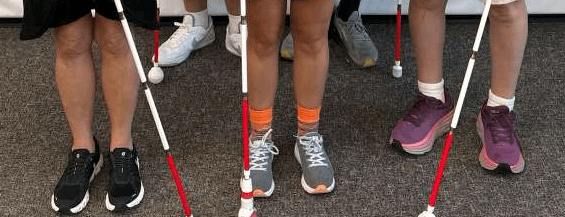
Image shows Caitlin and her O&M cohort – from about the knees down. In the front row are three pairs of tennis shoes, black, blue and purple and three white canes. In the back row are two more pairs of tennis shoes and two more white canes. The back left cane has a spherical tip, the back right has a marshmellow tip. Although the image doesn’t show their faces, I’m certain they all look proud and accomplished. :)