
Shout-out to my therapist for exhaustively reading this entire blog and making notes on all the reasons she’s proud of me, all the times she laughed, all the things she took the time to search up, and all the things we could talk about in future. She is truly the best, and I adore her and appreciate her beyond words.
Today for breakfast, I got a choco-chip muffin, and Jeffrey encouraged me (kindly) to try quinoa chocolate bark. Apparently, I tried this before, with Martha, on airplanes! But this one was homemade by the chef, and it was way tastier. It was a similar taste and texture to those chocolate / espresso coffee beans I used to snarf from Trader Joe’s: chocolatey and bitter and kinda … gritty. Shocking that I liked it, but I did!
Hannah had meetings, so Jeffrey and I did a quick route-plan, then reviewed and practiced a lot of the key take-aways from yesterday.
* I think I forgot to write yesterday that I’d somehow never really computed that we line ourselves up to cross along the inner curb because the traffic is closer to the outer curb. I mean, I guess I knew that … but not in those exact words. Necessarily. So you just listen to which side your traffic’s on, and then focus on the inner curb accordingly. MAGIC HACKS!
* This one took Jeffrey a couple tries to explain. When and if I veer while crossing a street, and my cane bumps a full curb on a left angle, that most likely means that, when I Go Go Gadget, the up-curb will be on my right, and vice versa. This may not always be true, but is a good place to start. We also talked about doing Go Go Gadget arm minimally at first, then extending farther on each side if I don’t immediately find something. If I go big first, I might miss the domes, since they’re often much closer than I think (IE, the veer is often not that big).
* Again, we practiced not moving my feet when I find the domes and using the traffic to check alignment on more simple crossing. For more complex crossings, I first line up with my shoulder lined up to the APS pole (we went from forearm to hand to shoulder because I am me and need Caitlin-specific choreography). Then, once I’m lined up with the pole, I use the traffic to confirm. This freaked me out a little because I’m usually not on the domes! I just have to trust the surge to guide me! I could also edge forward a LITTLE toward the domes, but carefully, so I don’t lose the magical position!
* Jeffrey reminded me again that it’s okay to wait until I get a parallel surge that I like. It’s okay to wait, take my time, and listen to one or more cycles to ascertain what’s going on and to make sure I’m lined up right.
* We also practiced using the traffic to get back on, or maintain, our line of travel. I always knew about this, but didn’t think as much about it in terms of avoiding sidewalk junk. Jeffrey pointed out that, typically, you get around sidewalk junk most safely by moving AWAY from the traffic. Maybe that should have been obvious, but, again, I just never thought about it that way.
* In terms of parallel surges, we talked about “The Golden Goose” surge, where the cars aren’t just tearing up to the intersection and passing through, but have been waiting for their turn, and are accelerating. This is complicated by the fact that (a) a lot of new cars idle very quietly, causing me to think no one is waiting and that they might be a new arrival, rather than an accelerator, and (b) in busy intersections or areas with lots of noise, it can be hard (for me, anyway) to differentiate.
* Funny moment:
Me: This car’s waiting for me, huh? But I want my all-quiet, all-clear.
Jeffrey: Right. What can you do to encourage him to move on? (Without thinking, I whirled around and pulled up my cane, acting like I was going to leave.)
Jeffrey: Ahh, don’t move those feet!
Me: Ahhh, I forgot!
Jeffrey: Look down or look away, but don’t move those feet.
Me: Should I look, you know, in the opposite direction? Or in their direction, so they know that I know they’re there?
Jeffrey: I think “nose to ground” is a good reminder.
After our water break back at the downtown lounge, we spent some more time with the Wheatley boards. Those are the big felt-covered boards with plastic strips for streets, blocks for intersections, little squares with bumps for truncated domes, little cars and people, etc. These can be velcroed in whatever place you want, to build intersections, simulate crossings and movement of pedestrians and cars, etc. It really seems like an art form to me when these instructors just built complex intersections in a trice.
We did a review of complex lighted intersections. Like with yesterday, Jeffrey took the time to explain things like lanes, different scenarios, being careful about cars that might turn unexpectedly and what can be done, etc.
We then did a quick walk to a complex intersection. It sounded SO wild, but Jeffrey made it clear that we were just going to listen, not cross. He wanted me to be able to hear it in person after we’d simulated and discussed it with the board. Hannah was also able to join us on this leg of the journey, which was great, because she and Jeffrey often tag-team and riff off each other with extra tips, ideas, suggestions, and noticings.
After lunch, we went to the mall, because I’d asked for techniques for the mall, stores, etc.
Best line:
Jeffrey (as Hannah cranks some music): Is this that song y’all were singing earlier? “Lifestyle Of Evan Williams?”
Me: Ahahahahahaha!
Jeffrey: Something about … Dean Williams?
Hannah: “Dear Evan Hansen.”
Jeffrey: Oh, is that what it was?
Me: My dad calls it “Dear Evan Handsome,” if that helps.
In the mall, we talked about using sounds as markers, which sounds like a good idea until you think about all the competing sounds in malls: fountains, mall music, people talking, echoes, music coming from individual stores, etc. Now that I look at it, that list actually doesn’t seem that intense, but it all adds up and becomes a lot. We practiced escalators and went up to Nordstroms. I was going to try soliciting verbal directions to the bathroom from a salesperson, but some customer who reminded me uncannily of my mom was taking forever and a day at the counter.
Me: Can you just pretend to be a stranger and I’ll practice with you?
Jeffrey (turning into his alter-ego, Joffrey The Boy King from Game of Thrones, which he’d told me about): Helloooo, madam, can I … (sketchily) help you?
Hannah (amused): Oh, no …
Me (trying to stay in Caitlin character): Can you please give me verbal directions to the women’s bathroom?
Joffrey (sinisterly): Yes. I’d loooove to. (breaking character) Okay, no, that got creepy.
Me: Ahahaha it was great.
Jeffrey: Okay, Joffrey’s gone, I’m back.
Hannah and I also practiced bathroom tips, but their Nordstroms bathroom was waaaay more straightforward and chill than ours. Still, good notes: try to stick with one wall at a time (not just flail around and go in wild circles, like I frequently do, in search of the stalls); trail the walls with the back of a hand; be mindful that sinks may stick out; etc.
Jeffrey also showed me one of those enormous marbles that rolls around and around in water. I can’t explain it now, but Martha showed me one at the county fair. They’re so wild!
We also talked about how malls seem totally, ridiculously insurmountable to me, but I could pick out a couple of stores and plan a route beforehand. And because they are cool, Hannah and Jeffry reiterated that human guide is a tool in my toolbox! So if I want to do that — if that makes the most sense, like if I just want to browse a mall and not get hung up on every single piece of mall junk — that’s an option.
Hannah also noted that many malls open before the actual stores open, and that would be an ideal time to practice, map out routes, etc., like when I used to practice my routes for school in the summer, or after school. Much easier to learn the route without people swarming everywhere.
On the drives to and from, we talked about odds and ends, from why I became a SpEd teacher, to my attempts to find something noise-canceling that doesn’t make my hearing feel weirdly occluded, to their experiences doing extensive training under blindfold. One of the ladies in our cohort also did a route with a blindfold and poignantly said to me, “I have so much respect for you, Caitlin, because my blindfold comes off, and yours doesn’t.” My “best straight guy friend,” Mitch, from college, said something similar after he did a Dining In The Dark-type simulation, and it really just warms my heart when people empathize in that way. I know people have big feelings about simulations, but when they’re paired with training, education, and-or exposure, as in these cases, I really do think they have their place, teaching empathy but not pity.
I was going to take a nap, but one of our crew texted our thread and told us there was ice cream in the piano lounge, and another told me there was an Oreo-type thing that I’d probably like … and she was right! At dinner, Jeffrey delivered my mail: a brailled letter from Martha (and Maite). Soooo cuuuute! I may or may not have gushed and bragged a bit about how sweet and brilliant she is. Everyone was properly touched.
We had fun chats about favorite desserts and adventures of the day, and I told the group that I, very suddenly, felt a huge influx of big feelings about leaving. I was a wreck after leaving guide dog school because I’d bonded so much with the cohort. And when I left LA after the “Dreaming In Color” summer, I was more sad than I think I’ve ever been in my life. For weeks! I cited that it’s not just about leaving the people and the, like, vibes, which is hard enough; it’s also about leaving a world that feels built for us, where blindness and visual impairment is normal, where we’re understood, respected, and treated well. It can feel very hard to leave that, especially when there are stressors at home, and when you feel some anxiety about preserving and keeping up what you’ve learned, as with guide dog school, but this time on your own (until you teach your people the things you learned, so they can support). The crew, of course, got this.
I forgot to mention that I tried the jumbo roller cane tip today and liked it as a lighter option. It doesn’t hop over cracks like the Pathfinder and Sensaball, but it does pretty well and is much lighter. I bought one at the RA office so I have it as an option.
I also did my best to take pics of the braille rails, wall of snacks (with its braille labels), and fridge (with the braille labels on its shelves) for my therapist. We’ll see how I did.
And, as ever, I’m zonking out! Only one more day … nooooo! I feel like I’ve been here forever!
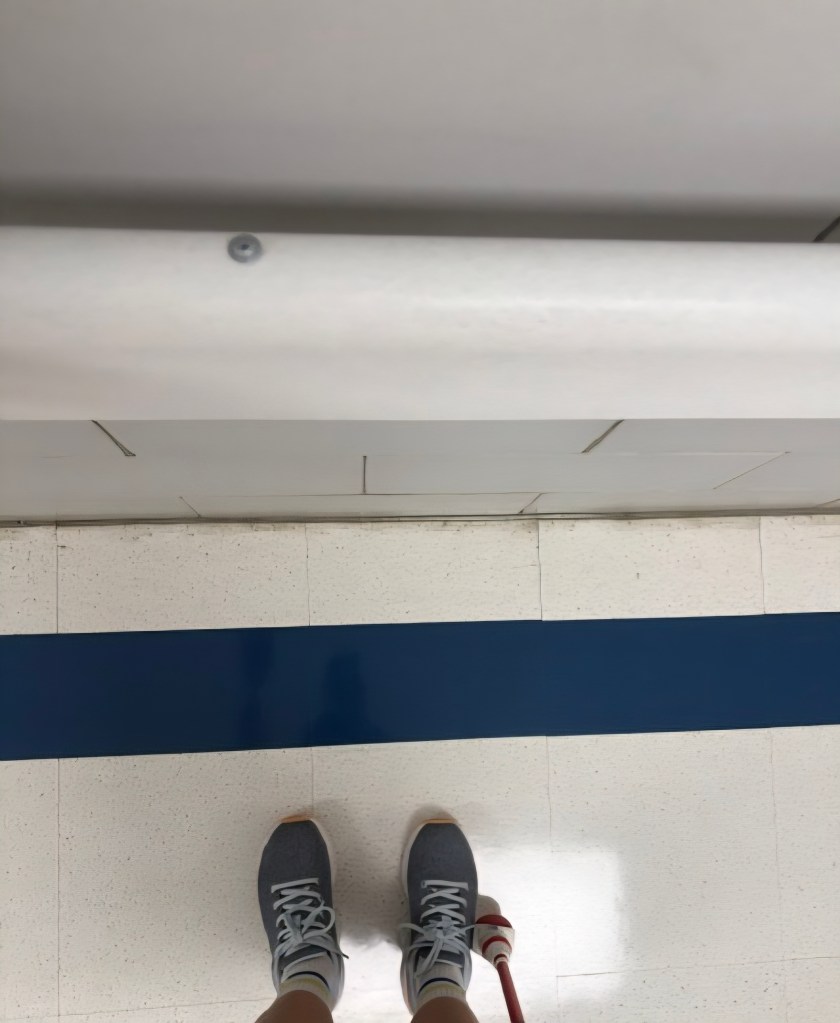
Image shows a bird’s eye view of a white painted hand rail with a “bump dot” screwed into it. Underneath it, on the floor, is a dark blue line running parallel to the wall, very visible against the white floor. Presumably for folks with some vision can use it. Unless it’s for the guide dogs? Next in the picture are Caitlin’s two feet, in their special, ankle-saving shoes and pride socks. Next to her right foot is her cane – the bottom section is red and it has a cane tip I don’t recognize on it. It’s red and white but I don’t think it’s the Sensaball. I’m doing my best, people. Caitlin is long abed and I’m posting this after choir practice. Which was awesome.

