Y’all. This world is…something else. I am still moved to tears on a regular basis about what we (the US as well as other countries) are doing in the name of…what? Capitalism? I don’t understand, honestly, how people can continue to act as if nothing is happening. I am doing all the things I know how to do in terms of boycotting and avoiding companies. I am speaking up whenever and where ever I can. And yet I still feel…hopeless. And ridiculous as I try to make videos and write stories for children.
This week I read One Day, Everyone Will Have Always Been Against This, by Omar El Akkad. It’s a deeply personal look at the ongoing crisis in Gaza and the way we, as part of Western civilization are managing – whether we are complicit, witnessing or actively looking away. It was a tough read.
And yet, it’s not all dark. He writes about things people are doing, boycotting and walking away from jobs, students denouncing their universities and others refusing to participate with their dollars in other ways. He writes about the responses of those in power – their shock and dismissiveness. Here’s a quote:
“The idea that walking away is childish and unproductive is predicated on the inability to imagine anything but a walking away from, never a walking away toward—never that there might exist another destination. The walking away is not nihilism, it’s not cynicism, it’s not doing nothing—it’s a form of engagement more honest, more soul-affirming, than anything the system was ever prepared to offer.”
Even as I continue to participate in the ways I have been, I am going to shift my own language away from the things I’m resisting. From now on I want to focus on the things I’m turning towards, smaller businesses, local community and building stronger interpersonal networks. I’m turning towards the arts and whatever joy and understanding I can muster. What are the ideas you are turning towards in this maelstrom?
Image is of a lightning storm at night – it’s dark and cloudy and the lightning looks pink.
Mia Mingus, a disabled activist of color, coined the term “access intimacy” some time ago. I remember stumbling across it and feeling that awe that comes with finally finding a label or phrase which perfectly encapsulates an experience that’s integral to your make-up as a person. To summarize very briefly, access intimacy refers to the comfort and ease disabled folks may feel, either with other disabled individuals or with non-disabled people who have truly become allies.
Being disabled, as is now becoming more widely understood and talked about, means constantly trying to function and find acceptance in a society which is not made for us. Even as a child, before I had language for any of this, I knew who I felt safest, happiest, and most myself around. My dad affectionately created the term “dealing” to encompass the things I often requested: a sighted guide, support around accessing the foods I could tolerate, visual descriptions, answers to my many questions. Even within my family, there were people who did this, if not technically “better” than others, with a certain warm, effortless finesse that I’d certainly never taught. I’m not sure that I’d know how to teach it, even now, though that’s not to say it can’t be learned.
In elementary and middle school, I often had my birthday parties at the roller-skating rink. I took turns skating with everyone. Everyone. It was easy, an unspoken given. Similarly, in college, I could rely on every member of my a cappella group to fill in proverbial blanks. Of course, some became my friends outside of singing, while others remained groupmates. Still, though, everyone understood me on a basic level: not just my needs, but also my strengths. I was expected to pull my weight and contribute, and I wouldn’t have had it any other way.
In my mid-twenties, I realized that my attachment to people — my difficulty in accepting that, sometimes, people come into our lives for a reason and a season — was rooted in more than simply being sensitive. It takes a higher level of trust, as a disabled person, to let someone in: to be vulnerable enough to name your needs and allow them to be met, without shame, by someone who may not fully share your experience. This is especially true when a disabled person takes the plunge to let a non-disabled person in. Teaching about disability, even in an incidental way, is labor. So losing access to that connection you’ve worked to build, as a disabled person, can naturally feel like a multi-layered loss.
Now that I’m a thirty-something, I think about this concept from a slightly different angle. I find myself waxing nostalgic about friendships like high school, college, and shared activities, where interacting with people on a daily basis automatically facilitated access intimacy. I’m lucky enough to be in touch with many of these folks, but times have changed. We’ve moved to different places, lived through different situations, and, in many cases, grown away from one another in such a way that meet-ups can sometimes feel awkward, even though mutual understanding and respect are still indisputably there.
People often say that friendships are harder in adulthood. Aside from neighborhoods and workplaces, it can be hard to find clear-cut pathways to create new connections. As a disabled adult, I both crave those connections and also, often, feel too tired and dispirited to summon the initiative needed to build them. And I do think that disability plays a part in this: a double-edged sword, of sorts. Those true connections can be harder to forge, but they can be so much more rewarding because of the work all parties must put in. I intend to remind myself of this whenever I question whether or not the effort is worth the outcome.
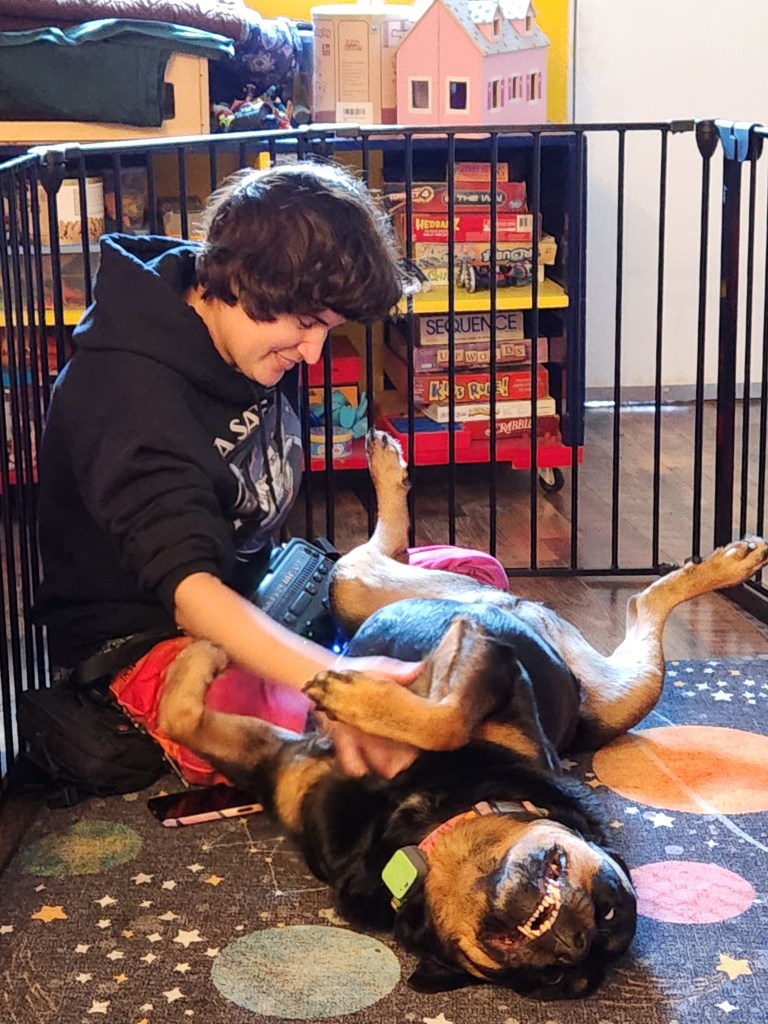
Image shows TJ (Caitlin) sitting on the floor on a space-themed rug, inside a huge baby gate setup with Maite the Rottweiler laying on her back right in front of her. TJ has her Braille Sense in her lap and is wearing her “I am a safe space” hoodie (which is also space themed, complete with an astronaut – although they are not visible). Maite’s mouth is a little bit open, teeth showing, but her face is very relaxed, complete with the whites of her eyes visible. Behind them are shelves with board games, a toy house and other toys. Everyone’s access needs are being met.
One of my fave “coffee shops” in SF is Christopher Elbow Chocolates. It’s in Hayes Valley, which is kind of fancy-pants and pretentious, but it’s freaking delicious, and it was close to where I used to live with my dad. I was introduced to this spot by my friend Kate, who’s a braille teacher, and I still go there with her every so often. I also used to take OK Cupid dates there back in the day, partly because of the comfy seating and close-but-not-too-close-to-home location, but also because the staff were always so friendly, respectful, and accommodating.
I went to Elbow last week to catch up with Kate and had an interesting set of interactions that I thought it might be cool to share.
1. My Para-Stranded driver was very kind: an English-language learner who seemed extra concerned about my well-being because Elbow doesn’t have an easy drop-off spot for the big bus. After escorting me across the street and to the door, he seemed hesitant to leave—not at all in a creepy way, but just a concerned way.
2. This is where one of the staff, whom I’ve interacted with often but wouldn’t necessarily have known by voice, greeted me with, “Oh, hi! We haven’t seen you in a while!”
I don’t know if she did it intentionally, but it served the dual purpose of (a) reminding me that I knew her and (b) assuring the driver that I was in good hands. As disabled folks know, worried non-disableds tend to listen MUCH more to other non-disableds’ reassurance than to OUR assurance … which, of course, is silly, because don’t we know ourselves best? No shade to this driver, though—he was sweet—although I kind of wondered what he planned to do as a means of helping me further? The shop is small. It’s not like there was a staircase I could fall down or anything.
3. I finished greeting the staffer, clarified that I was remembering her name right, and explained that Kate, whom she also knows well, would be coming soon. “Is it okay if I just hang out and wait for her?”
“Of course,” she said genuinely.
Out of habit, I found myself waiting for her to rush out from behind the counter, probably in a panic, and then flounder to guide me. I knew her well enough to know that she wouldn’t grab or pull me, but I found myself automatically bracing to be manhandled anyway. At this point, it’s just reflex to brace when I’m out in the world alone.
Interestingly, and awesomely, she didn’t actually do anything! She assumed competence! In response to that, I, on autopilot, almost asked for her to come and guide me to a chair. But then I remembered just how small and straight this place was, and how devoid of anything that I could damage in any way. It struck me, in a flash, how used I am to letting other people guide me, even when I really don’t need the help, because I’m so afraid of either getting in other people’s way, or appearing inept just by using my cane and doing something in a way non-disableds perceive as “different” or even “too slow.”
“Is anyone sitting back there?” I asked instead.
“Nope,” she replied cheerfully, “it’s all yours.”
And I took my left turn and effortlessly navigated directly to where I needed to be. No hiccups.
Every once in a while, I have these reminders. I remember another one, at my first teaching job. I was called to the phone in a colleague’s classroom while he, myself, and a third colleague were having a meeting across the room from the phone. I expected him to rush across the room and manhandle me to the phone, but he didn’t. I expected him or the other teacher to panic and have an entire fit as I clanked and clattered my way through the thirty-plus empty desks and chairs. But they didn’t. And I reached the phone fine. Maybe with some noise and flailing, but fine. And is it really a crime if I hit a desk or take a little longer? Totally not.
I tell the kids all the time, in response to their appalled gasps when the cane hits something, “It’s okay, that’s what the cane’s SUPPOSED to do. It bumps into things so I don’t have to.”
But I think I forget to remind myself about that sometimes.
I’m so wary of being perceived as hapless just for doing things “the blind way” that I think I sometimes sell myself short. But it feels so good when I’m able to do something simple for myself. And if people flip out about it, I can remind myself that that’s about them and their inexperience with disability. It doesn’t have to be something that I shoulder, take responsibility for, or feel shame about. We may look like we’re struggling, but more often than not, we aren’t, and I will be helping blind-kind more by letting myself flail a bit than by taking the path of least resistance when it’s not always necessary.
4. When Kate and I ordered, the staffer, as she always has, brought our stuff to us, which was very kind. I do think she does this for other folks, and that it’s not just a disability thing. However, she added an extra touch. I’d ordered drinking chocolate (the darkest possible), which is very rich, very thick, and very hot when it arrives.
“I usually fill people’s drinks to the very top,” she explained, “so they get all of what was in the blender. But I thought it might be easier to just give you the rest of the drink in the blender container instead, so you wouldn’t have an overflowing cup.”
I can imagine some blind-kind being pissed about this and going into a rage, railing at her, saying that they can very well drink the same damn drinks as sighted people, thank you very much. But I, personally, have a hard time holding very hot, very full cups gracefully. I appreciated the gesture and told her so.
5. After a delightful visit with Kate, I took Stranded home. The driver was new and couldn’t find my house. Martha wasn’t home and I was already late to feed the dog, so I asked the driver if he could just park and make sure I was in the right vicinity before leaving. He agreed to this, and we were, in fact, not far from my place.
Once we’d found my house, he very sweetly noticed that our trash cans were out and offered to bring them in for me. I thanked him and told him that wasn’t necessary, but that if he could wheel them slightly closer, I would go ahead and pull them in myself right away. This, I explained, would eliminate the need for me to flail all around the general area of the trash cans with my cane, trying to find where the bins had been left.
He understood this and followed my instructions to the letter, respecting my autonomy and giving just the amount of help I’d asked for. Even when I wrestled a little extra hard with the recycling bin, which is bigger and more unwieldy, and which I wanted to nestle in a spot I could more easily find when I opened the garage door to wheel it in, he was already walking away and didn’t comment. It shouldn’t be a novel thing when people genuinely hear me, but it is, so I always notice and appreciate it just that little bit more.
In closing, I just want to note that I’m not asking for advice or criticism for how I handle myself and mobility-related situations. I know I’m not perfect. No one is. I’m just sharing this because I find it interesting, and in the hopes that it may help someone else whose approach and struggles may be similar to mine.
Peace, hugz, and rainbowz to any and all who want them!
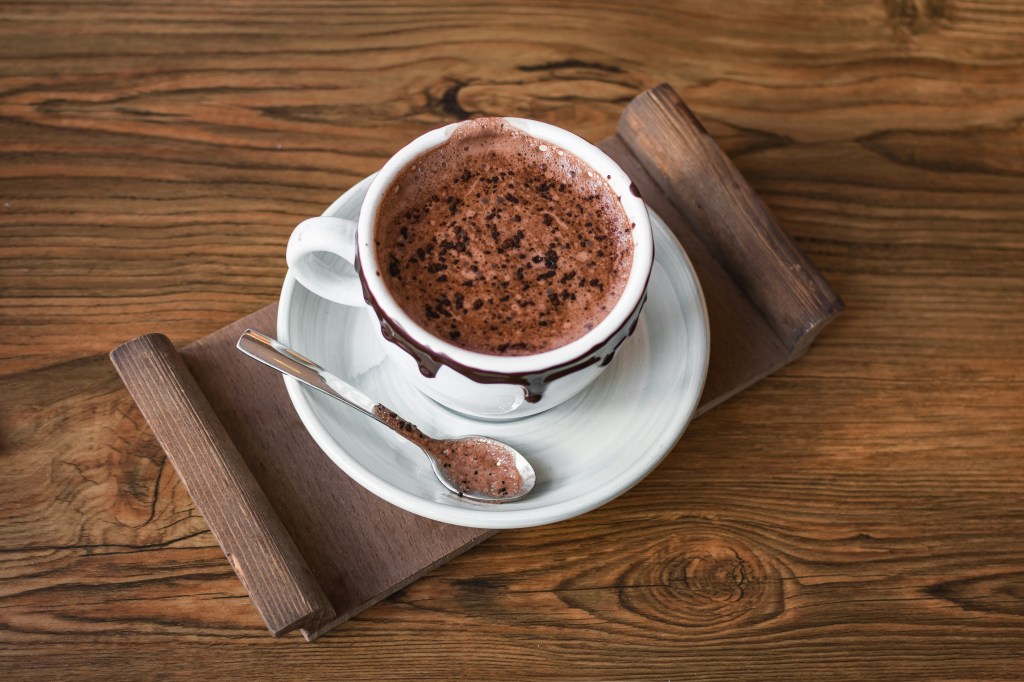
Image is of a cup of hot chocolate on a saucer. There is a spoon that has clearly already been in the chocolate. The cup and saucer are sitting on a tiny wooden tray, just wider than the saucer. To be clear, this is NOT TJ’s hot chocolate. I got this image from Unsplash (shout out to the photographer, Ashkan Forouzani) and thought it would make a nice addition. For sighties.
So, in case you are either (a) fully sighted with no blindies in your corner and-or (b) living under a rock, you oughta know that Facebook, in addition to all its inherent security and political badnesses, is becoming a regular trash-heap of accessibility problems. The most heinous of these include having to go through ridiculous work-arounds to do things as simple as composing a post, writing a comment, or being able to know what link we’re clicking on before we leave Facebook. Again, basic things. Totally unacceptable that these issues have been dragging on for literal months. Non-disableds would not stand for this.
As you can imagine, this app inaccessibility, combined with the fact that Facebook Mobile (on the computer, not the phone) is now also a cluster, has made me less and less inclined to post status updates. Therefore, ergo, and henceforth, the plan is to move gradually away from Facebook and more toward blogging. Will it work? No one knows. But it definitely won’t work if I don’t try!
Let’s break it down into nice paragraphs. I’ll even do little fake titles / headings. Mostly for the sighties. I think they like that. But I’m not doing formatting.
WHY A BLOG?
A long time ago, Martha and I thought it might be fun to blog together. Do you like our cute title?
Dots: speaks, of course, to my love of all things braille.
Doc: Have you met Doc Martha? She blogs and Instas already, but hopefully she’ll bring some Doc Martha Magic, as I call it, over to this little corner of the Interwebs.
Roc: The cool shorthand way of spelling “rock,” which is for Maíte, the Rock Wilder (Rottweiler). She is our eight-year-old dogter and we love her. She enjoys raw meat, singing, chasing “creachers” to the best of her abilities, and “para-ambulations.” She may guest-post on here occasionally, if she’s not too busy “ressing” in the “tsunchine.” Plus, we, all three of us, rock. And enjoy rocking out.
Most updates, I imagine, will be more brief and topical, but I have a few life updates that I think it will be helpful to fill you folks in on so you know where we are these days in Caitlinworld. I’m also not going to update on, you know, seemingly everything in ways I once did, but more things that feel more sharable for, and consumable by, the general public.
SCHOOL
This is my ninth year of teaching. It is ridonculous. Like, seriously, I don’t even know how that happened.
To make a very, very long, nine-year story short, I’m still having problems with our school district, to the point that I was pushed out of a school due to accommodations-related reasons. Last year, for the first time, I taught a special-day class for third, fourth, and fifth grade students with mild to moderate disabilities, in the hopes that the main accommodation issue would be less prevalent. In fact, the issue was still prevalent, and a bunch of other issues in that setting compounded it, most notably never being fully staffed.
Our school district is infamous in the news for its struggles and, thankfully, school sites seem to understand that, with almost a decade of special education teaching under my belt, I’m actually a useful staff member to have on their team, in spite of the fact that, you know, I can’t see things. This year, I’m back teaching small groups of kinders through fifth graders at a little elementary school that’s actually walkable from our house. The children are delightful, and some of the most hardcore, dedicated learners I’ve ever had. We haven’t had a special educator at our school for the past two years, so from the get-go, my crew, by and large, were extremely eager to receive the support.
I know some of us, myself included, miss kid-quotes! Kid-quotes make the world go ’round, don’t they? I have gotten out of the habit of putting them in a palatable format; I just tend to scribble them in my daily notes and across my lesson plans. And I haven’t made up kid-names in ages! But I will keep chewing on the idea of bringing them back. Maybe in, like, a weekly or monthly digest?
ARFID
As some of the long-time Facebookers may recall, my therapist was able to give me an official diagnosis of ARFID, or Avoidant Restrictive Food Intake Disorder. For the uninitiated, ARFID is often handily explained as “more than picky eating.” It’s when people struggle to eat typically, due to low interest or appetite, fears of choking or becoming ill, and-or sensory-based things like flavor, color, texture, etc. For me, it’s mostly about texture and poor hunger cues.
The texture component has been present for as long as I can remember, but the interoception piece, I think, worsened during the shelter in place, when eating was much less structured. School and being out and about in the world tends to help me with scheduling my eating; I just never really thought about it that way.
Long story short, after the shelter in place and returned to school, I had unintentionally lost a lot of weight, due to eating both less food and less frequently. I worked on it over the summer, got some guidance from providers familiar with ARFID, and joined some ARFID Zoom groups. Things got better for a while, but got worse throughout the school year. ARFID on its own was difficult enough, but last year, we were extremely short-staffed, and I wasn’t used to teaching the special-day class.
By the end of March, I’d lost so much appetite and weight that even Kaiser people were concerned, and I was referred to a partial hospitalization program in the city. I had to go on medical leave for the rest of the school year, and was at the program for eight hours six days a week. That gradually decreased as I was able to work on my eating.
Because ARFID is such a relatively new disorder, there aren’t really best practices on how to address it. I ended up trying a new med, which increased my appetite drastically and helped me put on weight rapidly, but it made me feel absolutely miserable. I quit the med after about a month, but it took a while to taper down, which was very unpleasant. But I’d put on enough weight and learned enough new skills that I got sprung from the program.
The folks at the program were pretty kind, and … well, you all know me, I brought my signature joy as best as I could. If nothing else, being able to focus on eating and not stress endlessly about school helped, and then I had the whole summer to stay in good patterns.
This school year has gone so much better, and I’ve kept up with eating … knock wood. My main takeaways have been to just TRY to eat, even if I don’t think I’ll be able to. And to eat whatever feels doable, even if it’s not what I quote “should” be eating. Relatedly, we have banned the concept of “junk food” in this house. It has been renamed to “simple” food, which you say with a French accent and hair-tossing. I will do a video of it sometime.
So that’s the ARFID update. Oh, also, we’ve been doing some fun videos of me trying new things, but, thankfully, the program did not force me to eat different things. They encouraged me to eat a higher volume of my “safe foods,” which was a big relief. I’ve never felt motivated to eat, quote, “normally,” and my blood tests have always been okay, thanks to vitamins and, at some points, iron.
OUR LITTLE FAM
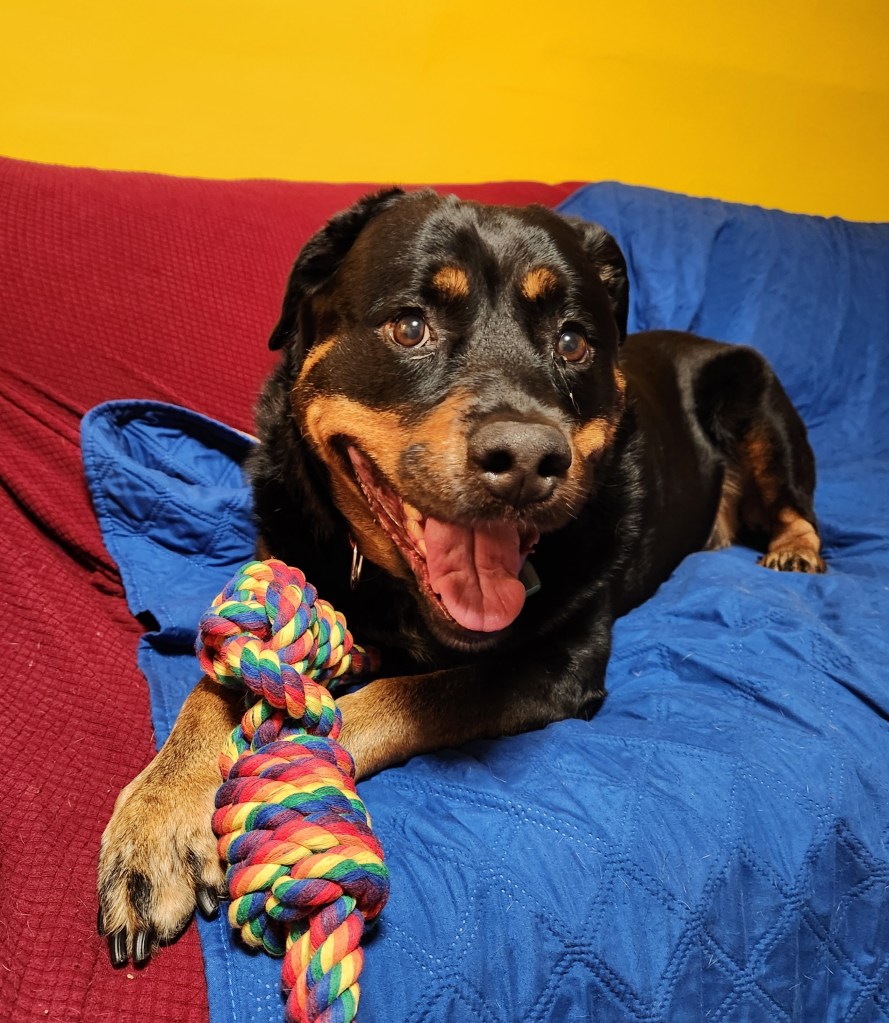
Image shows Maite lying on the couch with her rainbow pull toy between her paws. She has a big, open mouthed smile on her face. The colors are interesting (to me) because the wall behind her is yellow, the cover she is on is blue, and underneath that is the red couch. Very bright. Very Caitlin. – Martha
We’ve now been in our house for about three years.
We have the best next-door neighbor ever, “Uncle Wayne,” who calls himself the Mayor Of the Street. He is hilarious and always keeps an eye on us. Martha, in particular, knows all the dogs and their families, too.
We also hosted a block party, and now have a great sitter and walker for Maíte. So I feel like we are slowly but surely finding some community.
WRITING
This part saddens me: I have done literally NO writing. No Facebook posts, but also, for the first time in my life, I don’t have any story ideas, either. It’s super saddening. I did NaNoWriMo successfully for the first time in 2023, but flunked out midway in 2024 … and the stuff I did in 2023 wasn’t that great.
STAY TUNED
Hopefully, I can stay on this wagon and get back in the posting / writing groove! Think good thoughts for me!
If you made it this far, I shall send you e-hugs and rainbowz!

 dot doc n roc