dot doc n roc

Category: Uncategorized

  • ACCESS INTIMACY AND ADULTING

    Mia Mingus, a disabled activist of color, coined the term “access intimacy” some time ago. I remember stumbling across it and feeling that awe that comes with finally finding a label or phrase which perfectly encapsulates an experience that’s integral to your make-up as a person. To summarize very briefly, access intimacy refers to the comfort and ease disabled folks may feel, either with other disabled individuals or with non-disabled people who have truly become allies.

    Being disabled, as is now becoming more widely understood and talked about, means constantly trying to function and find acceptance in a society which is not made for us. Even as a child, before I had language for any of this, I knew who I felt safest, happiest, and most myself around. My dad affectionately created the term “dealing” to encompass the things I often requested: a sighted guide, support around accessing the foods I could tolerate, visual descriptions, answers to my many questions. Even within my family, there were people who did this, if not technically “better” than others, with a certain warm, effortless finesse that I’d certainly never taught. I’m not sure that I’d know how to teach it, even now, though that’s not to say it can’t be learned.

    In elementary and middle school, I often had my birthday parties at the roller-skating rink. I took turns skating with everyone. Everyone. It was easy, an unspoken given. Similarly, in college, I could rely on every member of my a cappella group to fill in proverbial blanks. Of course, some became my friends outside of singing, while others remained groupmates. Still, though, everyone understood me on a basic level: not just my needs, but also my strengths. I was expected to pull my weight and contribute, and I wouldn’t have had it any other way.

    In my mid-twenties, I realized that my attachment to people — my difficulty in accepting that, sometimes, people come into our lives for a reason and a season — was rooted in more than simply being sensitive. It takes a higher level of trust, as a disabled person, to let someone in: to be vulnerable enough to name your needs and allow them to be met, without shame, by someone who may not fully share your experience. This is especially true when a disabled person takes the plunge to let a non-disabled person in. Teaching about disability, even in an incidental way, is labor. So losing access to that connection you’ve worked to build, as a disabled person, can naturally feel like a multi-layered loss.

    Now that I’m a thirty-something, I think about this concept from a slightly different angle. I find myself waxing nostalgic about friendships like high school, college, and shared activities, where interacting with people on a daily basis automatically facilitated access intimacy. I’m lucky enough to be in touch with many of these folks, but times have changed. We’ve moved to different places, lived through different situations, and, in many cases, grown away from one another in such a way that meet-ups can sometimes feel awkward, even though mutual understanding and respect are still indisputably there.

    People often say that friendships are harder in adulthood. Aside from neighborhoods and workplaces, it can be hard to find clear-cut pathways to create new connections. As a disabled adult, I both crave those connections and also, often, feel too tired and dispirited to summon the initiative needed to build them. And I do think that disability plays a part in this: a double-edged sword, of sorts. Those true connections can be harder to forge, but they can be so much more rewarding because of the work all parties must put in. I intend to remind myself of this whenever I question whether or not the effort is worth the outcome.

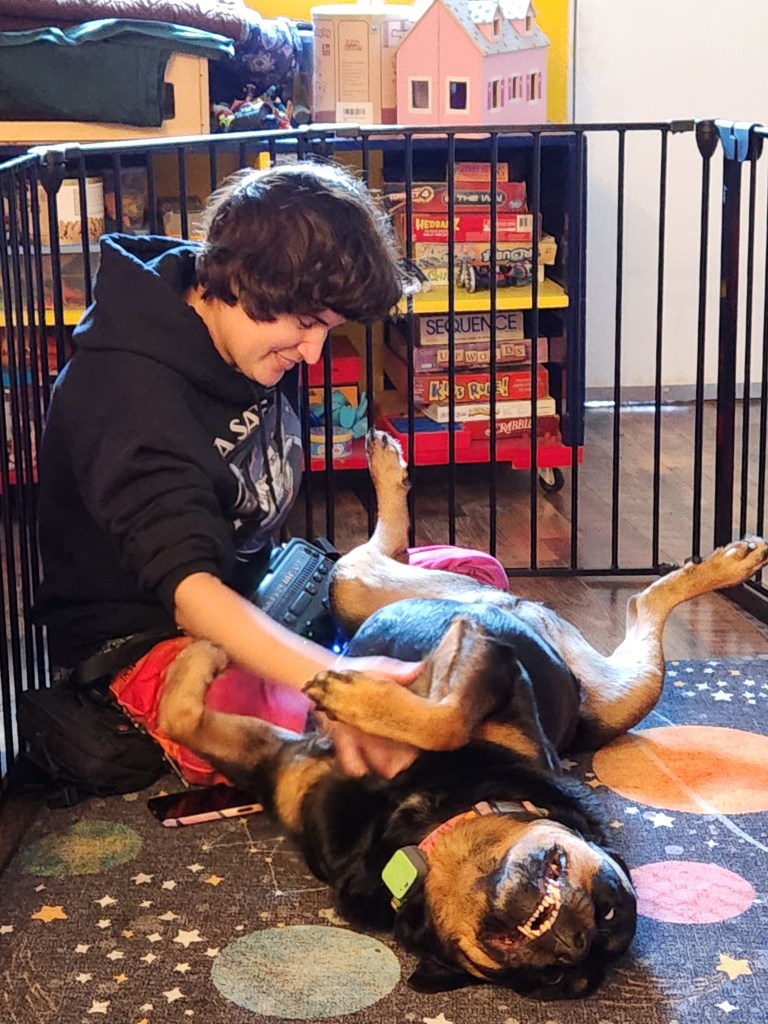
    Image shows TJ (Caitlin) sitting on the floor on a space-themed rug, inside a huge baby gate setup with Maite the Rottweiler laying on her back right in front of her. TJ has her Braille Sense in her lap and is wearing her “I am a safe space” hoodie (which is also space themed, complete with an astronaut – although they are not visible). Maite’s mouth is a little bit open, teeth showing, but her face is very relaxed, complete with the whites of her eyes visible. Behind them are shelves with board games, a toy house and other toys. Everyone’s access needs are being met.

  • NAME GAME


    HINT: Skip to the end if you're wondering why Martha calls me "TJ."

    For as long as I can remember, I wanted a nickname. For whatever reason, I've always connected nicknames with words like "blindie," blind jokes, and the right to (with consent) guide me in an unconventional way. All these things have to be earned.
    In the same way I despise outer-circle folks going around pontificating about "blindies," teasing me for a "blawkward" (blind plus awkward) moment, or steering me by the shoulders, I have always chafed at people's insistence on calling me "Cait," "CJ," or, God forbid, "Caity," unless they've expressly been told that I liked it.

    I wonder if I connected these ideas because, in the same way people project false familiarity around blindness, I feel that people have attached nicknames to me as a means of declaring friendship, connection, or even ownership that isn't really there. Or maybe it's just because, as a blind kid trying to cut it in a sighted world, with extracurriculars, blind stuff, and (then unidentified) ARFID sprinkled over a typical childhood, I felt like I had so little autonomy.

    As a kid, I was Caitlin to just about everyone. Very early on, my dad nicknamed me Trouble, or its derivatives, Troub and Troublemaker ... but that was very much his nickname alone. No one else used it until, years later, entirely unaware of my dad's nickname for me, my seventh-grade science teacher also awarded me the same label.

    "Cait" and "Caity" were exclusively family names, with only my grandparents and Aunt Linda allowed to use "Caity." My grandpa, with his affinity for Spanglish mixed with the occasional German from my grandma, called me "Diablito," or "little devil." In hindsight, I found it interesting that he didn't use "Diablita"; perhaps this was a nod to my wild-child, tomboyish behavior. I wish I'd thought to ask him before he passed away in 2012.

    By fourth grade, I was taking nicknaming into my own hands. My infamous Deraitland bestie, Derek, myself, and some other friends sometimes invented languages. In one, "Caitlin" backwards became "Niltiac," pronounced sort of like "Nil-shyack." In another, "Caitlin" in braille, upside-down, became "Itincoma," which I loathed and Derek, subsequently, used often in an attempt to rankle me.

    The nickname I lusted after constantly was CJ, for my first and middle initials. Derek, happily, was DJ, a nickname which I used a lot. CJ never really took, but for a time, we became "Coodge" and "Doodge," with the double Os in "book." But these were very much Deraitland names, and perhaps with good reason. I could be misremembering, but they may have been a nod to our constant fixation with imitating the speech synthesizers of the time. Though CJ and DJ would not have been read as "coodge" and "doodge," those names were reasonable approximations of how a screenreader might have misread them.
    By fifth grade, I was going totally rogue. I brailled and typed "Cat Hernandez" on all my papers, as though it was my given name. When some grown-ups would obligingly write "Cat" but never call me that, I tried Kit, Kit-Cat, and, in a final, desperate attempt, C. Nothing worked.

    "Cait" and "Caity" remained staples with the family; my dad added "It" and "Little It" to Troub and Trouble; and my sister, for reasons I now can't remember, called me Poopsy. My mom, when I was being particularly cute, would call me her "Little Lamb Chop," which I liked only because I loved both lamb chops and the show Lambchop's Playalong. But such a nickname was too sappy for public consumption.

    This seems like a logical time to pause and state that I have no problem with the name "Caitlin." It fits me. I'm especially grateful my parents picked the spelling they did, not only because I prefer the way my spelling looks in braille to that of all the others, but also because it enables me to make my albeit somewhat confusing crack, "Caitlin: remember, two Is but cannot C. Get it? Two EYES but cannot SEE," which, if you don't think about it so hard that you wonder whether the "cannot" means you ought to use a K and not, in fact, the correct C, helps people spell my name correctly.

    No ... in spite of the fact that there's no good story behind my name, other than that it went well with Courtney, my older sister's name, and that my dad had heard the name and thought it was, quote, "nice," I like my name. I think, though, that I did sometimes come to associate it with being in trouble. Maybe it was because people couldn't wave, make eye contact, or get to me visually, but often, even today, when I hear my name called, even in a casual way, I immediately panic and think that I'm in trouble. Sad, but perhaps true ... and possibly a reason why I always longed for a nickname that wasn't restricted to a certain crew of friends.

    In college, I tried to start out as CJ with my a cappella group. A few people used it somewhat, but in more of a tongue-in-cheek way, not as a true nickname. Amusingly, a label which did stick was "Cajherna," derived from my collegiate e-mail address, which I had not chosen. Apparently, there were so many C Hernandezs that the system spat out the second letter of my name, my middle initial, and the first part of Hernandez. I had to dictate my school e-mail address so many times when signing in at events that my a cappella group, claiming it sounded like a sneeze, began to call me that every so often. Another of the Acquire contingent, Andrea, also took to teasingly calling me Button, which came to light because of a random guy who, upon seeing us in Safeway and recognizing us from busking, said, "I remember you all singing, and I had to stop and tell you ... you're just as cute as a button." Some casual ableism there, as he must have known we were both college students and still insisted on treating me like a disabled child. However, as with "blindies," we took the comment and turned it into something fun.

    Some other in-group names:
    * Dez: short for Hernandez, from a later Acquire member, Caroline, and later adopted by the CRE Outreach (now Arts Up LA) boys.
    * MC, PC, LC: standing for "Poor Child," "My Child," and "Little Caitlin," respectively: all nicknames my dad came up with in the era of texting, again poking fun at people's insistence on feeling sorry for me or infantalizing me, even when nothing is wrong.
    * Little: What my sister started calling me, after getting me a braille bracelet which read "little sis." (She, of course, is Big, which appalls my mom, because some people are still laboring under the delusion that being big is bad. I might add that, though she's taller than me, Courtney is actually more delicate / small-presenting.)
    * Ti-Ti: What my niece has called me every since she could talk ... technically from the Spanish Ti­a, although no one in our family speaks Spanish meaningfully, and I doubt the kid even knows that ... I was just always Ti-Ti. It would be so weird if she ever called me Caitlin.

    The thing with nicknames, though, is that, beyond lamenting frequently that you want one, you can't force people to come up with the perfect, awesome, organic encapsulation of you. And then, once they find one, you can't coerce other people into using it ... and even if you could, it might seem weird, or nonsensical, depending on the origin of the nickname.

    Which brings us to Martha, and TJ.
    So you all know our adorable eight-year-old Rock Wilder (Rottweiler), Maite. Mighty Maite. Big Maíte. Fubu (For Us, By Us). Big Rock. Ruccoon (after Rocky Raccoon). And on and on.

    Since Maite was already Martha's "dogter" before I came on the scene, I became "Stepmom" to her. If you've heard any of our videos or recordings, or read transcripts, Maite has a very distinct way of speaking, a little like a kid with some speech quirks, sound additions and deletions, and some unexpected ways of mixing and garbling words and terms. So Stepmom became "Tep Mom" ... and, because I, of course, had told Martha about my quest to be "CJ," CJ, in Mai­te-speak, became "TJ." And because Martha is Martha, TJ stuck more than CJ did, because Maíte is such a talkative fixture in our house.

    Now, because I'm a rule-following people-pleaser, I did object, "But TJ has to stand for something. It's too confusing to explain, otherwise. How about Trouble Junior? Trouble has always stuck, and Maite is clearly the biggest troublemaker in our house."
    To which Maite, of course, responded, "That is not no true story, Tepmom, GAH!"

    But TJ stuck ... and now you all know the story. And while I would prefer for you to just call me Caitlin, I'm always open to new nickname ideas, should they arise. Just make sure you've earned it, and that I've approved, before you go shouting it all over the place.
  • Tiny Dose of Hope

    Lately I find myself sitting with a feeling of absolute disbelief with a side of despair. I haven’t posted much about what’s going on in the world because I feel like I don’t always understand what’s happening, but I do regularly repost videos and posts on insta from sources I trust. These are folks who have done their research, and I appreciate their work so much. Having an explanation can give us a place to work from – a way to identify where we might have agency. And a sense of agency is important. When we fall (or are pushed) into the feeling that nothing we do will make a difference, we are immobilized. For individuals, feeling like we don’t have voice or choice increases anxiety and/or depression. It decreases creativity and motivation. It can keep us from trying new things, from food to ideas. It adds a sense of hopelessness – of being stuck. There are people with more power than you or I that like nothing better than when people feel stuck and without recourse.

    This week I heard about the 48 Counties in Totonicapan that gather together monthly to decide what best for the people in that region, and it gave me a sense of hope. That organizing does work. That what we do can make a difference.

    I’m always interested in what gives other people hope. Let us know in the comments!


    If you are interested in following other folks: @ykreborn @lynaevanee @resmaamenakem @blairimani @ibramxk @wkamaubell @sogoreatelandtrust @asianmentalhealthcollective @prentishemphill @missxtinab

    Image shows the wall of a shop covered in brightly colored shirts from the market in Totonicapan.

  • The thing is…

    …wherever you go, there you are. TJ (Caitlin) calls me The Ruiner, and it’s a title that I hold with pride. IYKYK. However, noticing racism, ableism, sexism and other oppressions takes a toll. TJ and I went on a cruise, y’all, and I had no idea what to expect. Neither one of us has ever done it, but this was our idea of a vacation that combined travel with a special interest, so we decided to go for it.

    I’m not sure why I was surprised to find that this floating hotel was a small microcosm of the US. Or maybe a slice of rich mostly United Statesians. Yes, there were people there from other places, but we mostly ran into yt people from the US. Also, if you are looking for the highlights, you’ll have to scroll to the picture at the bottom.

    The whole trip started out rocky because they (the cruise line AND the Star Trek folks) refused to make the printed material accessible to Caitlin. All they had to do was email her the things! I know that those documents exist in e-form, because they were printed out and left in our rooms every day. I’m guessing they were printed before we left shore, so they could have, in theory, emailed her everything before we left. Yes, I know things can change, but they could have said, This is how things stand right now, and the schedule is subject to change. It’s not that hard. And I suspect that kind of accommodation would be helpful for many people, not just blindies.

    And speaking of accommodations – I saw a number of so-called service dogs on the boat. I know, I know, there’s no way to tell from over where I am what those dogs were there to do. There are MANY ways a dog can provide a service that I would not be able to see. That said, I saw several that I had serious doubts about. The thing is, if I had doubts, other people also had doubts. I’m not saying people cannot have their service dogs with them. At all. But there are people who game the system and convince someone that their dog qualifies. If that dog then behaves badly, it makes it that much harder for people with actual service dogs to get access later.

    Meanwhile….colonizer vibes were everywhere. Almost all of the people working on the ship were BIPOC. Wait staff, cleaners, stewards and cooks, all BIPOC and working with a level of invisibility that I found super uncomfortable. Passengers (mostly yt) walked past them without a word, so much so that when we greeted people they seemed surprised that we noticed them. We heard one woman tell the wait staff that he needed to have his eyes checked, and asked if he was blind because he jokingly told her he needed to see her ID when she ordered wine. I met someone just before the trip who had worked on cruises before and they told me that they don’t make much money and that tips would likely be appreciated – but twice employees told us that the tip was too high, and tried to give it back.

    The whole thing was extremely wasteful, too. Given that the food is included, I knew there would be waste, but it was more than I imagined. We made it to breakfast just once (it was a vacation, y’all. Don’t judge) and as we were going out I saw a man scooping yogurt out of the cup and into a bucket. Straight to the trash. I get it, once they’ve put them into those cups with fruit, they can’t save them for the next day, but there were another dozen cups waiting for him. Every day I saw many people leaving piles of food on the table as they left the dining area.

    The steward was prepared to change our towels twice a day! And sheets once a day. I told him that wasn’t necessary for us, but walking down the corridor our room was on I saw people removing piles of towels and linens from the same rooms every day.

    Image shows TJ gleefully petting a dolphin. She was the only one in our group that got to tickle a dolphin and the resulting vocalizations were awesome.

    All of these things are present in my everyday life – but on a boat out in the middle of the ocean – there was no respite. I loved being able to spend pretty much every minute with TJ. I was happy to watch her enjoy the Wave Rider and go down the water slide. I enjoyed some panels and Tim Russ jamming with his band. We got to hang out with dolphins which, while also fraught, was a fantastic experience. We walked around holding hands for hours every day. We read and talked and laughed. I love her dearly and appreciated every minute of our time together. AND I was VERY ready to get off that boat at the end of the trip. TJ and I really have co-created a life that I love, and I feel fortunate for every minute of it.

  • Millonaria

    I am loving the Vida album by Ana Tijoux. Especially Millonaria.

  • First Post

    Sometimes, all you want is a simple site to put your thoughts. One that you don’t have to attach a lot of caveats to. Or maybe that’s just me. I’m so ready for a place that’s just for us.