Y’all. This world is…something else. I am still moved to tears on a regular basis about what we (the US as well as other countries) are doing in the name of…what? Capitalism? I don’t understand, honestly, how people can continue to act as if nothing is happening. I am doing all the things I know how to do in terms of boycotting and avoiding companies. I am speaking up whenever and where ever I can. And yet I still feel…hopeless. And ridiculous as I try to make videos and write stories for children.
This week I read One Day, Everyone Will Have Always Been Against This, by Omar El Akkad. It’s a deeply personal look at the ongoing crisis in Gaza and the way we, as part of Western civilization are managing – whether we are complicit, witnessing or actively looking away. It was a tough read.
And yet, it’s not all dark. He writes about things people are doing, boycotting and walking away from jobs, students denouncing their universities and others refusing to participate with their dollars in other ways. He writes about the responses of those in power – their shock and dismissiveness. Here’s a quote:
“The idea that walking away is childish and unproductive is predicated on the inability to imagine anything but a walking away from, never a walking away toward—never that there might exist another destination. The walking away is not nihilism, it’s not cynicism, it’s not doing nothing—it’s a form of engagement more honest, more soul-affirming, than anything the system was ever prepared to offer.”
Even as I continue to participate in the ways I have been, I am going to shift my own language away from the things I’m resisting. From now on I want to focus on the things I’m turning towards, smaller businesses, local community and building stronger interpersonal networks. I’m turning towards the arts and whatever joy and understanding I can muster. What are the ideas you are turning towards in this maelstrom?
Image is of a lightning storm at night – it’s dark and cloudy and the lightning looks pink.
Ever had a child swear at you? No, not that kid, not the kid that you just told, “Close the chromebook,” or “Time for bed.” I’m talking about the child who swears at you and then afterwards you are left thinking, “What did I do?”
Swearing is an important part of communication, and I am a fan. I know not everyone is, but I find that it can convey a sense of community (in the right circumstance) and of course, adds emphasis to what we’re saying. There is a whole continuum of swearing, with people who swear so much that the emphasis part of that gets somewhat diluted, and people who never utter swear words, and I respect that choice.
Children swearing, though, is often seen as distinctly different. Some people believe that children should not be allowed to swear, and if we do pretend we cannot hear them swearing on the playground, that at the very least they are NOT to swear at adults.
I generally have a pretty relaxed attitude about it. I have long told children that if they are going to swear in front of me (in my office or in my own family), they can swear ABOUT things, but they may not swear AT people, or call them by swear names (no calling names is a regular rule in my office, so “swear names” is just a continuation of that rule). When kids are following those rules, I really don’t mind when they swear. Even if they are mad at me and using all kinds of swears.
Why doesn’t it bother me much? It doesn’t because I know if a child is throwing around those heavy words, they must feel pretty powerless. I understand that even adults who use those words in the context of a power differential, real or perceived, are doing so in order to exert some power of their own.
Full transparency – it does bother me more with teens and adults – but I still think that words used in an effort to hurt say much more about the person saying them than they say about me.
Image shows Maite laying on the deck from last summer. Her tongue is out and she looks relaxed. She is a great swearer.
One of my fave “coffee shops” in SF is Christopher Elbow Chocolates. It’s in Hayes Valley, which is kind of fancy-pants and pretentious, but it’s freaking delicious, and it was close to where I used to live with my dad. I was introduced to this spot by my friend Kate, who’s a braille teacher, and I still go there with her every so often. I also used to take OK Cupid dates there back in the day, partly because of the comfy seating and close-but-not-too-close-to-home location, but also because the staff were always so friendly, respectful, and accommodating.
I went to Elbow last week to catch up with Kate and had an interesting set of interactions that I thought it might be cool to share.
1. My Para-Stranded driver was very kind: an English-language learner who seemed extra concerned about my well-being because Elbow doesn’t have an easy drop-off spot for the big bus. After escorting me across the street and to the door, he seemed hesitant to leave—not at all in a creepy way, but just a concerned way.
2. This is where one of the staff, whom I’ve interacted with often but wouldn’t necessarily have known by voice, greeted me with, “Oh, hi! We haven’t seen you in a while!”
I don’t know if she did it intentionally, but it served the dual purpose of (a) reminding me that I knew her and (b) assuring the driver that I was in good hands. As disabled folks know, worried non-disableds tend to listen MUCH more to other non-disableds’ reassurance than to OUR assurance … which, of course, is silly, because don’t we know ourselves best? No shade to this driver, though—he was sweet—although I kind of wondered what he planned to do as a means of helping me further? The shop is small. It’s not like there was a staircase I could fall down or anything.
3. I finished greeting the staffer, clarified that I was remembering her name right, and explained that Kate, whom she also knows well, would be coming soon. “Is it okay if I just hang out and wait for her?”
“Of course,” she said genuinely.
Out of habit, I found myself waiting for her to rush out from behind the counter, probably in a panic, and then flounder to guide me. I knew her well enough to know that she wouldn’t grab or pull me, but I found myself automatically bracing to be manhandled anyway. At this point, it’s just reflex to brace when I’m out in the world alone.
Interestingly, and awesomely, she didn’t actually do anything! She assumed competence! In response to that, I, on autopilot, almost asked for her to come and guide me to a chair. But then I remembered just how small and straight this place was, and how devoid of anything that I could damage in any way. It struck me, in a flash, how used I am to letting other people guide me, even when I really don’t need the help, because I’m so afraid of either getting in other people’s way, or appearing inept just by using my cane and doing something in a way non-disableds perceive as “different” or even “too slow.”
“Is anyone sitting back there?” I asked instead.
“Nope,” she replied cheerfully, “it’s all yours.”
And I took my left turn and effortlessly navigated directly to where I needed to be. No hiccups.
Every once in a while, I have these reminders. I remember another one, at my first teaching job. I was called to the phone in a colleague’s classroom while he, myself, and a third colleague were having a meeting across the room from the phone. I expected him to rush across the room and manhandle me to the phone, but he didn’t. I expected him or the other teacher to panic and have an entire fit as I clanked and clattered my way through the thirty-plus empty desks and chairs. But they didn’t. And I reached the phone fine. Maybe with some noise and flailing, but fine. And is it really a crime if I hit a desk or take a little longer? Totally not.
I tell the kids all the time, in response to their appalled gasps when the cane hits something, “It’s okay, that’s what the cane’s SUPPOSED to do. It bumps into things so I don’t have to.”
But I think I forget to remind myself about that sometimes.
I’m so wary of being perceived as hapless just for doing things “the blind way” that I think I sometimes sell myself short. But it feels so good when I’m able to do something simple for myself. And if people flip out about it, I can remind myself that that’s about them and their inexperience with disability. It doesn’t have to be something that I shoulder, take responsibility for, or feel shame about. We may look like we’re struggling, but more often than not, we aren’t, and I will be helping blind-kind more by letting myself flail a bit than by taking the path of least resistance when it’s not always necessary.
4. When Kate and I ordered, the staffer, as she always has, brought our stuff to us, which was very kind. I do think she does this for other folks, and that it’s not just a disability thing. However, she added an extra touch. I’d ordered drinking chocolate (the darkest possible), which is very rich, very thick, and very hot when it arrives.
“I usually fill people’s drinks to the very top,” she explained, “so they get all of what was in the blender. But I thought it might be easier to just give you the rest of the drink in the blender container instead, so you wouldn’t have an overflowing cup.”
I can imagine some blind-kind being pissed about this and going into a rage, railing at her, saying that they can very well drink the same damn drinks as sighted people, thank you very much. But I, personally, have a hard time holding very hot, very full cups gracefully. I appreciated the gesture and told her so.
5. After a delightful visit with Kate, I took Stranded home. The driver was new and couldn’t find my house. Martha wasn’t home and I was already late to feed the dog, so I asked the driver if he could just park and make sure I was in the right vicinity before leaving. He agreed to this, and we were, in fact, not far from my place.
Once we’d found my house, he very sweetly noticed that our trash cans were out and offered to bring them in for me. I thanked him and told him that wasn’t necessary, but that if he could wheel them slightly closer, I would go ahead and pull them in myself right away. This, I explained, would eliminate the need for me to flail all around the general area of the trash cans with my cane, trying to find where the bins had been left.
He understood this and followed my instructions to the letter, respecting my autonomy and giving just the amount of help I’d asked for. Even when I wrestled a little extra hard with the recycling bin, which is bigger and more unwieldy, and which I wanted to nestle in a spot I could more easily find when I opened the garage door to wheel it in, he was already walking away and didn’t comment. It shouldn’t be a novel thing when people genuinely hear me, but it is, so I always notice and appreciate it just that little bit more.
In closing, I just want to note that I’m not asking for advice or criticism for how I handle myself and mobility-related situations. I know I’m not perfect. No one is. I’m just sharing this because I find it interesting, and in the hopes that it may help someone else whose approach and struggles may be similar to mine.
Peace, hugz, and rainbowz to any and all who want them!
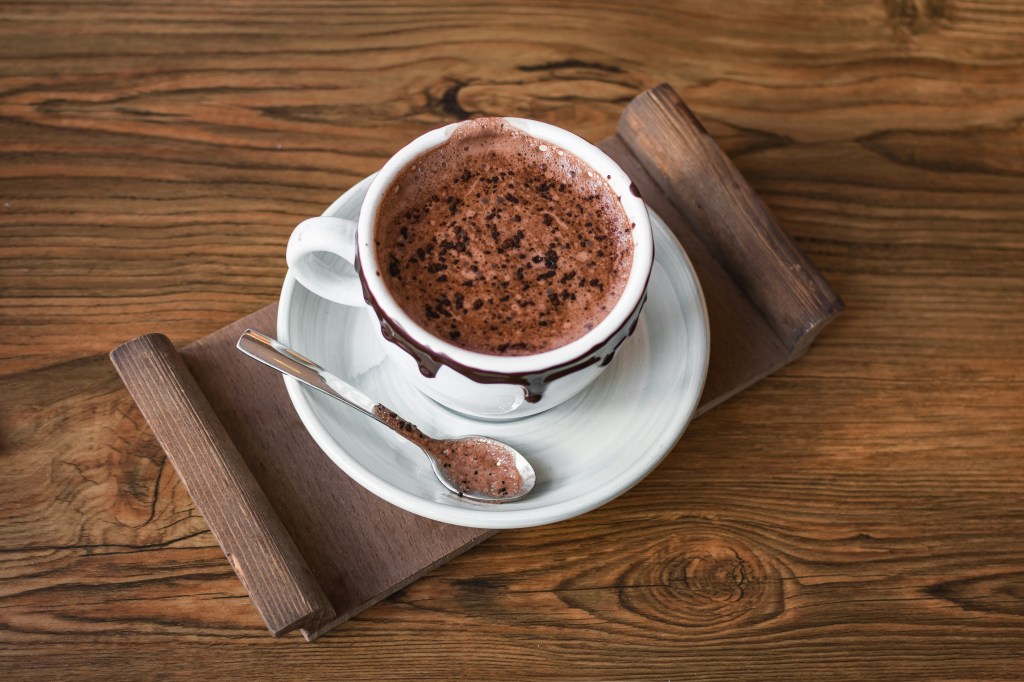
Image is of a cup of hot chocolate on a saucer. There is a spoon that has clearly already been in the chocolate. The cup and saucer are sitting on a tiny wooden tray, just wider than the saucer. To be clear, this is NOT TJ’s hot chocolate. I got this image from Unsplash (shout out to the photographer, Ashkan Forouzani) and thought it would make a nice addition. For sighties.


 dot doc n roc