Mia Mingus, a disabled activist of color, coined the term “access intimacy” some time ago. I remember stumbling across it and feeling that awe that comes with finally finding a label or phrase which perfectly encapsulates an experience that’s integral to your make-up as a person. To summarize very briefly, access intimacy refers to the comfort and ease disabled folks may feel, either with other disabled individuals or with non-disabled people who have truly become allies.
Being disabled, as is now becoming more widely understood and talked about, means constantly trying to function and find acceptance in a society which is not made for us. Even as a child, before I had language for any of this, I knew who I felt safest, happiest, and most myself around. My dad affectionately created the term “dealing” to encompass the things I often requested: a sighted guide, support around accessing the foods I could tolerate, visual descriptions, answers to my many questions. Even within my family, there were people who did this, if not technically “better” than others, with a certain warm, effortless finesse that I’d certainly never taught. I’m not sure that I’d know how to teach it, even now, though that’s not to say it can’t be learned.
In elementary and middle school, I often had my birthday parties at the roller-skating rink. I took turns skating with everyone. Everyone. It was easy, an unspoken given. Similarly, in college, I could rely on every member of my a cappella group to fill in proverbial blanks. Of course, some became my friends outside of singing, while others remained groupmates. Still, though, everyone understood me on a basic level: not just my needs, but also my strengths. I was expected to pull my weight and contribute, and I wouldn’t have had it any other way.
In my mid-twenties, I realized that my attachment to people — my difficulty in accepting that, sometimes, people come into our lives for a reason and a season — was rooted in more than simply being sensitive. It takes a higher level of trust, as a disabled person, to let someone in: to be vulnerable enough to name your needs and allow them to be met, without shame, by someone who may not fully share your experience. This is especially true when a disabled person takes the plunge to let a non-disabled person in. Teaching about disability, even in an incidental way, is labor. So losing access to that connection you’ve worked to build, as a disabled person, can naturally feel like a multi-layered loss.
Now that I’m a thirty-something, I think about this concept from a slightly different angle. I find myself waxing nostalgic about friendships like high school, college, and shared activities, where interacting with people on a daily basis automatically facilitated access intimacy. I’m lucky enough to be in touch with many of these folks, but times have changed. We’ve moved to different places, lived through different situations, and, in many cases, grown away from one another in such a way that meet-ups can sometimes feel awkward, even though mutual understanding and respect are still indisputably there.
People often say that friendships are harder in adulthood. Aside from neighborhoods and workplaces, it can be hard to find clear-cut pathways to create new connections. As a disabled adult, I both crave those connections and also, often, feel too tired and dispirited to summon the initiative needed to build them. And I do think that disability plays a part in this: a double-edged sword, of sorts. Those true connections can be harder to forge, but they can be so much more rewarding because of the work all parties must put in. I intend to remind myself of this whenever I question whether or not the effort is worth the outcome.
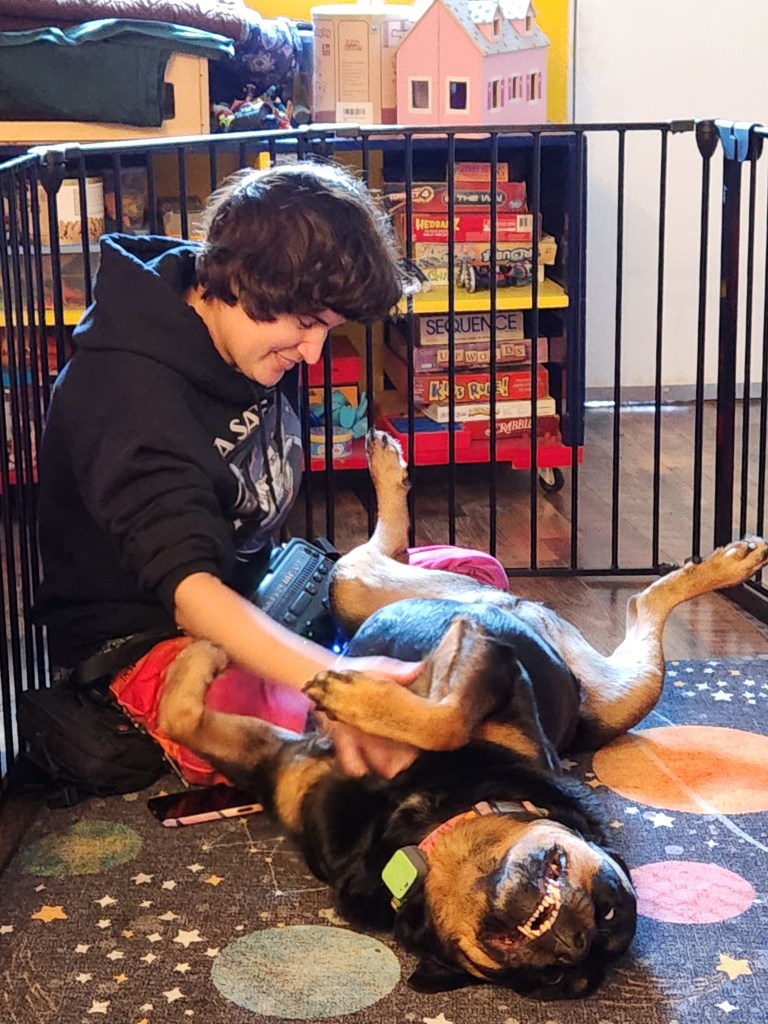
Image shows TJ (Caitlin) sitting on the floor on a space-themed rug, inside a huge baby gate setup with Maite the Rottweiler laying on her back right in front of her. TJ has her Braille Sense in her lap and is wearing her “I am a safe space” hoodie (which is also space themed, complete with an astronaut – although they are not visible). Maite’s mouth is a little bit open, teeth showing, but her face is very relaxed, complete with the whites of her eyes visible. Behind them are shelves with board games, a toy house and other toys. Everyone’s access needs are being met.

 dot doc n roc